




Legacy System Modernization: A 2026 Guide for Australian Businesses
Many Australian businesses are still relying on legacy systems built years, or even decades, ago. While these systems may continue to function, they often struggle to support modern business demands such as cloud integration, real-time data processing, and seamless digital experiences. As a result, organizations face rising maintenance costs, limited scalability, and increasing security risks.
In fact, a significant portion of IT budgets is still spent maintaining outdated systems, leaving little room for innovation. At the same time, evolving customer expectations and competitive pressure are forcing businesses to move faster and operate more efficiently.
Legacy system modernization has become a strategic priority, not just an IT upgrade, but a business transformation. In this guide, we explore key approaches, costs, challenges, and a practical roadmap to help Australian businesses modernize effectively and future-proof their systems.
Key Takeaways
- Legacy systems increase costs, limit scalability, and create security risks for modern businesses.
- There are five main modernization approaches: rehosting, replatforming, refactoring, rebuilding, and replacing.
- Choosing the right strategy depends on business goals, system complexity, and budget.
- Enterprise modernization projects in Australia can range from AUD 50,000 to AUD 700,000+.
- A structured roadmap helps reduce risks and ensure successful implementation.
- Outsourcing to Vietnam can reduce costs by 40–60% while maintaining quality and speed.
- Partnering with an experienced vendor is key to minimizing disruption and maximizing value.
Table of Contents
- What Is Legacy System Modernization?
- Why Legacy Systems Are Holding Back Australian Businesses
- What Are the Benefits of Modernizing Legacy Systems
- Key Approaches to Legacy System Modernization
- How to Choose the Right Modernization Strategy
- Legacy System Modernization Cost in Australia
- Step-by-Step Roadmap for a Successful Modernization
- Common Challenges and How to Overcome Them
- Why Outsourcing to Vietnam is a Strategic Move for Australian Firms
- Kaopiz: Your Trusted Partner for Legacy System Modernization
- Conclusion
- FAQs
What Is Legacy System Modernization?
Many businesses still rely on legacy systems that were built years ago. While these systems may continue to function, they often struggle to keep up with modern business demands such as cloud migration, real-time data processing, and seamless digital experiences.
As a result, organizations face increasing challenges in maintaining performance, scalability, and competitiveness in a rapidly evolving market.
In this section, we explore what legacy system modernization is, examine the common types of legacy systems, and understand how they differ from modern architectures.
Definition of Legacy System Modernization
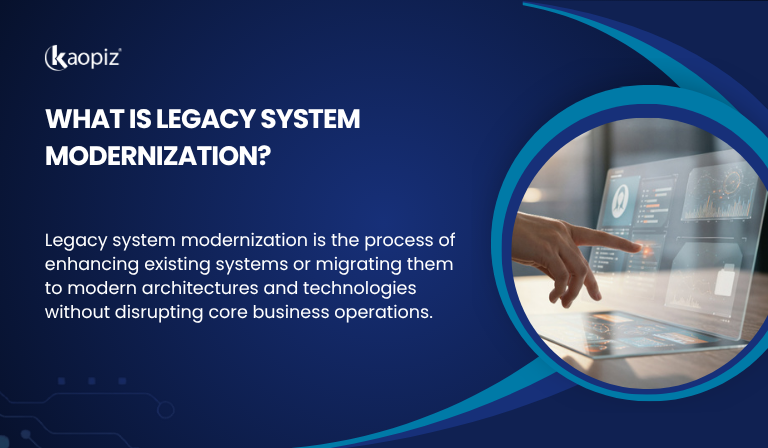
Legacy system modernization is the process of enhancing existing systems or migrating them to modern architectures and technologies without disrupting core business operations.
This can involve multiple approaches, such as:
- Migrating applications to the cloud
- Refactoring or re-architecting outdated code
- Replacing legacy components with modern solutions
- Integrating new technologies like APIs, microservices, or AI
For Australian enterprises, modernization is increasingly becoming a necessity rather than an option, especially in industries where compliance, data security, and system reliability are critical.
Common Types of Legacy Systems
Legacy systems can exist in many forms, depending on when and how they were originally built. Some of the most common types include:
- Monolithic Applications: Older systems often built as a single, tightly coupled codebase, making updates and scaling difficult.
- On-Premises Systems: Applications hosted on internal servers instead of the cloud, leading to higher infrastructure and maintenance costs.
- Outdated Programming Languages and Frameworks: Systems built with older technologies such as COBOL, legacy Java versions, or unsupported frameworks make it hard to find skilled developers.
- Legacy Enterprise Systems (ERP, CRM, Core Banking): Critical business systems that are deeply embedded in operations but lack flexibility for integration and innovation.
- Highly Customized Systems: Systems that have been modified over time with patches and workarounds, resulting in complex, hard-to-maintain architectures.
Legacy vs Modern Systems
Understanding the differences between legacy and modern systems helps clarify why modernization is essential.
| Aspect | Legacy Systems | Modern Systems |
|---|---|---|
| Architecture | Monolithic, tightly coupled | Microservices, modular |
| Scalability | Limited and costly to scale | Highly scalable (cloud-based) |
| Maintenance | High cost, time-consuming | Easier and more efficient |
| Integration | Difficult to integrate with new tools | API-first, easy integration |
| Performance | Often slow under high load | Optimized for speed and reliability |
| Security | Higher risk due to outdated tech | Built with modern security standards |
Key takeaways: Legacy systems are designed for stability in the past, while modern systems are built for agility, scalability, and continuous innovation.
Why Legacy Systems Are Holding Back Australian Businesses
While legacy systems continue to support core operations, they are increasingly becoming a barrier to growth for Australian businesses operating in a fast-evolving digital economy. A major challenge lies in cost; organizations typically spend 60–80% of their IT budgets maintaining legacy systems, leaving limited resources for innovation and transformation initiatives.
Scalability is another critical limitation. Legacy systems are not designed for modern workloads such as cloud computing, real-time data processing, or high user demand. As businesses grow, these systems create performance bottlenecks, slow down operations, and negatively impact customer experience.
Security and compliance risks further amplify the problem. These are not just IT concerns; they are business continuity threats. For Australian businesses operating in regulated industries, this creates significant exposure to financial and reputational damage.
Finally, legacy systems slow down innovation. Development teams often spend more time maintaining outdated infrastructure than building new features. Combined with limited integration capabilities, this makes it difficult to adopt modern technologies such as AI, cloud services, and advanced analytics—ultimately restricting long-term growth and competitiveness.
What Are the Benefits of Modernizing Legacy Systems
Modernization of legacy systems enables businesses to improve performance, reduce operational costs, and unlock greater scalability. It also empowers organizations to innovate faster, enhance security, and stay competitive in an increasingly digital-first market.
Reduced Operational Costs by 40%
Modernizing legacy systems can significantly lower operational expenses by reducing maintenance, infrastructure, and support costs. Organizations often spend up to 80% of their IT budgets maintaining legacy systems, while modernization, especially through cloud adoption, can cut costs by 20–40%.
In addition, outdated systems lead to inefficiencies and costly downtime, with enterprise outages costing up to $300,000/hour. By moving to modern architectures, businesses can streamline operations, reduce waste, and reinvest savings into growth.
Improved Scalability & Performance
Legacy systems often struggle to handle increasing workloads, leading to performance bottlenecks and limited scalability. As businesses grow, these systems require costly infrastructure upgrades but still fail to deliver consistent performance during peak demand.

Modernizing to cloud-native or distributed architectures allows businesses to scale resources on demand, improving system reliability and responsiveness. According to AWS, cloud adoption can deliver up to 66% infrastructure cost savings while significantly improving system availability and performance.
Enhanced Security & Compliance
Legacy systems rely on outdated technologies and often lack regular updates, making them more vulnerable to cyber threats and compliance risks. This is especially critical for businesses operating in regulated industries where data protection is essential.
Modern systems are built with advanced security practices, including automated patching and continuous monitoring. IBM reports that the average cost of a data breach reached $4.45 million, with 78% of breaches linked to unpatched vulnerabilities, highlighting the risks of maintaining outdated systems.
Faster Time-to-Market
Legacy systems slow down development due to rigid architectures and technical debt, forcing teams to spend more time on maintenance than innovation. This delays product releases and limits the ability to respond quickly to market demands.
Modernizing legacy applications enables agile development, automation, and modular architectures, allowing faster feature delivery. According to McKinsey, companies adopting modern engineering practices can achieve 20–30% faster time-to-market, improving competitiveness and growth potential.
Better Customer Experience
Legacy systems often result in slow performance, system downtime, and fragmented user experiences, which negatively impact customer satisfaction. As expectations rise, these limitations become a significant barrier to retention and engagement.
Modern systems support real-time processing, faster load times, and seamless integrations, enabling smoother digital experiences. Research by PwC shows that 73% of customers consider experience a key factor in purchasing decisions, making system performance critical to business success.
Key Approaches to Legacy System Modernization
There is no one-size-fits-all approach to legacy system modernization. The right strategy depends on factors such as system complexity, business goals, budget, and risk tolerance.
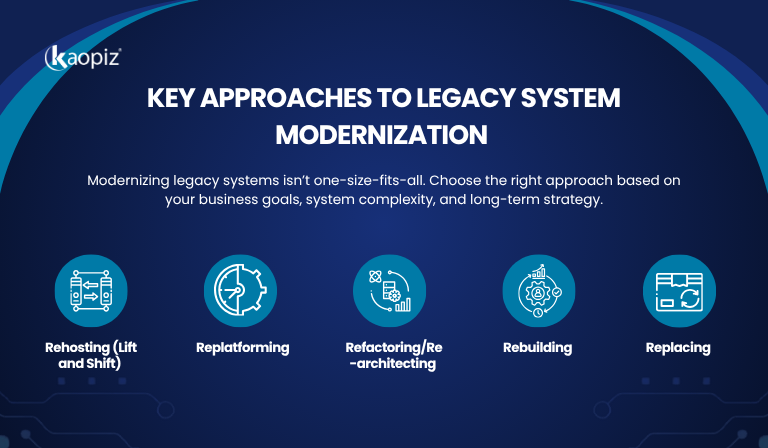
In practice, most organizations adopt one of the following five legacy system modernization approaches, each offering different trade-offs between cost, speed, and long-term value.
Rehosting (Lift and Shift)
Rehosting involves migrating existing applications to a new infrastructure, typically the cloud, without making significant changes to the codebase.
This approach is the fastest and least disruptive, making it ideal for organizations looking to quickly reduce infrastructure costs or move away from on-premises systems. However, while rehosting improves scalability and availability, it does not address underlying architectural limitations.
Replatforming
Replatforming involves making minor optimizations to applications during migration, such as upgrading databases or leveraging cloud-native services, without fully redesigning the system.
This approach offers a balance between speed and improvement, allowing businesses to gain some performance and scalability benefits while keeping costs and risks relatively low.
Refactoring/Re-architecting
Refactoring focuses on restructuring and optimizing existing code to improve performance, scalability, and maintainability, often transitioning from monolithic to microservices architecture.
Although more complex and time-consuming than rehosting or replatforming, this approach delivers significant long-term benefits by reducing technical debt and enabling faster innovation.
Rebuilding
Rebuilding involves redeveloping the entire system from scratch using modern technologies and architectures, while retaining the original business logic.
This approach provides maximum flexibility and performance improvements but requires higher investment, longer timelines, and careful planning to minimize disruption.
Replacing
Replacing means discarding the legacy system entirely and adopting a new solution, such as a SaaS platform or a commercial off-the-shelf system.
This approach can be the most efficient when the existing system no longer aligns with business needs. However, it may require significant changes in workflows and user adoption.
How to Choose the Right Modernization Strategy
Choosing the right legacy system modernization strategies depends on balancing business priorities, technical realities, and available resources. While some organizations need a quick infrastructure upgrade, others may require a deeper transformation to improve agility, security, and long-term scalability.
To make the right decision, businesses should evaluate their modernization options from four key perspectives: business goals, system complexity, budget and timeline, and a clear decision-making framework.
Based on Business Goals
The first step is to clarify what the business wants to achieve through modernization. If the goal is to reduce infrastructure costs or exit on-premise environments quickly, rehosting or replatforming may be the most practical option. If the priority is to improve scalability, enable faster product releases, or support new digital services, refactoring or rebuilding may deliver greater long-term value.

In short, the modernization strategy should align with the desired business outcome, not just the technical condition of the system.
Based on System Complexity
System complexity is another critical factor. Smaller applications with limited dependencies can often be modernized more quickly through rehosting or replatforming. In contrast, large enterprise systems with multiple integrations, custom workflows, and mission-critical functions may require refactoring, re-architecting, or phased rebuilding.
The more complex the system, the more important it is to assess risks such as downtime, data migration, and integration challenges before choosing an approach.
Based on Budget and Timeline
Budget and timeline often shape what is realistically possible. Rehosting is usually the fastest and most cost-effective option for businesses that need quick wins with minimal disruption. Replatforming offers moderate improvements with manageable investment. Refactoring and rebuilding require more time and budget, but they can generate stronger long-term returns by reducing technical debt and improving flexibility.
For organizations under pressure to modernize quickly, a phased approach may be more practical than a full transformation at once.
Decision Framework (Step-by-step)
A simple way to choose the right strategy is to follow a structured decision framework:
- Assess the current system: Identify performance issues, technical debt, dependencies, and security risks
- Define business goals and KPIs: Clarify objectives such as cost reduction, scalability, faster delivery, or compliance improvement
- Evaluate modernization options: Compare approaches based on cost, risk, timeline, and expected business impact
- Prioritize initiatives: Determine which systems or components should be modernized first
- Choose execution approach: Decide between phased modernization or full-scale transformation
This step-by-step process helps reduce uncertainty and ensures the chosen modernization strategy supports both immediate needs and long-term business growth.
Legacy System Modernization Cost in Australia
The cost of legacy system modernization in Australia varies significantly depending on system size, complexity, and regulatory requirements. While smaller projects may cost tens of thousands of dollars, enterprise-level modernization can reach AUD 350,000–700,000+, especially for mission-critical systems.
More importantly, businesses should evaluate modernization cost not just as an upfront investment, but as a trade-off against rising maintenance expenses, operational inefficiencies, and long-term risk.
Key Cost Factors
Several factors influence the total cost of modernization:
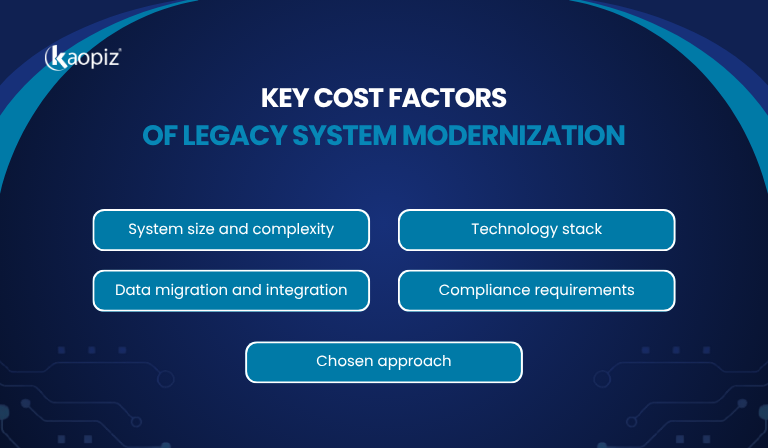
- System size and complexity: Larger, highly integrated systems require more effort to modernize
- Data migration and integration: Moving and restructuring legacy data increases cost and risk
- Technology stack: Outdated or unsupported technologies may require deeper transformation
- Compliance requirements: Regulated industries (finance, healthcare) add additional cost layers
- Chosen approach: Rehosting is cheaper, while rebuilding or re-architecting is more expensive
Estimated Cost Range
Modernization costs can vary widely based on scope:
- Small projects: ~AUD 50,000 – AUD 150,000
- Mid-sized systems: ~AUD 150,000 – AUD 350,000
- Enterprise systems: AUD 350,000 – AUD 700,000+
Additionally, global benchmarks show similar patterns, with enterprise modernization projects often exceeding USD 150,000–500,000+, depending on complexity.
Hidden Costs to Consider
Beyond initial investment, modernization projects often include hidden costs:
- Downtime and business disruption during migration
- Training and change management for teams
- Parallel system operation during transition
- Unexpected complexity or rework, as many IT projects run 45% over budget on average
In-house vs Outsourcing Cost Comparison
Choosing between in-house development and outsourcing also affects cost efficiency:
- In-house teams
- Higher salary and operational costs
- Limited scalability
- Longer hiring timelines
- Outsourcing (e.g., Vietnam)
- 40–60% cost savings compared to local development
- Access to skilled engineers
- Faster project ramp-up
For many Australian businesses, outsourcing provides a more cost-effective way to modernize systems while maintaining quality and delivery speed.
Step-by-Step Roadmap for a Successful Modernization
A successful legacy system modernization requires a structured, phased approach to minimize risks and ensure alignment with business goals. By following a clear roadmap, organizations can reduce disruption, control costs, and maximize long-term value.
Step 1: System Assessment
The first step is to evaluate the current system in detail. This includes identifying performance issues, technical debt, dependencies, and security vulnerabilities.
A thorough assessment helps determine which parts of the system should be modernized, replaced, or retained.
Step 2: Define Goals and KPIs
Next, organizations need to clearly define what they want to achieve. This may include reducing costs, improving scalability, enhancing security, or accelerating time-to-market.
Establishing measurable KPIs, such as system performance, uptime, or deployment speed, ensures the modernization effort stays aligned with business objectives.
Step 3: Choose the Right Approach
Based on the assessment and goals, businesses can select the most suitable modernization approach, whether rehosting, replatforming, refactoring, or rebuilding.
The chosen strategy should balance cost, risk, timeline, and expected business impact.
Step 4: Implementation
Modernization should be executed in phases to reduce disruption. This may involve migrating components gradually, adopting agile methodologies, and ensuring continuous communication between technical and business teams.
A phased approach allows organizations to manage risks while maintaining operational continuity.
Step 5: Testing and Deployment
Before full rollout, rigorous testing is essential to ensure system stability, performance, and security. This includes functional testing, integration testing, and user acceptance testing.
A controlled deployment process helps minimize downtime and ensures a smooth transition.
Step 6: Continuous Optimization
Modernization does not end at deployment. Continuous monitoring, optimization, and improvement are necessary to ensure long-term success.
By leveraging analytics, automation, and feedback loops, businesses can continuously enhance system performance and adapt to changing needs.
Common Challenges and How to Overcome Them
Legacy system modernization is a complex process that involves both technical and business risks. Without proper planning, organizations may face delays, cost overruns, or operational disruptions. Understanding the common challenges and how to address them can significantly increase the chances of success.
| Challenge | Description | How to Overcome |
|---|---|---|
| Data Migration Risks | Risk of data loss, corruption, or inconsistency during migration | Conduct data audits, use phased migration, and implement backup & validation processes |
| System Downtime | Service disruptions impacting operations and customer experience | Use phased rollout, run parallel systems, and deploy during low-traffic periods |
| Budget Overruns | Costs exceeding initial estimates due to hidden complexity | Define clear scope, adopt agile approach, and continuously monitor progress |
| Lack of Skilled Talent | Difficulty finding expertise in both legacy and modern technologies | Upskill internal teams or partner with experienced vendors |
| Integration Challenges | Legacy systems struggle to integrate with modern tools and platforms | Use APIs, middleware, and gradually transition to microservices |
Key takeaways: While modernization comes with challenges, a structured approach combined with the right tools and expertise can effectively mitigate risks. By proactively addressing these issues, businesses can ensure a smoother transition and maximize the long-term value of modernization.
Why Outsourcing to Vietnam is a Strategic Move for Australian Firms
For Australian businesses, outsourcing offers a cost-effective and scalable way to modernize legacy systems while addressing local talent shortages. Vietnam has become one of the best outsoucing destinations thanks to its strong technical capabilities and competitive pricing.
- Cost Efficiency: Businesses can reduce development costs by 40–60% compared to local teams, while maintaining high-quality delivery.
- Skilled Talent Pool: Vietnam offers a large pool of experienced engineers with expertise in cloud, AI, and enterprise systems.
- Time Zone Alignment: With close time zone overlap, Australian teams can collaborate with Vietnamese teams in real time, improving communication and delivery speed.
- Proven Delivery Capability: Vietnamese IT providers have strong experience delivering large-scale projects for global clients, ensuring reliability and quality.
Outsourcing to Vietnam enables Australian firms to modernize systems faster, reduce costs, and access high-quality talent, making it a strategic choice for long-term growth.
Kaopiz: Your Trusted Partner for Legacy System Modernization
As a trusted IT outsourcing company with over 12 years of experience and a team of 1,000+ engineers, Kaopiz has successfully delivered large-scale modernization projects across industries such as education, logistics, healthcare, and finance. We specialize in transforming outdated systems into scalable, cloud-ready platforms that support long-term growth.

Our approach focuses on:
- Minimizing disruption through phased modernization strategies
- Optimizing costs with flexible delivery models
- Ensuring security and compliance aligned with international standards
- Accelerating time-to-value with proven frameworks and best practices
For Australian businesses, Kaopiz offers a reliable, cost-effective way to modernize legacy systems while maintaining high quality and delivery standards.
Why Choose Kaopiz
Over the years, Kaopiz has successfully supported Japanese clients in modernizing legacy platforms, migrating systems to cloud environments, and improving scalability while maintaining strict quality standards. This experience demonstrates our ability to deliver reliable, high-performance solutions for enterprise clients globally.
- Proven Experience in Legacy Modernization: We have hands-on experience modernizing complex legacy systems, from infrastructure upgrades to full system re-architecting, ensuring smooth transitions with measurable outcomes.
- Strong Engineering Capability: With a large pool of highly skilled engineers, Kaopiz delivers expertise in cloud, microservices, AI, and enterprise system development, supporting even the most complex modernization needs.
- Cost-Effective Delivery Model: Our offshore development model enables businesses to reduce costs by 40–60% compared to local teams, without compromising on quality or performance.
- AWS Expertise and Cloud-Native Solutions: As an AWS Advanced Consulting Partner, we help businesses leverage cloud technologies to build scalable, secure, and high-performance systems.
- Flexible Engagement Models: We offer tailored engagement options, including dedicated teams, ODC, and project-based delivery, allowing businesses to scale resources based on their needs.
- Strong Focus on Security and Quality: Kaopiz is certified with ISO 27001 and ISO 9001, ensuring secure and reliable delivery for enterprise clients.
Partner with Kaopiz to transform your legacy system into a secure, cloud-ready platform, without disrupting your operations.
Case Study: Modernizing a Legacy E-learning System on AWS
Overview
A leading education technology provider operating an enterprise e-learning platform faced growing challenges with its legacy system infrastructure. Built over 10 years ago on AWS, the platform relied on an outdated operating system environment, limiting scalability, increasing security risks, and making long-term maintenance more complex.
To support future growth and ensure system stability, the organization required a modernization strategy that could upgrade the infrastructure without disrupting ongoing operations.
Challenges
The existing system presented several key limitations:
- Outdated OS environment (Amazon Linux 1) with limited support and increasing security risks
- Scalability constraints, making it difficult to handle growing user demand
- High maintenance effort due to aging infrastructure
- Risk of service disruption during migration, as the platform supported active users
These challenges made it critical to modernize the system while ensuring continuity and minimal impact on end users.
Solution
Kaopiz implemented a structured infrastructure modernization approach on AWS, focusing on stability, scalability, and risk mitigation:
- Replatformed the system by upgrading from Amazon Linux 1 to Amazon Linux 2
- Designed a gradual migration strategy to ensure high availability and minimize disruption
- Maintained backward compatibility to allow existing functionalities to operate seamlessly after migration
- Enhanced system architecture to support future scalability and expansion
- Conducted end-to-end testing and performance validation to ensure system reliability
This approach allowed the system to be modernized without requiring a full rebuild, reducing both cost and risk.
Results
The modernization delivered clear improvements in both technical performance and business readiness:
- Improved system security and maintainability through updated infrastructure
- Enabled scalable architecture, supporting future growth and new service development
- Achieved smooth migration with minimal user impact, ensuring business continuity
- Enhanced overall system quality through comprehensive testing and optimization
This case demonstrates how a well-planned modernization strategy can reduce risk, improve performance, and create a strong foundation for long-term digital growth.
Conclusion
Legacy system modernization is no longer optional; it is a critical step for businesses looking to remain competitive in today’s fast-moving, digital-first environment. Outdated systems not only increase operational costs and security risks but also limit scalability and slow down innovation.
By choosing the right modernization approach, whether rehosting, replatforming, or re-architecting, organizations can transform legacy systems into agile, scalable, and future-ready platforms. With a clear roadmap and the right technology partner, modernization can be achieved efficiently while minimizing disruption.
FAQs
- Why Should Businesses Modernize Legacy Systems?
- Modernizing legacy systems helps reduce maintenance costs, improve system performance, enhance security, and enable faster innovation. It also allows businesses to stay competitive in a digital-first market.
- How Long Does Legacy System Modernization Take?
- The timeline depends on system complexity and the chosen approach. Small projects may take a few months, while large enterprise modernization can take 6–18 months or longer, especially if done in phases.
- Is It Better to Modernize or Replace a Legacy System?
- It depends on the system condition and business goals. Modernization is often more cost-effective if the core system is still valuable, while replacement is suitable when the system no longer meets business needs.
- Why Do Australian Companies Outsource Legacy System Modernization?
- Many Australian businesses outsource to reduce costs, access skilled talent, and accelerate delivery. Countries like Vietnam offer 40–60% cost savings while maintaining high-quality engineering standards.
- WWhat Are the Biggest Risks in Legacy System Modernization?
- Common risks include data migration issues, system downtime, budget overruns, and integration challenges. These can be mitigated with proper planning, phased implementation, and experienced partners.


No Comments yet!