


Build-Operate-Transfer (BOT) Model: A Guide for Singapore Businesses
As Singapore continues to grow as a leading technology hub, companies face increasing pressure to scale quickly while managing high hiring costs and talent shortages. Building an in-house team locally can be time-consuming and expensive, making it difficult for businesses to stay competitive.
The Build-Operate-Transfer (BOT) model offers a practical alternative, allowing companies to build dedicated offshore teams, accelerate development, and gradually gain full ownership. This approach combines the flexibility of outsourcing with the long-term benefits of an in-house team, making it an increasingly popular strategy for scaling technology capabilities.
This article provides a comprehensive overview of the BOT model, including how it works, its benefits, costs, and how to determine if it is the right strategy for your business.
Key Takeaways
- The BOT model enables companies to build, operate, and transfer a dedicated offshore team with full ownership in the long term.
- Businesses can achieve 30–70% cost savings compared to hiring locally in Singapore.
- The model helps overcome talent shortages by providing access to a global pool of skilled engineers.
- Typical implementation timeline: 1–3 months (Build), 6–24 months (Operate), 1–2 months (Transfer).
- BOT offers a balance between speed, cost efficiency, and long-term control, making it ideal for scaling businesses.
- It is best suited for long-term development and expansion, rather than short-term or fixed-scope projects.
Table of Contents
- What Is the Build-Operate-Transfer (BOT) Model?
- How the BOT Model Works: 3 Key Phases
- Build–Operate–Transfer Examples
- Key Benefits of the BOT Model
- BOT Model vs Other Outsourcing Models
- When Should You Choose the BOT Model?
- Cost & Timeline of a BOT Model
- What Are the Risks of BOT Contracts (And How to Mitigate Them)?
- How to Choose the Right BOT Partner in 2026
- Why Kaopiz is a Trusted BOT Partner for Singapore Companies
- Conclusion
- FAQs
What Is the Build-Operate-Transfer (BOT) Model?
The Build-Operate-Transfer model is increasingly adopted by companies in Singapore as they seek to balance cost efficiency, speed, and greater control over their technology capabilities. In this section, we explore its definition, common variations, and why it is becoming a preferred approach for Singapore businesses.
BOT Model Definition
The Build-Operate-Transfer (BOT) model is a strategic outsourcing model in which a service provider helps a company build a dedicated team or development center, operate it on the client’s behalf, and eventually transfer full ownership back to the client after a defined period.
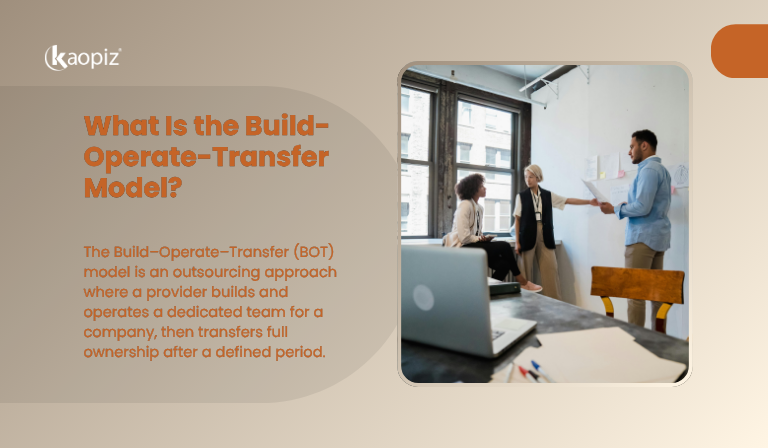
In the Build phase, the vendor sets up the team, infrastructure, and processes based on the client’s requirements. During the Operate phase, the vendor manages day-to-day operations, ensuring productivity, quality, and stability. Finally, in the Transfer phase, the entire team, knowledge, and operations are handed over, allowing the client to take full control.
Unlike traditional outsourcing, where companies rely on external vendors long-term, the BOT model is designed to create a sustainable, in-house capability while minimizing initial risks and investment.
Common Variations on the BOT Contract
Types of build-operate-transfer exist to suit different business goals and levels of control:
- Build–Operate–Transfer (BOT): The vendor builds and operates the team before transferring full ownership to the client. Ideal for gradual capability building with lower upfront risk.
- Build–Own–Operate–Transfer (BOOT): The vendor owns and manages the setup during the contract period, then transfers it. Suitable for companies looking to defer both operational and capital investment initially.
- Build–Own–Operate (BOO): The vendor builds, owns, and operates the team without a transfer phase. This resembles long-term outsourcing with a dedicated setup.
- Hybrid BOT Models: Flexible variations that adjust timelines, ownership, or governance to match specific business needs.
Choosing the right variation depends on factors such as ownership goals, budget, and desired level of control.
Why Singapore Companies Are Adopting the BOT Model
Singapore companies are increasingly adopting the BOT model due to high hiring costs, talent shortages, and the need to scale quickly. Mid-to-senior software engineers can cost SGD 6,000–15,000+ per month, making local hiring expensive, while demand for tech talent continues to exceed supply.
In addition, hiring timelines can take 10–18 weeks or more, slowing down product development and growth. The BOT model offers a practical solution by enabling companies to build offshore teams faster, reduce costs, and retain long-term ownership, making it an attractive strategy for scaling technology capabilities.
How the BOT Model Works: 3 Key Phases
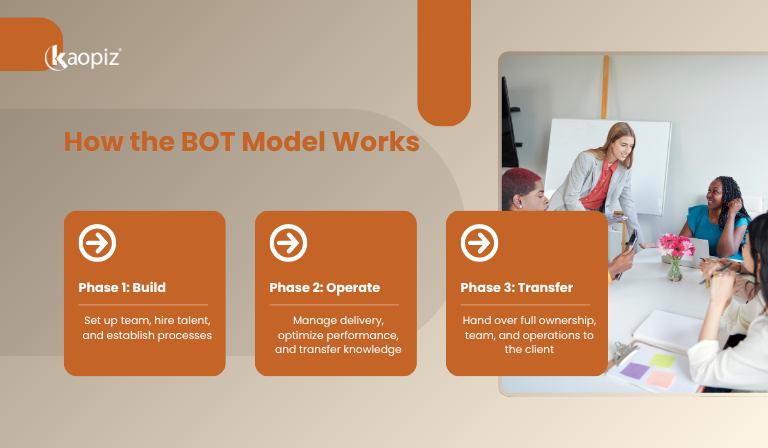
The BOT model follows a structured approach that ensures smooth team setup, efficient operations, and seamless ownership transfer. It is typically implemented through three key phases: Build, Operate, and Transfer.
Phase 1: Build
In the Build phase, the vendor sets up a dedicated team and operational foundation based on the client’s requirements. This includes recruiting talent, establishing infrastructure, and defining workflows, tools, and governance models aligned with the client’s standards.
The focus of this phase is to ensure the team is not only technically capable but also culturally aligned and ready to integrate with the client’s business. By the end of the Build phase, the client has a fully functional offshore team in place, ready to begin delivery.
Phase 2: Operate
In the Operate phase, the vendor takes responsibility for managing the team’s day-to-day activities while ensuring consistent delivery, quality, and performance. This includes project management, process optimization, performance monitoring, and ongoing support.
During this stage, the client remains involved through regular communication and governance, gradually gaining visibility and control over the team. At the same time, knowledge transfer begins progressively, preparing the team and processes for a smooth transition in the next phase.
Phase 3: Transfer
In the Transfer phase, full ownership of the team, processes, and knowledge is handed over to the client. This includes the legal transfer of employment, access to systems, documentation, and complete operational control.
The transition is typically planned and executed in stages to ensure continuity and minimize disruption. By the end of this phase, the offshore team becomes a fully integrated extension of the client’s organization, allowing the business to operate independently with full control over its technology capabilities.
Build–Operate–Transfer Examples
To better understand how the BOT model works in practice, here are a few examples across both infrastructure and software development contexts:
Airport Development (Infrastructure BOT)
Governments often use BOT to develop large-scale infrastructure such as airports.
- Build: A private consortium designs and constructs new terminals and facilities
- Operate: The consortium manages daily operations and generates revenue over a concession period (e.g., 20–30 years)
- Transfer: Ownership is handed back to the government at the end of the contract
This model helps governments reduce upfront investment while leveraging private expertise.
Offshore Development Center (Software BOT)
A Singapore-based company wants to scale its engineering team but faces high hiring costs locally.

- Build: A technology partner recruits and sets up a dedicated team in Vietnam
- Operate: The partner manages operations, delivery, and team performance
- Transfer: After stabilization, the team is transferred to the client as a fully owned offshore unit
This allows companies to scale faster, reduce costs, and retain long-term ownership of their team.
Digital Transformation Team (Enterprise BOT)
An enterprise aims to modernize its legacy systems and build internal digital capabilities.
- Build: A partner sets up a specialized team for cloud migration and system modernization
- Operate: The team delivers projects while improving processes and technical standards
- Transfer: The internal team takes over with full knowledge and ownership
This approach enables businesses to develop internal expertise while minimizing risk during transformation.
Key Benefits of the BOT Model
The BOT model offers a unique combination of flexibility, efficiency, and long-term value for growing businesses. Below are the key Build-Operate-Transfer advantages that make it an attractive choice for companies looking to scale their technology capabilities.
Full Ownership in the Long Term
One of the key advantages of the BOT model is that it enables companies to build and eventually own their offshore team as an internal asset. Unlike traditional outsourcing, where businesses remain dependent on external vendors, BOT ensures a clear path to full ownership after the transfer phase.
This allows companies to retain complete control over talent, processes, and intellectual property, while preserving the knowledge built during the operation phase. As a result, businesses can scale sustainably and operate with greater independence in the long term.
Faster Market Entry
The BOT model enables companies to set up and scale development teams much faster compared to traditional hiring. Instead of navigating lengthy recruitment processes, businesses can leverage the vendor’s existing networks, resources, and expertise to build a ready-to-operate team in a shorter timeframe.
This accelerated setup allows companies to launch products, expand capabilities, and respond to market opportunities more quickly, giving them a competitive advantage, especially in fast-moving industries.
Cost Optimization
The BOT model helps companies reduce development costs by leveraging offshore talent, with typical savings of 30–50% compared to hiring locally in Singapore. These savings are driven by lower salary benchmarks as well as reduced recruitment and setup costs.

In addition, the model minimizes overhead related to infrastructure and employee benefits. Insights from Deloitte show that offshore models are widely used to improve cost efficiency while maintaining quality, making BOT a practical choice for sustainable scaling.
Access to Skilled Talent
The BOT model provides access to a broader and more diverse talent pool beyond local markets. Instead of being limited by talent shortages in Singapore, companies can tap into highly skilled engineers in offshore locations with strong expertise in areas such as AI, cloud, and software development.
By leveraging the vendor’s recruitment network and hiring capabilities, businesses can build high-quality teams faster while ensuring the right technical and cultural fit. This makes it easier to scale capabilities and maintain consistent delivery without the constraints of local hiring challenges.
Reduced Risk Compared to Direct Hiring
The BOT model reduces many of the risks associated with direct hiring, especially in unfamiliar or competitive markets. Instead of investing heavily upfront in recruitment, legal setup, and operations, companies can rely on the vendor’s established processes and local expertise to build and manage the team.
This approach minimizes risks such as hiring mismatches, compliance issues, and high attrition rates, while allowing businesses to scale more confidently. At the same time, the phased structure of BOT ensures a smoother transition to ownership, reducing disruption and operational uncertainty in the long run.
BOT Model vs Other Outsourcing Models
Choosing the right engagement model is critical for scaling your technology capabilities effectively. While the BOT model offers a structured path to ownership, other models, such as staff augmentation, dedicated teams (ODC), and project-based outsourcing, serve different business needs. Below is a comparison to help you determine which model fits your goals.
| Criteria | BOT Model | Staff Augmentation | Dedicated Team (ODC) | Project-Based Outsourcing |
|---|---|---|---|---|
| Ownership | Full ownership after transfer | No ownership | Vendor-owned | No ownership |
| Control Level | High (increases over time) | High (client-managed) | Medium (shared) | Low |
| Setup Speed | Medium (structured setup) | Fast | Medium | Fast |
| Management Responsibility | Vendor → Client (gradual transition) | Client | Vendor | Vendor |
| Best For | Long-term team building & scaling | Short-term resource gaps | Long-term outsourcing without ownership | Fixed-scope projects |
| Scalability | High | Medium | High | Low |
| Knowledge Retention | High (transferred to client) | Medium | Low–Medium | Low |
| Cost Efficiency | High (long-term optimization) | Medium | High | Medium |
| Time Horizon | Long-term | Short to mid-term | Mid to long-term | Short-term |
BOT vs Staff Augmentation
Staff augmentation allows companies to temporarily extend their in-house team by hiring external developers on a short-term basis. While this model provides flexibility and quick scaling, the client remains responsible for management, integration, and long-term retention.
In contrast, the BOT model offers a more structured and long-term approach. The vendor handles recruitment, operations, and management in the early stages, before transferring full ownership to the client. This makes BOT more suitable for companies looking to build a sustainable offshore team, rather than just fill immediate resource gaps.
BOT vs Dedicated Team (ODC)
A dedicated team or Offshore Development Center (ODC) provides a long-term, vendor-managed team that works exclusively for the client. While this model ensures consistency and scalability, ownership of the team and operations typically remains with the vendor.
The BOT model goes one step further by offering a clear transition to ownership. After the operation phase, the team, processes, and knowledge are transferred to the client, enabling greater control and independence. BOT is ideal for companies that want to start with outsourcing but eventually internalize their capabilities.
BOT vs Project-Based Outsourcing
Project-based outsourcing focuses on delivering a specific scope of work within a defined timeline and budget. It is best suited for short-term or well-defined projects where the client does not need ongoing team ownership.
In contrast, the BOT model is designed for long-term collaboration and capability building. Instead of delivering a one-time project, BOT enables companies to establish a dedicated team that evolves with their business needs. This makes it a better fit for organizations planning continuous development and long-term scaling.
When Should You Choose the BOT Model?
The BOT model is best suited for companies that want to build long-term technology capabilities while maintaining flexibility in the early stages. It allows businesses to scale efficiently without the full upfront cost and complexity of setting up a local team.

You should consider the BOT model when:
- You plan to build a long-term development team rather than rely on short-term outsourcing
- You want to expand into new markets or establish an offshore development center
- You need to scale quickly, but face challenges in hiring local talent
- You aim to reduce costs while maintaining quality and control
- You want a clear path to ownership of your team, processes, and intellectual property
However, the BOT model may not be suitable if:
- You only have a short-term or fixed-scope project
- You do not intend to take ownership of the team in the future
- You require a quick, low-commitment solution
In these cases, models like project-based outsourcing or staff augmentation may be more appropriate.
Cost & Timeline of a BOT Model
The cost of a BOT model includes three main components: setup (Build), operational costs (Operate), and transfer (Transfer). One of the biggest advantages comes from leveraging offshore talent markets like Vietnam, where costs are significantly lower than in Singapore.
For example, the average software developer salary in Singapore ranges from SGD 4,000 to SGD 15,000/month, while in Vietnam, a senior developer typically earns around SGD 2,700–3,200. On an annual basis, developers cost roughly SGD 74,000 in Singapore compared to SGD 23,000 in Vietnam, representing up to 60–70% cost savings. This significant gap makes the BOT model an attractive strategy for companies looking to scale efficiently while maintaining cost control.
In terms of timeline, the BOT model follows a structured approach across three phases:
- Build phase (1–3 months): Recruiting talent, setting up infrastructure, and onboarding the team
- Operate phase (6–24 months): Managing delivery, optimizing processes, and gradually transferring knowledge
- Transfer phase (1–2 months): Handing over full ownership, team, and operations to the client
This phased model enables companies to scale faster and reduce hiring delays, especially compared to lengthy local recruitment cycles in Singapore.
What Are the Risks of BOT Contracts (And How to Mitigate Them)?
While the BOT model offers significant advantages, it also comes with certain risks that companies should carefully consider. Understanding these challenges and how to address them can help ensure a smoother and more successful implementation.
One common risk is vendor dependency during the early stages, where businesses rely heavily on the partner for recruitment and operations. Another is ineffective knowledge transfer, which may impact long-term ownership. Companies may also face cultural misalignment or legal and compliance issues when operating across borders.
To better understand these risks and how to address them, the table below summarizes key challenges and mitigation strategies:
| Risk | Description | How to Mitigate |
|---|---|---|
| Vendor Dependency | Heavy reliance on the partner during Build and Operate phases | Establish clear governance, KPIs, and regular reporting; ensure early involvement from the client team |
| Poor Knowledge Transfer | Loss of critical knowledge during transition | Implement structured documentation, training, and phased handover from early stages |
| Cultural & Communication Gaps | Misalignment in work style, expectations, or communication | Choose partners with international experience; set clear communication protocols |
| Legal & Compliance Risks | Issues related to employment laws, IP protection, or contracts | Work with experienced vendors familiar with local regulations; ensure strong legal frameworks |
| Talent Retention Risk | Key team members may leave before or during transfer | Offer retention plans, career development, and incentives during transition |
How to Choose the Right BOT Partner in 2026
Selecting the right BOT partner is critical to the success of your long-term strategy. Beyond cost savings, businesses should look for a partner that can build, operate, and successfully transfer a high-performing team with minimal risk and disruption.
When evaluating a BOT provider, consider the following key factors:
- Proven Experience in BOT Projects: Look for partners with a track record of successfully delivering BOT engagements, particularly in your industry or target market. Experience ensures smoother execution and fewer operational risks.
- Strong Recruitment & Talent Network: The ability to quickly source and retain high-quality talent is essential. A reliable partner should have an established recruitment pipeline and deep access to skilled engineers.
- Transparent Processes & Governance: Clear communication, defined KPIs, and regular reporting are crucial. Choose a partner that offers full visibility into operations, performance, and costs throughout all phases.
- Effective Knowledge Transfer Capability: A successful BOT model depends on seamless transition. Ensure the partner has structured processes for documentation, training, and phased handover.
- Cultural Fit & Communication: Alignment in work culture, communication style, and time zone collaboration plays a key role in long-term success, especially for Singapore-based companies working with offshore teams.
- Legal & Compliance Expertise: The partner should understand local regulations, employment laws, and IP protection to ensure a secure and compliant engagement.
In 2026, as more companies adopt hybrid and offshore models, the right BOT partner is not just a vendor, but a strategic partner that enables sustainable growth and long-term ownership.
Why Kaopiz is a Trusted BOT Partner for Singapore Companies
Kaopiz is a trusted IT outsourcing partner for Singapore businesses looking to scale efficiently through the BOT model. With 1,000+ engineers and over 12 years of experience, Kaopiz supports companies in building, operating, and successfully transferring high-performing offshore teams.
Key reasons why Singapore companies choose Kaopiz:
- Significant Cost Savings (up to 60%): Leverage Vietnam’s talent market to reduce development costs compared to Singapore, while maintaining high quality standards
- Large & Skilled Talent Pool: Access to 1,000+ engineers with expertise in AI, cloud, and enterprise software, enabling fast and flexible team scaling
- Fast Team Setup (within 2–6 weeks): Strong recruitment pipeline allows rapid onboarding, helping businesses accelerate time-to-market
- Proven International Experience: Delivered 1,000+ projects for 500+ global clients, including companies in Singapore and Japan
- Transparent Operations & Governance: Clear KPIs, regular reporting, and alignment with client workflows ensure full visibility and control
- Seamless Knowledge Transfer: Structured documentation, training, and phased handover minimize risks during the transition to full ownership
With a combination of cost efficiency, speed, and long-term ownership, Kaopiz enables Singapore companies to scale confidently while building sustainable in-house capabilities.
Ready to explore the BOT model for your business?
Conclusion
The Build-Operate-Transfer model offers a strategic approach for companies looking to scale efficiently while maintaining long-term control over their technology capabilities. By combining the advantages of outsourcing with a clear path to ownership, BOT enables businesses to reduce costs, access global talent, and build sustainable in-house teams.
For Singapore companies facing high hiring costs and talent shortages, the BOT model provides a practical solution to accelerate growth without compromising quality or control. With the right partner, businesses can not only scale faster but also create lasting value through fully owned, high-performing teams.
FAQs
- How Much Does a Build-Operate-Transfer Model Cost?
- The cost of a BOT model includes setup, operational, and transfer expenses. Compared to hiring locally in Singapore, companies can typically achieve 30–70% cost savings by leveraging offshore teams, depending on location, team size, and project scope.
- How Long Does a BOT Model Take?
- A BOT model is usually implemented in three phases: Build (1–3 months), Operate (6–24 months), and Transfer (1–2 months). The exact timeline varies based on business goals and team complexity.
- Is BOT Suitable for Mid-sized Businesses?
- Yes, the BOT model is well-suited for mid-sized businesses that want to scale efficiently without the high cost of local hiring. It allows companies to build dedicated teams while gradually gaining full ownership.
- When Should Companies Not Use a BOT Model?
- The BOT model may not be suitable for short-term projects, limited budgets, or businesses without plans for long-term team ownership. In such cases, simpler models like project-based outsourcing may be more appropriate.
- What Happens After the Transfer Phase?
- After the transfer phase, the offshore team becomes fully owned and managed by the client. This includes full control over team members, processes, and intellectual property, allowing the business to operate independently.
Trending Post

No Comments yet!