
[Webinar Recap] The Real Ship vs AI Slop: How Tech Teams Use AI Without Shipping Garbage
As AI-assisted software development becomes mainstream, engineering teams are shipping code faster than ever before. But alongside that acceleration comes a new challenge: how do you maintain production quality when AI can generate days of code in just a few hours? This recap of the Real Ship vs AI Slop webinar breaks down how engineering teams are answering that question.
Kaopiz Global hosted the webinar “The Real Ship vs AI Slop: How Tech Teams Use AI Without Shipping Garbage” to dig into exactly this. The session brought together engineering leaders, CTOs, and software professionals across Singapore and Southeast Asia to discuss why traditional development practices struggle in the age of AI and what teams can do differently.
About the Webinar
Held on 14 July 2026, this one-hour online session focused on one of the fastest-growing challenges in modern software engineering: governing AI-generated code at scale.
Rather than discussing prompt engineering or coding assistants, the webinar examined the operational side of AI adoption. It introduced a governance-first approach that helps engineering teams maintain code quality, reduce hidden risks, and build sustainable AI-assisted development workflows.
Event Details
- Date: Tuesday, 14 July 2026
- Time: 10:00 AM – 11:00 AM (UTC+7)
- Format: Online via Zoom
- Audience: CTOs, Engineering Managers, Technical Leaders, Software Architects, and Product Teams
Speakers
Ethan Cao – Chief Technology Officer, Kaopiz Global
With over a decade of experience building, scaling, and leading high-performing engineering teams for global clients, Ethan oversees Kaopiz Global’s technology strategy and AI initiatives. Throughout his career, he has helped organizations modernize software delivery, adopt cloud-native architectures, and integrate AI into enterprise development workflows.
During the webinar, Ethan shared why AI has fundamentally changed the software development lifecycle, not because it writes better code, but because it generates code faster than traditional engineering processes can effectively govern. He walked through why standard code review breaks down under AI-generated volume, and introduced The Real Ship Framework, explaining how engineering teams can maintain delivery speed without compromising code quality, architectural integrity, or long-term maintainability.
Sean Trinh – Senior Engineer, Kaopiz Global
Sean is a Senior Engineer at Kaopiz Global with more than 8 years of experience delivering enterprise software across AI, cloud, and digital transformation projects. He has been deeply involved in AI-augmented engineering workflows, working closely with development teams to integrate generative AI into production software delivery.
Drawing from real project experience, Sean walked through how the Real Ship architecture works in practice, then presented a production case study, sharing practical lessons on implementing governance, safety guardrails, and structured AI collaboration to improve delivery consistency while preventing hidden quality risks.
Key Takeaways
Throughout the webinar, participants explored practical frameworks and production lessons that can be applied immediately to AI-assisted software development. Here is the recap the Real Ship vs AI slop webinar:
Why Traditional Code Review No Longer Scales
One of the central discussions focused on how AI fundamentally changes software delivery.
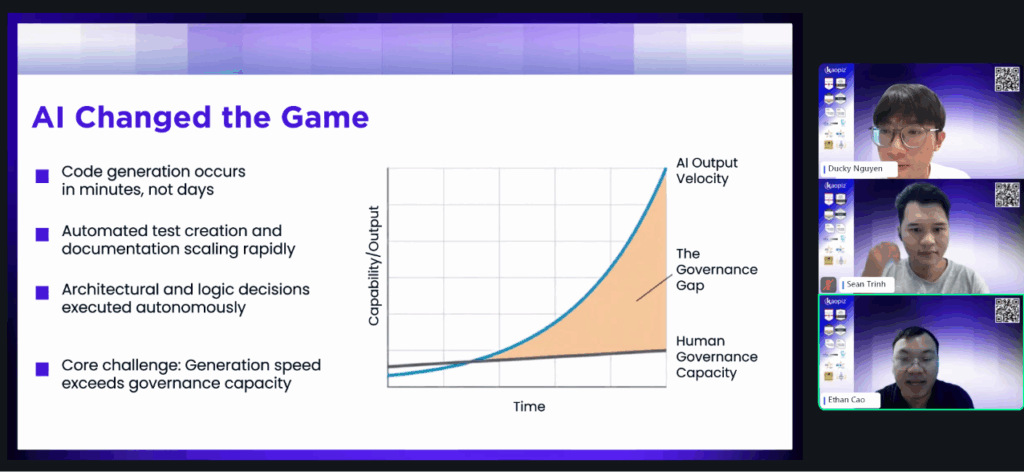
When AI can generate multiple days of engineering output within hours, traditional pull request reviews quickly become the bottleneck. The session explained four structural weaknesses that legacy SDLC processes fail to address when reviewing AI-generated code, the absence of a single source of truth, an overwhelmed review process, a blind dependency loop where hallucinations slip through unnoticed, and silent over-engineering that passes every automated check while quietly building up technical debt, highlighting why governance must evolve alongside development speed.
Introducing the Real Ship Framework
The webinar introduced The Real Ship Framework, a governance model designed specifically for AI-assisted engineering teams, built on three pillars: Context is King (AI agents need full access to a team’s real architecture, history, and domain rules, not just the ticket in front of them), Test-First Guardrails (tests are defined before the AI writes any code, giving the team a clear, objective definition of “done”), and Human-in-the-Loop (humans review at the checkpoints that actually matter, rather than trying to check every line).
In practice, this framework runs on a four-stage architecture: a Unified Context Layer that feeds agents real architectural and historical context, a Multi-Agent Pod with specialized Architect, Coder, and QA agents, deterministic gateways that force self-documentation and automated checks before a pull request is even created, and a retention gate that confirms whatever gets merged is actually maintainable long-term.
Together, these stages help engineering teams maintain consistency, improve review quality, and reduce technical debt while continuing to benefit from AI-driven productivity.
Learning from a Production AI Case Study
Participants also walked through a real-world case study involving an agentic AI platform for the EdTech industry.
The speakers shared how the platform, for EdTech company, was delivered under aggressive timelines while handling sensitive student data, with autonomous AI decision-making and built-in safety guardrails maintaining production quality throughout. The discussion highlighted practical engineering decisions rather than theoretical AI concepts, giving attendees a realistic view of deploying AI in enterprise environments.
Practical Resources Engineering Teams Can Use
Beyond the framework itself, attendees were introduced to several internal engineering resources that Kaopiz teams use in production, including:
- An Agent Team configuration
- A SKILL.md file, a living document covering architecture rules, coding standards, domain context, and merge criteria that plugs directly into a team’s AI coding tools
- A free 30-minute architecture review with Ethan’s team, benchmarking a team’s own pipeline against the session’s merge criteria
These resources demonstrate how governance can be embedded directly into AI-assisted development workflows to improve code quality, consistency, and delivery confidence.
Next Steps
Although the live webinar has concluded, the discussion around AI governance is only becoming more relevant as engineering teams continue integrating AI into their daily workflows.
If you were unable to attend, or would like to revisit the session, you can now watch the full webinar recording and explore the practical frameworks, production case study, and engineering resources shared during the event.
Kaopiz Global will continue hosting webinars and technical knowledge-sharing sessions covering AI engineering, cloud-native development, digital transformation, and enterprise software delivery.
Stay connected for upcoming sessions and exclusive resources.
Author

Lucie Tran
Head of Growth of Kaopiz Global
Lucie Tran leads Growth and Market Expansion at Kaopiz Global, where she helps businesses translate complex AI and cloud capabilities into clear commercial value. With a consultative approach and strong technical understanding, she builds long-term partnerships across industries such as edtech, fintech, and healthtech.
Table of Contents
Don’t miss what’s next!
Thank you! Your form has been submitted successfully.