
ODC Team Structure in Australia: Roles, Sizes and Examples in 2026
An effective ODC team structure has three layers: onshore leadership in Australia that owns product direction, an offshore delivery management layer that owns daily execution, and cross-functional pods of 5–9 engineers that build and test the product. With engineering talent in short supply across Australia, more companies now build an offshore development center (ODC). Yet the teams that struggle rarely lack skilled engineers. They lack clear decision owners on both sides of the time zone.
This guide covers the core roles, seniority ratios and onshore–offshore split we use for Australian clients.
Key Takeaways
- A working ODC team has three layers: onshore leadership, offshore delivery management and cross-functional delivery pods.
- Keep each pod at 5–9 people, with roughly one QA engineer for every 3–4 developers.
- Place a PO proxy offshore so the team keeps moving when the Australian product owner is unavailable.
- Vietnam sits 3–4 hours behind Australian east-coast time, which allows shared standups and sprint reviews instead of overnight hand-offs.
- Scale from a starter pod (5–8 people) to a multi-pod centre (25–50+) as delivery stabilises over the first 12 months.
What Is an ODC Team Structure?
An ODC team structure is the way roles, seniority levels and reporting lines are arranged inside an offshore development center so the team delivers as part of your own engineering organisation. It sets out who decides priorities, who makes technical calls, who owns quality and who the offshore engineers report to each day.
An offshore development center is a dedicated team in another country that works only on your products, under your roadmap and processes. The structure turns that headcount into a working delivery unit. Across our work with Australian clients, two ODCs with the same number of engineers deliver very differently: the one with clear decision owners ships steadily, while the other waits on approvals.

An ODC team structure also differs from a project team structure in three ways:
- Long-term by design: the team stays together across releases and builds product knowledge over years, not months.
- Client-owned roadmap: you own the roadmap, while the ODC partner handles hiring, retention and daily people management.
- Built to scale: roles such as tech lead, QA lead and PO proxy are planned before the second pod is added.
What Does a Typical ODC Team Structure Look Like?
A typical ODC team structure has three layers: onshore leadership in Australia, an offshore delivery management layer, and one or more cross-functional delivery pods. Each layer owns a different type of decision, so work keeps moving even when one side of the team is offline.
Layer 1: Onshore Leadership in Australia
This layer sets direction. It includes your product owner, an engineering manager or CTO and, for complex platforms, a solution architect. They decide what gets built, in what order, and whether finished work meets the business need. In the Australian ODCs we support, this layer is usually 1–3 people. It stays small on purpose: its job is to decide and accept, not to manage offshore engineers task by task.
Layer 2: Offshore Delivery Management
This layer turns priorities into delivery. It includes an ODC delivery manager, a PO proxy and a tech lead for each pod. The delivery manager owns hiring, capacity, retention and reporting. The PO proxy clarifies requirements during the working day, so engineers never wait overnight for answers from Sydney or Melbourne. The tech lead owns code standards, reviews and technical decisions within agreed limits.
Layer 3: Cross-Functional Delivery Pods
Pods do the building. Each pod has 5–9 people, typically 3–6 developers, one QA engineer and a share of a DevOps engineer, and owns one product area or service end to end. This size follows the Scrum Guide recommendation of 10 or fewer people per team, which keeps communication simple and accountability clear. When the workload grows, add a new pod instead of enlarging an existing one.
The reporting line stays simple. Pod members report to their tech lead, tech leads report to the delivery manager, and the delivery manager reports to your onshore engineering lead. The PO proxy works on a dotted line to your product owner, so every product decision traces back to Australia.
Core Roles in an ODC Team and What Each One Owns
An ODC team needs seven core roles: product owner, PO proxy, delivery manager, tech lead, software engineers, QA engineers and DevOps engineers. Business analysts and UI/UX designers join when your onshore team does not already cover them. The table below shows where each role sits, what it owns and how many you need.
| Role | Location | Owns | Typical headcount |
|---|---|---|---|
| Product owner | Australia | Product vision, backlog priority, final acceptance | 1 per product |
| PO proxy | Offshore | Daily requirement clarification, story splitting, blocker escalation | 1 per 1–2 pods |
| Delivery manager | Offshore | Hiring, capacity, retention, KPI reporting | 1 per 15–30 people |
| Tech lead | Offshore | Code standards, reviews, technical decisions | 1 per pod |
| Software engineers | Offshore | Feature development, unit tests | 3–6 per pod |
| QA engineers | Offshore | Test plans, automation, release quality | 1 per 3–4 developers |
| DevOps engineer | Offshore | CI/CD, environments, monitoring | 1 per 2–3 pods |
| BA / UI/UX designer | Either | Requirements analysis, user flows, design | As needed |
Product Owner and PO Proxy
The product owner stays in Australia because they hold the business context and the authority to say no. The PO proxy acts on their behalf during offshore hours: answering engineers’ questions, splitting stories and flagging blockers early. Agree in writing which decisions the proxy makes alone, such as acceptance criteria details, and which go back to the product owner, such as scope changes.
Delivery Manager (ODC Manager)
The delivery manager runs the ODC as one unit. They hire and onboard engineers, plan capacity, manage retention and report KPIs to your engineering lead every sprint: velocity, defect leakage, on-time delivery and attrition. In our ODCs, this role becomes full-time once the team passes 10 people.
Tech Lead and Solution Architect
Each pod needs a hands-on tech lead who owns code reviews, standards and technical decisions within the architecture you approve. A solution architect joins once two or more pods share services, so design choices stay consistent across the platform.
Software Engineers
Seniority mix decides speed more than headcount does. A balanced pod uses roughly 1 senior : 2 mid-level : 1 junior engineer. Junior-heavy pods look cheaper on paper, but they push review load onto the tech lead and slow every release.
QA Engineers
Plan one QA engineer for every 3–4 developers. Start with manual and exploratory testing, then shift effort to automation as the product stabilises, so regression testing time does not grow with every sprint.
DevOps, Security and Supporting Roles
One DevOps engineer supports 2–3 pods by owning CI/CD pipelines, environments and monitoring. Add a security lead once the ODC handles personal or financial data. Bring in a business analyst or UI/UX designer only where your Australian team lacks that capacity, to avoid duplicated work.
ODC Team Structure by Size: 3 Org Charts for Australian Companies
The right ODC team structure depends on team size: a starter pod of 5–8 people, a growth team of 10–25 people, or a multi-pod centre of 25–50+ people. Each stage adds roles only when the previous structure starts to strain. Use the comparison below to find your starting point, then copy the matching org chart.
| Team size | Offshore roles | Onshore roles (Australia) | Best for | Time to full capacity |
|---|---|---|---|---|
| Starter pod (5–8) | 1 tech lead, 3–5 developers, 1 QA, part-time DevOps and delivery manager | Product owner | Startups and scale-ups testing an ODC on one product area | 4–8 weeks |
| Growth team (10–25) | 2–3 pods, full-time delivery manager, PO proxy, dedicated DevOps, BA | Product owner, engineering manager | Mid-market companies running several product streams | 3–6 months |
| Multi-pod centre (25–50+) | Pod leads, engineering manager, solution architect, QA lead, security lead, HR/admin | Product owners, CTO or VP Engineering | Enterprises building a long-term engineering hub | 6–12 months |
Starter Pod (5–8 People)
One tech lead, 3–5 developers, one QA engineer and a part-time DevOps engineer form a single pod. Your product owner stays in Australia and works directly with the tech lead, while a delivery manager covers the team part-time. This shape suits Australian startups and scale-ups testing an ODC on one product area. Keep scope narrow for the first 2–3 sprints, so the team learns your codebase before it takes on critical features.
Growth Team (10–25 People)
At this size, 2–3 pods work in parallel, and coordination becomes a job of its own. Add a full-time delivery manager, a PO proxy to keep pods moving during offshore hours, a dedicated DevOps engineer and, where needed, a business analyst. Each pod keeps its own tech lead and owns a separate product area, which prevents merge conflicts and blurred accountability. Most mid-market Australian companies run their ODC at this size.
Multi-Pod Centre (25–50+ People)
A multi-pod centre runs like an engineering department. Pod leads report to an offshore engineering manager, a solution architect governs shared services, and a QA lead drives test automation across pods. Add a security lead, plus HR and admin support for hiring and retention at scale. At this stage, many companies consider a Build-Operate-Transfer (BOT) model to take full ownership of the centre later.
How Should Australian Companies Split Roles Onshore vs Offshore?
Keep product direction and final acceptance onshore in Australia, and move execution, quality assurance and day-to-day requirement clarification offshore. This split puts decisions with the people who hold business context, and work with the people closest to the code.
The time zone makes this split easier for Australian companies than for US or European ones. Vietnam (UTC+7) sits 3 hours behind AEST and 4 hours behind AEDT during daylight saving. A Vietnamese team working 8:30am–5:30pm overlaps with Sydney and Melbourne office hours for about 5–6 hours a day, and Brisbane, which does not observe daylight saving, keeps around 6 hours all year.
That window is long enough for real-time standups, sprint planning and reviews, so you do not need the overnight hand-off routines that US-focused ODC guides recommend.
| Role | Where it sits | Why |
|---|---|---|
| Product owner | Onshore | Holds business context and budget authority |
| Engineering manager / CTO | Onshore | Sets technical strategy and approves architecture |
| PO proxy | Offshore | Answers questions during offshore working hours |
| Delivery manager | Offshore | Manages people and capacity where the team sits |
| Tech lead | Offshore | Reviews code alongside the engineers |
| Developers, QA, DevOps | Offshore | Core delivery capacity |
| Solution architect | Either | Onshore during early design; offshore once pods share services |
How Does an ODC Team Structure Evolve as You Scale?
An ODC team structure grows in three phases when setting up an ODC: a starter pod (months 0–3), a multi-pod team (months 3–12) and a self-managing centre (month 12 onwards). Rushing between phases is a common cause of quality drops.
- Months 0–3: Build the foundation. Run one pod with close onshore involvement and focus on knowledge transfer: codebase, coding standards and a shared Definition of Done.
- Months 3–12: Add structure. Add 1–2 pods, appoint a PO proxy, make the delivery manager full-time and shift QA toward automation.
- Month 12 onwards: Hand over ownership. Offshore pod leads take on more decisions while onshore leaders focus on the roadmap. Some companies then move to a Build-Operate-Transfer (BOT) model.
What Are the Most Common ODC Team Structure Mistakes?
The five most common ODC team structure mistakes are skipping the PO proxy, staffing pods with too many juniors, under-resourcing QA, keeping the tech lead onshore only, and stretching one delivery manager across too many teams. Each one shows up as slow delivery long before anyone calls it a structural problem.
- No PO proxy. Engineers wait hours for answers and fill gaps with guesses, which leads to rework. Appoint a PO proxy with written decision rights from the first pod.
- Junior-heavy pods. Costs look low, but code reviews pile up on the tech lead and releases slip. Keep a mix of roughly 1 senior : 2 mid-level : 1 junior engineer.
- Too few QA engineers. Defects reach production, and your onshore team starts retesting everything. Plan one QA engineer per 3–4 developers and invest in automation early.
- Tech lead only onshore. Reviews wait overnight, and the offshore team never builds technical ownership. Place a tech lead inside every offshore pod.
- An overstretched delivery manager. When one manager covers several clients or 30+ people, hiring and retention suffer first. Make the role full-time once your team passes 10 people.
“The mistake we see most often with Australian clients is treating the offshore team as a ticket queue. The product owner stays in Sydney, every question waits for their reply, and a capable pod sits idle for half the day. Giving one offshore person clear authority over day-to-day product calls fixes more delivery problems than adding engineers ever does.” – Lucie Tran, Head of Growth, Kaopiz Global
How Kaopiz Structures ODC Teams for Australian Clients
Kaopiz builds ODCs for Australian clients on the same three-layer structure described above, adjusted to each client’s product, team size and compliance needs. Our engineering teams work from Hanoi and Da Nang, and our group also operates in Japan and Singapore.
Before the first hire, we run a structure workshop with your product and engineering leads to map roles, decision rights and the onshore–offshore split. We then staff a starter pod, assign a delivery manager and PO proxy, and add pods only when sprint KPIs show steady delivery. Every engineer signs IP assignment terms, and access to your systems follows the privacy and security owners agreed at kickoff.
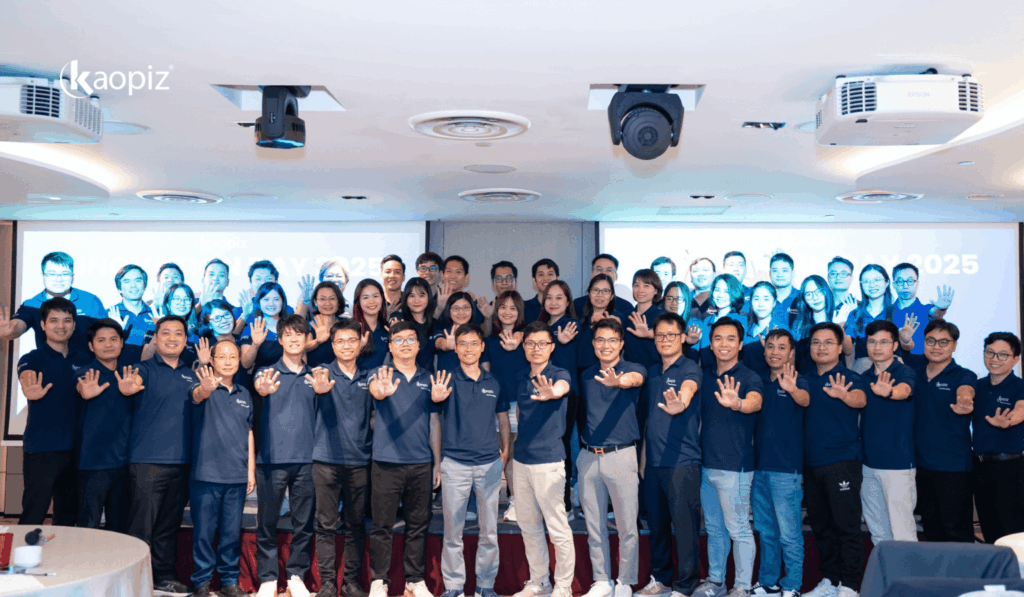
That process rests on scale and track record. Kaopiz has 1,000+ staff and has delivered 1,000+ projects for 500+ clients over 12 years, across Japan, Singapore, Hong Kong, Australia, the US and Europe. Our engineers cover web, mobile, AI, cloud and blockchain, and we work as an AWS Partner. In 2026, Kaopiz won Gold at the Globee® Awards for Technology as Company of the Year – IT Services, and joined Vietnam–Australia Tech Connect 2026 at UTS Sydney to build closer ties with Australian businesses.
“I’ve chosen Kaopiz as a partner for the core development team. I found really talented people here that allow me to really trust them with this very core piece of the engineering that we’re doing.” – Ariel Geifman, Founder of Felix AI
Planning your own ODC? Talk to us about a team structure that fits your roadmap.
Conclusion
A strong ODC team structure comes down to three layers and clear decision owners: onshore leaders who set direction, an offshore management layer that runs delivery, and cross-functional pods of 5–9 people that build the product.
For Australian companies, the 3–4 hour gap with Vietnam makes this structure easier to run, because both sides share most of the working day. Start with one pod, add roles only when the structure strains, and name owners for privacy, security and IP from day one.
FAQs
- How Many People Are in an ODC Team?
- Most ODC teams start with 5–8 people in a single pod and grow to 10–25 people within the first year. Large multi-pod centres run 25–50+ engineers. Each pod stays at 5–9 people, so the team grows by adding pods rather than enlarging existing ones.
- What Is the Ideal Developer-to-QA Ratio in an ODC?
- Plan one QA engineer for every 3–4 developers. Products with heavy compliance needs, such as fintech or healthtech, often need a tighter ratio of 1:2 or 1:3. As test automation matures, one QA engineer covers more developers without lowering release quality.
- Who Manages an ODC Team, the Client or the Vendor?
- Both, with different responsibilities. The client owns the product roadmap, priorities and final acceptance. The ODC vendor manages hiring, retention, payroll, workspace and daily people management through a delivery manager. Engineers work only on the client’s product and follow the client’s processes and tools.
- What Is the Difference Between an ODC Team and a Dedicated Development Team?
- A dedicated development team is a group of engineers assigned full-time to one client’s product. An ODC is broader: a long-term offshore centre that holds one or more dedicated teams, plus its own delivery management, QA, DevOps, security and HR support. In short, an ODC is a structured, scalable set of dedicated teams.
- What Time Zone Overlap Does a Vietnam ODC Give Australian Companies?
- Vietnam (UTC+7) is 3 hours behind AEST and 4 hours behind AEDT. A Vietnamese team working 8:30am–5:30pm shares about 5–6 working hours with Sydney and Melbourne, and around 6 hours with Brisbane all year. That window supports live standups, sprint planning and reviews.
Author

Lucie Tran
Head of Growth of Kaopiz Global
Table of Contents
Don’t miss what’s next!
Thank you! Your form has been submitted successfully.