











Time and Materials vs. Fixed-Price: Which Contract Model Is Right for You?
Choosing the right contract model can make or break your software project. When comparing time and materials vs. fixed-price, IT leaders are not just looking for definitions — they want to avoid budget overruns, scope conflicts, and delivery risks. The contract structure you choose directly affects cost predictability, flexibility, risk allocation, and the overall success of your collaboration with a development partner.
So which model is better? The answer depends on your project clarity, risk tolerance, internal resources, and product maturity. In this guide, we explain how each model works, compare their key differences, outline when each makes sense, and provide a practical decision framework to help you choose with confidence — whether you are building an MVP, scaling a digital product, or evaluating outsourcing options.
Key Takeaways:
Before diving deeper, here are the most important insights about time and materials vs. fixed-price contracts:
- Time and Materials (T&M) offers flexibility and works best for evolving or Agile projects, but requires active budget monitoring.
- Fixed-Price contracts provide cost predictability when requirements are clearly defined, but limit flexibility and can create friction during change requests.
- The core difference is not just pricing — it is who carries the risk.
- T&M shifts scope risk to the client but allows continuous optimization.
- Fixed-price shifts estimation risk to the vendor but reduces adaptability.
- Hybrid models (e.g., fixed-price discovery + T&M development) often provide the best balance.
- The right choice depends on scope stability, project complexity, internal involvement capacity, and risk appetite — not just cost.
If you are deciding between time and materials vs. fixed-price for your software outsourcing project, the following sections will guide you step by step.
Table of Contents
- What Is a Time and Materials (T&M) Contract?
- What Is a Fixed-Price Contract?
- Time and Materials vs. Fixed-Price – A Side-by-Side Comparison
- When Should You Choose Time and Materials?
- When Is Fixed-Price the Better Option?
- A Practical Decision Framework for IT Leaders
- How Kaopiz Helps You Choose the Right Engagement Model
- Conclusion
- FAQs
What Is a Time and Materials (T&M) Contract?
A Time and Materials contract is a pricing model in which the client pays for the actual time spent and resources used to complete a project. Instead of agreeing on a fixed total cost upfront, billing is based on hourly or daily rates for each team member, plus any additional expenses required to deliver the work.

In software development and IT outsourcing, this model is commonly used for projects where requirements are not fully defined at the beginning. Rather than locking the scope early, the project evolves over time. The client pays for the development effort as it progresses, making T&M a flexible and adaptive engagement model.
How Time and Materials Works in Practice
Under a T&M contract:
- Each role (developer, QA engineer, project manager, designer, etc.) has a predefined hourly or monthly rate.
- The vendor tracks time spent on tasks or sprints.
- The client is invoiced periodically (weekly or monthly) based on actual hours worked.
- Scope adjustments can be made without renegotiating the entire contract.
This model aligns particularly well with Agile development, where features are refined continuously and priorities may shift based on user feedback or business needs.
Key Advantages of Time and Materials
- Flexibility in Scope: Because there is no rigid scope lock-in, you can add, remove, or adjust features as the project evolves.
- Faster Project Start: T&M projects can begin once high-level requirements are defined, without requiring lengthy estimation and detailed specification phases.
- Better for Innovation and Uncertainty: For R&D initiatives, MVP development, or digital transformation projects, flexibility is often more valuable than cost predictability.
- Transparent Resource Allocation: Clients can see exactly how much effort is being invested and where the time is spent.
Potential Risks of Time and Materials
While T&M offers flexibility, it also requires active involvement and strong governance.
- Budget unpredictability: Costs may increase if the scope expands or progress slows.
- High client involvement: Regular sprint reviews, backlog prioritization, and oversight are necessary.
- Risk of inefficiency: Without proper tracking and performance management, projects can drift.
In short, a time and materials contract is ideal when adaptability matters more than fixed budgeting. However, it demands transparency, collaboration, and disciplined project management to ensure costs remain under control.
In the next section, we examine how fixed-price contracts differ — and why the choice between time and materials vs. fixed-price ultimately comes down to risk allocation and project clarity.
What Is a Fixed-Price Contract?
A Fixed-Price contract is a pricing model in which the total project cost is agreed upon upfront, based on a clearly defined scope of work. The vendor commits to delivering specific features, deliverables, and milestones for a predetermined price, regardless of the actual time or effort required to complete them.

In software development, this model is typically used when project requirements are stable, detailed, and unlikely to change. Before development begins, both parties align on specifications, timelines, acceptance criteria, and payment milestones. Once signed, the agreed price remains fixed unless the scope is formally modified.
How Fixed-Price Works in Practice
Under a fixed-price agreement:
- The project scope is documented in detail (often through a Statement of Work or technical specification).
- The vendor performs a comprehensive estimation phase.
- The total budget is defined upfront.
- Payments are usually tied to milestones or deliverables.
- Any changes to the scope require a formal change request and potential contract amendment.
Because the price is locked, the vendor assumes the estimation risk. If development requires more effort than expected, the vendor absorbs the additional cost.
Key Advantages of Fixed-Price Contracts
- Budget Certainty: Clients know the total cost in advance, which simplifies financial planning and internal approvals.
- Lower Financial Risk for the Client: Cost overruns caused by misestimation are typically borne by the vendor.
- Clear Deliverables and Expectations: A detailed scope reduces ambiguity around what will be delivered.
- Suitable for Procurement-Driven Environments: Enterprise organizations with strict budgeting and compliance processes often prefer fixed-price structures.
Potential Risks of Fixed-Price Contracts
Despite its predictability, fixed-price contracts have limitations:
- Limited flexibility: Adjusting scope mid-project can be slow and costly.
- Change request friction: Every modification may require renegotiation.
- Hidden cost buffers: Vendors may increase initial estimates to protect against risk.
- Reduced adaptability: Innovation and iteration can be constrained once scope is locked.
In essence, a fixed-price contract works best when project requirements are well-defined and unlikely to change. However, in fast-moving or evolving product environments, the rigidity of this model can create operational and strategic constraints.
Next, we compare time and materials vs. fixed-price side by side to clarify the key differences in risk, flexibility, and overall project impact.
Time and Materials vs. Fixed-Price – A Side-by-Side Comparison
To clearly understand the difference between time and material and fixed price, it helps to evaluate both models across the most critical decision factors: cost control, flexibility, risk allocation, and project governance.
Below is a direct comparison between fixed price model vs time and material:
| Criteria | Time and Materials (T&M) | Fixed-Price |
|---|---|---|
| Pricing Structure | Pay for actual hours and resources used | Pre-agreed total cost |
| Cost Predictability | Medium – depends on scope changes | High – fixed upfront |
| Scope Flexibility | High – changes are easy to implement | Low – changes require formal request |
| Risk Allocation | Client bears scope risk | Vendor bears estimation risk |
| Project Start Speed | Faster – can begin with high-level requirements | Slower – requires detailed scoping first |
| Change Management | Agile and continuous | Structured but rigid |
| Client Involvement | High – ongoing collaboration required | Moderate – less day-to-day involvement |
| Best For | Agile, evolving, innovative projects | Clearly defined, stable projects |
| Budget Control Approach | Active monitoring & sprint planning | Contractual agreement & milestone control |
While the table provides a quick overview, the real difference lies in how each model handles uncertainty and risk.
Cost Predictability vs. Cost Control
A fixed-price contract offers cost predictability — you know the total project cost before development begins. This is especially valuable for organizations with strict budgeting requirements or procurement processes.
In contrast, a T&M model offers cost control rather than cost certainty. While the final total is not predetermined, you gain the ability to optimize spending by adjusting scope, priorities, and team size as the project progresses.
The key question is: Do you prefer fixed numbers upfront, or financial flexibility as your product evolves?
Flexibility and Scope Management
If your requirements are stable and unlikely to change, a fixed-price model can work effectively. However, if new ideas, user feedback, or market shifts are expected, fixed contracts may create friction through change requests.
T&M contracts are inherently adaptable. You can reprioritize features, pivot strategy, or iterate rapidly without renegotiating the entire agreement. This makes them ideal for Agile environments and innovation-driven projects.
Risk Allocation – Who Carries the Uncertainty?
In fixed-price contracts, the vendor assumes the risk of inaccurate estimation. To protect themselves, vendors may include buffer costs in their pricing.
In T&M contracts, the client carries scope risk. If requirements expand or timelines extend, costs increase accordingly. However, this also allows for better transparency and shared accountability.
Ultimately, the decision between time and materials vs. fixed-price is less about price and more about who absorbs uncertainty.
Speed of Execution and Time to Market
Because fixed-price contracts require detailed documentation and estimation upfront, they often take longer to initiate.
T&M projects can begin earlier, even with high-level requirements, allowing teams to refine details during development. For startups and fast-moving markets, this speed can be a competitive advantage.
Governance and Collaboration Level
Fixed-price engagements typically require less day-to-day client involvement once the scope is finalized. The vendor focuses on delivering agreed milestones.
T&M projects demand active collaboration — sprint planning, backlog refinement, and frequent reviews. While this increases client engagement, it also enhances alignment and product quality.
When Should You Choose Time and Materials?
A Time and Materials (T&M) contract is the right choice when flexibility, adaptability, and speed are more important than having a fixed budget upfront. This model works best in environments where change is expected and innovation is part of the process.
Below are the most common scenarios where choosing T&M makes strategic sense.
When Project Requirements Are Not Fully Defined
If your project scope is still evolving, a fixed-price contract can create unnecessary friction. In early-stage projects, requirements often change as stakeholders clarify business goals, technical constraints, or user needs.
T&M allows you to:
- Start development with high-level requirements
- Refine features during sprints
- Adjust priorities without renegotiating contracts
This flexibility is especially valuable in product discovery phases and digital transformation initiatives.
When You Are Building an MVP or Testing a New Idea
Startups and innovation teams rarely have complete certainty about their final product at the beginning. Features may pivot based on user feedback, market validation, or investor input.
In such cases, T&M enables:
- Faster time to market
- Iterative improvements
- Continuous optimization based on real-world data
Rather than locking in assumptions early, you can evolve the product in controlled increments.
When You Follow Agile Development Methodology
Agile frameworks such as Scrum or Kanban emphasize continuous iteration, backlog reprioritization, and adaptive planning. A fixed-price structure may conflict with Agile’s dynamic nature.
T&M naturally aligns with Agile because:
- Work is delivered in sprints
- Scope can evolve over time
- Budget is managed through sprint capacity and burn rate tracking
If your organization already operates in an Agile mindset, T&M provides the contractual flexibility to support it.
When Speed Matters More Than Cost Certainty
If your priority is launching quickly — for example, to beat competitors or capture market opportunity — T&M can reduce time spent on lengthy estimation and documentation phases.
Since detailed scoping is not required before starting development, projects can begin earlier, with requirements refined during execution.
This can be a critical advantage in fast-moving industries.
When You Can Actively Participate in Project Governance
T&M works best when the client can:
- Attend regular sprint reviews
- Participate in backlog prioritization
- Monitor progress and budget usage
- Make timely decisions
Because costs are based on actual effort, strong collaboration and oversight are essential to maintain alignment and prevent scope drift.
When Long-Term Product Evolution Is Expected
For products that will continuously grow — such as SaaS platforms, enterprise systems, or AI-driven solutions — rigid scope definitions rarely hold over time.
T&M supports long-term partnerships by allowing:
- Feature expansion
- Continuous improvement
- Scalability planning
Instead of treating development as a one-time project, T&M enables ongoing product evolution.
When Is Fixed-Price the Better Option?
A fixed-price contract is the better choice when stability, budget certainty, and clearly defined outcomes matter more than flexibility. This model works best in structured environments where requirements are unlikely to change and financial predictability is a priority.
Below are the scenarios where fixed-price contracts provide the most value.
When Requirements Are Clearly Defined and Stable
If your project scope is well-documented, technically validated, and unlikely to evolve, a fixed-price model can work efficiently.

This typically applies to:
- Projects with detailed specifications
- System upgrades with predefined deliverables
- Regulatory or compliance-driven initiatives
When ambiguity is low, the risk of change requests is minimized — making fixed-price both practical and predictable.
When Budget Certainty Is Critical
Organizations operating under strict financial controls or annual budgeting cycles often prefer fixed-price agreements. With a predefined total cost, it becomes easier to:
- Secure executive approval
- Allocate funds internally
- Plan cash flow accurately
For procurement-driven enterprises, cost certainty may outweigh the need for flexibility.
When Internal Resources Are Limited
Fixed-price contracts typically require less day-to-day client involvement once the scope is finalized. If your internal team cannot actively participate in sprint planning, backlog refinement, or continuous oversight, fixed-price may reduce operational burden.
The vendor takes responsibility for delivering agreed milestones, allowing your team to focus on strategic priorities rather than tactical management.
When Risk Transfer Is a Priority
In fixed-price engagements, the vendor assumes the risk of underestimation. If actual development effort exceeds the estimate, the vendor absorbs the additional cost.
For clients who prefer to transfer financial risk rather than actively manage it, this model can offer peace of mind — provided that requirements are accurately defined upfront.
When Scope Changes Are Unlikely
If the project has a fixed objective, such as:
- Migrating a system to a new platform
- Rebuilding an existing application with identical functionality
- Delivering a well-scoped feature set
Then the rigidity of fixed-price contracts becomes an advantage rather than a limitation.
When Procurement or Compliance Processes Require It
In enterprise environments — especially in finance, healthcare, or government sectors — procurement policies may mandate fixed budgets and detailed contractual commitments.
In such cases, fixed-price contracts align better with internal governance, audit requirements, and vendor management procedures.
A Practical Decision Framework for IT Leaders
Choosing between time and materials vs. fixed-price is not just a budgeting decision — it is a strategic risk decision. The right model depends on how stable your requirements are, how much uncertainty you can tolerate, and how actively your team can participate in project governance.
Instead of asking “Which model is better?”, IT leaders should ask: Which model aligns with our project maturity, risk appetite, and internal capability?
Below is a practical framework to guide your decision.
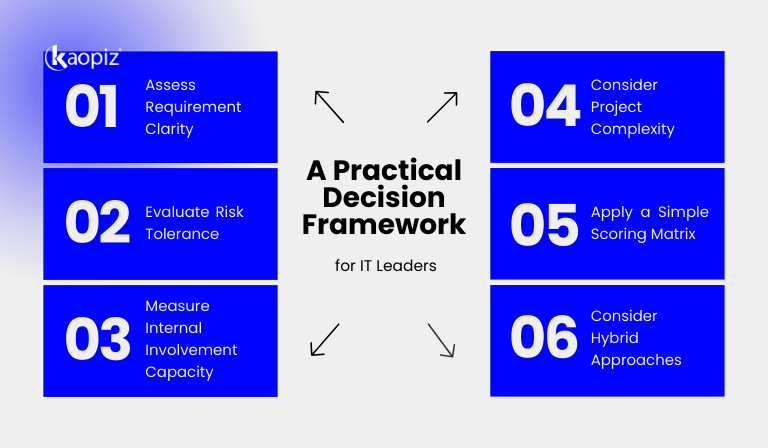
Step 1 – Assess Requirement Clarity
Start by evaluating how well-defined your project scope is.
Ask yourself:
- Are business requirements documented in detail?
- Have technical constraints been validated?
- Are integrations and dependencies clearly mapped?
- Is stakeholder alignment already achieved?
If the answer is “yes” to most of these, a fixed-price contract may be feasible. If requirements are still evolving or partially defined, T&M is usually safer.
Rule of thumb: The more uncertainty in scope, the stronger the case for T&M.
Step 2 – Evaluate Risk Tolerance
Every contract model distributes risk differently.
- Fixed-price → Vendor carries estimation risk
- T&M → Client carries scope and duration risk
Consider:
- Can your organization absorb potential scope expansion?
- Is budget variance acceptable within a controlled range?
- Do you prefer predictable cost or adaptable execution?
If cost predictability is non-negotiable, fixed-price offers financial stability. If flexibility and optimization matter more, T&M provides strategic control.
Step 3 – Measure Internal Involvement Capacity
T&M requires active collaboration. Fixed-price requires strong upfront specification.
Ask:
- Can your team attend regular sprint reviews?
- Do you have a product owner or decision-maker available?
- Can stakeholders provide timely feedback?
If your organization can actively participate in governance and Agile ceremonies, T&M can maximize value.
If internal bandwidth is limited, fixed-price may reduce operational overhead.
Step 4 – Consider Project Complexity and Innovation Level
Projects involving innovation, AI integration, R&D, or new product development often contain unknown variables.
In such environments:
- Assumptions may change
- User feedback may reshape features
- Technical challenges may emerge unexpectedly
T&M supports this adaptive process.
Conversely, straightforward migrations, feature replication, or regulatory implementations typically fit fixed-price better.
Step 5 – Apply a Simple Scoring Matrix
You can simplify the decision using a quick evaluation:
| Evaluation Factor | Lean Toward T&M | Lean Toward Fixed-Price |
|---|---|---|
| Scope clarity | Low | High |
| Change frequency | Frequent | Rare |
| Innovation level | High | Low |
| Budget flexibility | Moderate | Strict |
| Internal involvement | Active | Limited |
If most factors fall in the left column → Time and Materials is likely the better fit. If most factors fall in the right column → Fixed-Price may be more appropriate.
Step 6 – Consider Hybrid Approaches
In reality, many successful software projects combine both models.
For example:
- Fixed-price for discovery and requirement definition
- T&M for iterative development
- Milestone-based structure with capped T&M budget
This hybrid strategy balances cost control with flexibility and often reduces overall risk exposure.
How Kaopiz Helps You Choose the Right Engagement Model
Selecting between fixed price vs time and material is not just about pricing — it is about aligning risk, flexibility, governance, and long-term business goals. At Kaopiz, we do not push a single contract structure. Instead, we help clients evaluate their project maturity, budget constraints, and operational capacity before recommending the most suitable engagement model.
With over 12 years of experience and 1,000+ successfully delivered projects across Singapore, Japan, the US, and other global markets, we have worked with startups, scale-ups, and enterprises under both T&M and fixed-price structures. This practical experience allows us to advise based on real-world outcomes — not theoretical assumptions.
A Structured Assessment Before Contracting
Before proposing a model, our solution architects conduct a structured evaluation that covers:
- Scope clarity and requirement maturity
- Technical complexity and integration risks
- Timeline sensitivity
- Internal stakeholder availability
- Budget flexibility and financial governance
This ensures the chosen engagement model supports both delivery efficiency and financial control.
Flexible Engagement Options
Kaopiz offers multiple engagement models to match different project needs:
- Time and Materials for Agile, evolving, or innovation-driven initiatives
- Fixed-Price for well-defined, stable projects
- Dedicated Development Teams for long-term product scaling
- Hybrid Models that combine cost control with flexibility
Rather than forcing a rigid structure, we tailor the model to the project stage and risk profile.
Governance and Transparency to Reduce Risk
Regardless of the contract model, we implement strong governance practices to maintain transparency and accountability:
- Clear sprint planning and backlog management
- Regular progress reporting and budget tracking
- Defined acceptance criteria and milestone reviews
- ISO 27001-aligned security and compliance standards
For T&M engagements, we help clients control burn rate through structured sprint reviews. For fixed-price projects, we mitigate estimation risk through detailed discovery and technical validation phases.
Strategic Partnership, Not Just Project Delivery
Our goal is not simply to deliver software — it is to build sustainable, long-term partnerships. Many clients begin with one model and evolve into another as their product matures. Because we understand both structures deeply, we can support that transition seamlessly.
If you are evaluating time and materials vs. fixed-price for your next software project, our team can help you assess risks, compare options, and design a contract structure that aligns with your strategic objectives.
Book a free consultation with our solution architects to explore the right engagement model for your project.
Conclusion
There is no one-size-fits-all answer to time and materials vs. fixed-price. The right model depends on your project clarity, risk tolerance, budget constraints, and internal involvement capacity.
Choose Time and Materials if flexibility, speed, and adaptability are critical. Choose Fixed-Price if requirements are stable and cost predictability is your top priority. Ultimately, the best decision is the one that aligns your contract structure with your project’s level of uncertainty and long-term business goals.
If you are unsure which model fits your software initiative, consulting with experienced solution architects can help you minimize risk and move forward with confidence.
FAQs
- Is Time and Materials More Expensive Than Fixed-price?
- Not necessarily. T&M can be more cost-efficient when scope changes are expected. Fixed-price contracts often include risk buffers in the initial quote. The real cost difference depends on scope clarity, change frequency, and governance quality.
- Which Contract Model Is Better for Agile Development?
-
Time and Materials is generally better suited for Agile development. Agile methodologies rely on iterative delivery, evolving requirements, and continuous backlog refinement. T&M naturally supports this flexibility because it allows scope adjustments without renegotiating the contract.
Fixed-price can work in Agile environments only if the scope is well-defined upfront or if a hybrid model is used (for example, fixed-price discovery followed by T&M development). - Who Bears the Risk in Each Model?
- In fixed-price contracts, the vendor bears estimation risk. In T&M contracts, the client carries scope and duration risk. The key difference lies in how uncertainty is distributed.
- Can a Fixed-price Contract Change During the Project?
-
Yes, but changes require a formal change request process. Any modification to scope, timeline, or deliverables typically results in contract amendments and potential cost adjustments.
While possible, frequent changes in fixed-price projects can slow down delivery and create negotiation friction. That is why fixed-price works best when requirements are stable and unlikely to evolve. - How Do I Prevent Budget Overruns in a T&M Contract?
-
Budget overruns in T&M projects can be controlled with proper governance and transparency. Best practices include:
- Setting a clear project roadmap and prioritized backlog
- Establishing sprint-level budget tracking
- Agreeing on a monthly budget cap if needed
- Conducting regular progress reviews
- Using transparent time-tracking and reporting tools
Trending Post



No Comments yet!