


Waterfall Model Explained: Is It Still a Viable Choice for Businesses?
Despite the growing popularity of Agile methodologies, the Waterfall model remains relevant in many software projects today—particularly in structured, compliance-driven environments like Singapore. Known for its linear, sequential approach, Waterfall emphasizes upfront planning, clear documentation, and predictable delivery.
For organizations working with fixed requirements, regulated industries, or enterprise systems, the real question is not whether Waterfall is outdated, but when it is still the right choice. This article explains how the Waterfall model works, its key phases, advantages and limitations, and how Singapore businesses can apply it effectively in modern software development.
Table of Contents
- What Is the Waterfall Model?
- 5 Key Phases of the Waterfall Model
- Advantages and Disadvantages of the Waterfall Model
- Is Waterfall Still Relevant in Modern Software Development?
- Who Should Consider the Waterfall Model?
- Waterfall vs. Agile: Which is Right for Your Next Project?
- When Should You Use the Waterfall Model? (Singapore Context)
- How Kaopiz Modernizes the Waterfall Approach for Maximum Efficiency
- Conclusion
- FAQs
What Is the Waterfall Model?
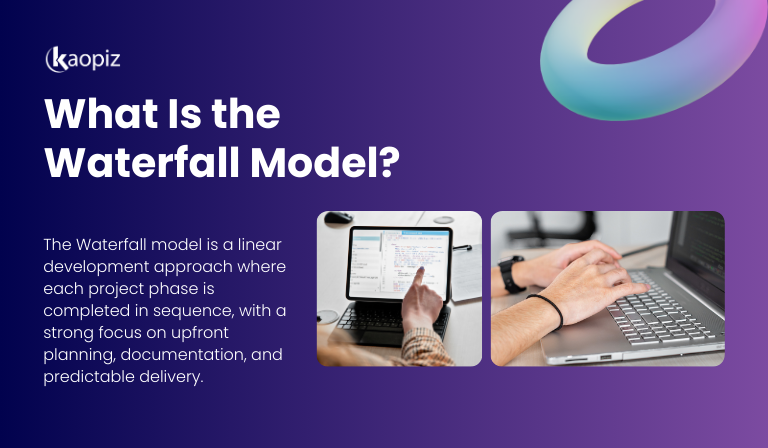
The Waterfall model is a traditional software development methodology that follows a linear, sequential process. In this approach, a project is divided into clearly defined phases, such as requirements analysis, design, implementation, testing, and deployment. Each phase must be completed and approved before the next one begins. Once a phase is finished, teams typically do not return to it, which is why the model is often described as “one-way” or “top-down.”
At its core, software development life cycle waterfall model is built around upfront planning and documentation. Project requirements are gathered in detail at the beginning, timelines and budgets are defined early, and deliverables are clearly specified. This makes the model highly structured and predictable compared to iterative or Agile approaches.
Historically, Waterfall was one of the earliest formalized SDLC models. It was widely adopted in enterprise software, manufacturing, and government projects. Today, it is still used when requirements are stable, changes are costly, and strong governance or compliance is required.
Rather than prioritizing rapid iteration, the Waterfall model prioritizes control, traceability, and clarity. Qualities that can be critical for certain types of projects and organizations.
5 Key Phases of the Waterfall Model
The Waterfall model project management is structured around a series of clearly defined phases, each with specific objectives and deliverables. Understanding these Waterfall model phases is essential to see how it ensures control, predictability, and traceability throughout the project lifecycle.
Phase 1: Requirements Analysis
The Requirements Analysis phase establishes the foundation of the Waterfall model. During this stage, all business, functional, and technical requirements are gathered, analyzed, and documented in detail before development begins.
Requirements are typically reviewed and formally approved by stakeholders, creating a fixed baseline for the project. Because later changes are costly, this phase ensures clarity, alignment, and predictable outcomes, especially in fixed-scope or regulated projects.
Phase 2: System & Software Design
In the System & Software Design phase, the approved requirements are translated into a detailed technical blueprint for the solution. This stage defines how the system will be built, including overall architecture, data structures, system components, and technology choices.
Design activities typically include high-level system architecture design as well as detailed software design specifications that guide development teams. Key decisions on architecture, data, security, and integrations are finalized to reduce implementation risk.
Because the Waterfall model relies on limited change once development begins, a thorough and well-documented design is essential. A strong design phase helps reduce technical risk and ensures alignment between stakeholders and developers. It enables smoother execution in the subsequent implementation phase.
Phase 3: Implementation
The Implementation phase is where the system is built according to the approved design specifications. Development teams begin coding the application, configuring system components, and integrating modules based strictly on the predefined architecture and requirements.
In the Waterfall model, implementation follows a structured and controlled process, with minimal changes to scope or design. Progress is measured against planned milestones, and development activities focus on delivering functionality exactly as specified. This approach supports predictability but also means that any requirement changes at this stage can be time-consuming and costly.
Successful implementation depends on strong requirements and design, highlighting the importance of upfront planning.
Phase 4: Testing & Verification
The Testing & Verification phase begins after implementation is complete and focuses on ensuring the system meets the approved requirements and design specifications. During this stage, the software is systematically tested to identify defects, validate functionality, and confirm that all components work together as intended.
Testing activities typically include functional testing, system testing, integration testing, and user acceptance testing (UAT). Because testing occurs later in the Waterfall lifecycle, issues discovered at this stage can be more expensive to fix, especially if they require changes to previously completed phases.
This phase plays a critical role in quality assurance, providing formal validation before deployment and helping organizations reduce operational risk—particularly in projects where reliability, compliance, and stability are essential.
Phase 5: Deployment & Maintenance
This phase marks the transition of the system from development into a live production environment. During deployment, the software is released to end users, data is migrated if required, and operational procedures are put in place to support ongoing use.
Once live, the system enters the maintenance stage, where it is monitored, supported, and updated to address defects, performance issues, or minor enhancements. In the Waterfall model, maintenance changes are typically handled through formal change requests, as the core development phases have already been completed.
This structured approach reinforces stability and control, making the Deployment & Maintenance phase particularly important for enterprise and regulated projects where system reliability and long-term support are critical.
Advantages and Disadvantages of the Waterfall Model
Understanding the strengths and limitations of the Waterfall model is essential when deciding whether it fits a specific project. While its structured approach offers clarity and predictability, it also introduces constraints that may not suit every development scenario.
Advantages of the Waterfall Model
The Waterfall model is known for providing clarity and control in predictable project environments.
- Clear structure and defined phases: Each stage has specific objectives, deliverables, and approval points, making the project easier to plan and manage from the outset.
- Predictable timeline and budget: Because requirements are finalized early, teams can estimate costs and schedules more accurately, reducing uncertainty for stakeholders.
- Strong documentation: Comprehensive documentation supports compliance, auditing, onboarding, and long-term maintenance—critical for enterprise and regulated projects.
- Easier governance and control: The sequential workflow simplifies progress tracking, formal reviews, and stakeholder sign-off at each milestone.
These strengths make Waterfall particularly effective for projects that prioritize stability, accountability, and upfront planning.
Disadvantages of the Waterfall Model
Despite its benefits, the Waterfall model also introduces constraints that can create challenges in more dynamic environments.
- Low flexibility to change: Once a phase is completed, revisiting it is difficult and often costly, limiting the ability to adapt to new requirements.
- Late user feedback: Users typically interact with the system near the end of the project, increasing the risk of discovering misalignment too late.
- Higher cost of changes: Issues identified during testing or deployment may require rework across earlier phases, impacting both timeline and budget.
- Not ideal for evolving requirements: Projects with unclear goals or rapidly changing business needs may struggle under the rigid structure of Waterfall.
Because of these limitations, Waterfall works best when requirements are stable and clearly defined from the start.
Is Waterfall Still Relevant in Modern Software Development?
Despite the widespread adoption of Agile and iterative methodologies, the Waterfall model has not disappeared from modern software development methods. Instead, its role has become more context-specific, serving projects where structure, predictability, and control are critical.

Waterfall remains relevant in environments with stable requirements, fixed budgets, and strict governance or compliance needs. Finance, healthcare, government, and large enterprises require documentation and audit trails, where Waterfall performs well.
At the same time, modern development practices have highlighted Waterfall’s limitations in handling change and rapid feedback. As a result, many organizations no longer apply it in a purely rigid form. Instead, they adapt the model by combining structured upfront planning with more flexible execution and testing practices.
Today, Waterfall is less about rigid process and more about choosing the right delivery strategy. When applied thoughtfully or combined with hybrid approaches, it remains an effective framework for reliable software delivery.
Who Should Consider the Waterfall Model?
The Waterfall model is best suited for organizations and projects where requirements are clear, changes are limited, and predictability is a priority. It is not designed for every situation, but it can be highly effective in the right contexts.
Organizations and project types that should consider the Waterfall model include:
- Enterprises and large organizations: These organizations often require structured planning, formal approvals, and detailed documentation to support governance and cross-team coordination.
- Regulated industries: Sectors such as finance, healthcare, and government benefit from Waterfall’s strong emphasis on documentation, traceability, and audit readiness.
- Fixed-scope and fixed-budget projects: When deliverables, timelines, and costs must be defined upfront—such as in procurement or tender-based projects—Waterfall provides predictability and control.
- Vendor-led or offshore development engagements: Clear specifications and predefined milestones help reduce ambiguity and execution risk when working with external development teams.
- Projects with stable and well-understood requirements: When business needs are unlikely to change significantly, Waterfall supports efficient execution without frequent rework.
For these scenarios, the Waterfall model offers a reliable framework for delivering software with clarity, accountability, and minimal uncertainty.
Waterfall vs. Agile: Which Is Right for Your Next Project?
Choosing between Waterfall and Agile depends on which approach best fits your project context. Both models are designed to solve different problems and manage different types of risk.
The table below highlights the key differences to help guide your decision:
| Aspect | Waterfall Model | Agile Methodology |
|---|---|---|
| Project structure | Linear and sequential phases | Iterative and incremental cycles |
| Requirements | Defined and fixed upfront | Evolve throughout the project |
| Flexibility | Low; changes are costly | High; changes are expected |
| Delivery | Working software delivered near the end | Frequent, incremental releases |
| User involvement | Limited after requirements phase | Continuous collaboration |
| Documentation | Extensive and detailed | Lightweight and adaptive |
| Risk handling | Risks addressed early through planning | Risks reduced through iteration |
| Best suited for | Stable, well-defined, regulated projects | Dynamic, fast-changing projects |
In practice, the decision should be based on requirement stability, compliance needs, timeline constraints, and stakeholder availability. Waterfall suits projects needing predictability and governance, while Agile fits those requiring flexibility and rapid change.
In some cases, combining elements of both—using Waterfall for upfront planning and Agile for execution—can deliver the best results.
When Should You Use the Waterfall Model? (Singapore Context)
In Singapore’s technology landscape, project success is often driven by governance, compliance, and delivery certainty rather than speed alone. This makes the Waterfall model a practical choice in specific scenarios where structure and predictability outweigh the need for rapid iteration.
You should consider the Waterfall model when:
- Operating in regulated industries: Sectors such as finance, healthcare, insurance, and GovTech in Singapore require strong documentation, traceability, and audit readiness. Waterfall’s documentation-driven approach aligns well with regulatory reviews and compliance standards.
- Managing fixed-scope, fixed-budget projects: Many enterprise and procurement-based projects in Singapore require clear scope definition, upfront cost estimates, and strict timeline commitments. Waterfall supports this by locking requirements early and minimizing uncertainty.
- Delivering enterprise or legacy system implementations: Large-scale systems such as core platforms, internal business applications, or system replacements often have well-defined requirements and dependencies, making a sequential approach more effective.
- Working with vendor-led or offshore development teams: When collaborating with external vendors or offshore teams, clear specifications and milestone-based delivery reduce miscommunication and execution risk—an area where Waterfall performs well.
- Prioritizing governance and stakeholder alignment: Projects involving multiple stakeholders, formal approval processes, or executive oversight benefit from Waterfall’s structured checkpoints and sign-off stages.
In these contexts, the Waterfall model provides the control, clarity, and accountability that many Singapore organizations need. When applied thoughtfully—or combined with modern execution practices—it remains a reliable framework for delivering complex software projects.
How Kaopiz Modernizes the Waterfall Approach for Maximum Efficiency
At Kaopiz, we recognize that the Waterfall model provides structure and predictability. However, applying it too rigidly in today’s software environment can reduce efficiency and limit responsiveness. That’s why we focus on modernizing the Waterfall approach—retaining its strengths while addressing its traditional limitations.
Instead of treating Waterfall as a one-size-fits-all methodology, Kaopiz – a trusted software development company, begins with a delivery model assessment, evaluating project scope, regulatory requirements, risk profile, and stakeholder expectations. This allows us to design a tailored Waterfall or hybrid framework that fits the client’s business context, particularly for enterprise and Singapore-based projects.
Key ways Kaopiz enhances the Waterfall model include:
- Stronger upfront discovery with practical validation: We refine requirements through structured workshops and early technical validation to reduce ambiguity before design is finalized.
- Design-driven risk reduction: Architecture and system design are reviewed with scalability, security, and long-term maintenance in mind, minimizing downstream rework.
- Structured execution with controlled flexibility: While maintaining phase discipline, we introduce controlled feedback loops within implementation and testing to surface issues earlier.
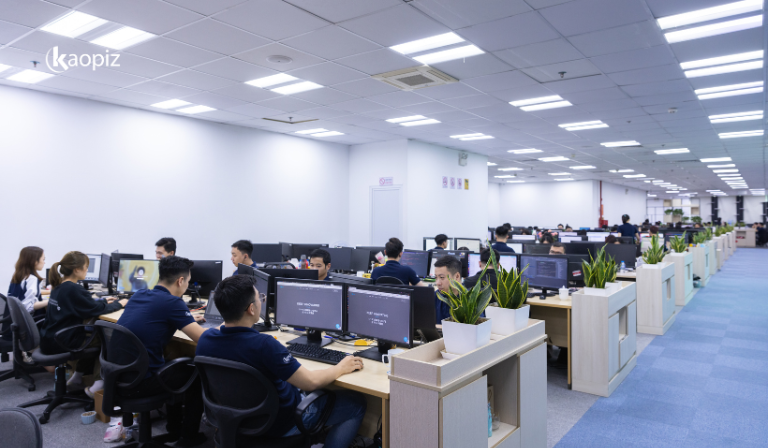
- Enterprise-ready documentation and governance: Our team of 700+ professionals delivers documentation aligned with compliance, audit, and procurement standards commonly required in Singapore.
With over 11 years of global delivery experience, Kaopiz supports Waterfall, Agile, and hybrid models. Clients are guided toward the most efficient and low-risk delivery strategy, not locked into a single methodology.
Kaopiz helps organizations modernize the Waterfall model to deliver predictable, high-quality results.
Conclusion
The Waterfall model may no longer dominate modern software development, but it remains effective when used in the right context. For projects with stable requirements, fixed budgets, and strong governance—common among Singapore enterprises and regulated industries—it provides clarity, structure, and predictable outcomes.
Rather than viewing Waterfall as outdated, organizations should evaluate it as part of a broader delivery strategy, considering project constraints, risk tolerance, and compliance requirements. When modernized through thoughtful planning and controlled flexibility, the Waterfall model can still deliver reliable outcomes in today’s software landscape.
FAQs
- Is Waterfall Outdated?
-
No. While Agile and iterative approaches are more common today, the Waterfall model is not outdated. It remains relevant for projects with stable requirements, fixed scope, and strong governance needs, where predictability and documentation are critical. - Is Waterfall Suitable for Startups?
-
Usually, not ideal for early-stage startups.
Requirements often change quickly. However, Waterfall can work for startups delivering well-defined products, regulated solutions, or contract-based projects with fixed deliverables. - Why Waterfall Still Matters in Singapore’s Tech Landscape?
-
Singapore’s tech environment emphasizes compliance, procurement standards, and enterprise governance.
For regulated industries, government-related projects, and large organizations, Waterfall provides the structure, traceability, and control needed to meet these expectations. - Can Waterfall and Agile Be Combined?
- Yes. Many teams use a hybrid approach: Waterfall for upfront planning, requirements, and design, then Agile practices during development and testing for flexibility and earlier feedback.
- Why Is Waterfall Still Used in Regulated Industries?
-
Regulated industries need detailed documentation, formal approvals, and clear audit trails.
Waterfall supports this by enforcing structured phases, comprehensive documentation, and controlled change management throughout the project lifecycle.
Trending Post




No Comments yet!