
AI Development Cost in Singapore: What to Budget in 2026
AI development in Singapore can cost anywhere from S$8,000 for a basic chatbot to over S$600,000 for an enterprise AI platform, a gap wide enough to make budgeting feel impossible without the right benchmarks. Yet most businesses entering their first AI project have no reliable way to estimate what their specific build will cost, or where the budget surprises are likely to come from.
This guide breaks down AI development cost in Singapore from every angle: by solution type, by project phase, by delivery model, and by the factors that most consistently push budgets off course. The goal is not to give you a single number; it is to give you the framework to evaluate any number a vendor puts in front of you.
Key Takeaways
- AI development costs range from S$8,000 for a basic chatbot to S$600,000+ for an enterprise AI platform, solution type, data readiness, and compliance requirements determine where your project lands
- Data engineering is the most consistently underestimated cost, accounting for 30–40% of total project budget across all solution types
- Hidden costs, inference fees, model retraining, compliance updates, and change management, add 30–50% to build cost over the first two years of operation
- Singapore government grants such as the EDG can cover up to 50% of qualifying AI development costs, effectively halving the net investment for eligible SMEs
- The hybrid delivery model, Singapore-side oversight with offshore engineering execution, remains the most cost-efficient structure for the majority of Singapore AI projects in 2026
How Much Does AI Development Cost in Singapore?
AI development cost in Singapore ranges from S$8,000 for a basic chatbot to over S$600,000 for an enterprise platform. The three sections below break down what drives that range, by solution type, by project phase, and by the location of your delivery team.
AI Development Cost Breakdown by Solution Type
Before diving into numbers, one context point matters: organizations in Singapore report spending an average of S$18.9 million per AI initiative in 2025, yet only 23% say those investments have delivered expected returns. The gap between spend and outcome often traces back to a single root cause: businesses commit budgets before understanding what type of AI system they actually need to build.
The 6 solution types below cover the most common AI projects Singapore businesses invest in. AI development cost in Singapore ranges reflect 2026 market benchmarks compiled from Singapore-based vendors and Kaopiz’s project experience delivering AI systems for clients in Singapore, Japan, and the broader Asia-Pacific region.
AI development costs in Singapore range from S$8,000 for a basic chatbot to over S$600,000 for an enterprise AI platform. The right budget depends entirely on the type of system you are building, not just the size of your project.
| Solution Type | Estimated Cost (SGD) | Typical Timeline |
|---|---|---|
| AI Chatbot / Virtual Assistant | S$8,000 – S$60,000 | 4 – 10 weeks |
| RAG / Document Intelligence System | S$30,000 – S$80,000 | 6 – 14 weeks |
| AI-Powered Web or Mobile App | S$40,000 – S$120,000 | 8 – 20 weeks |
| Agentic AI / Workflow Automation | S$50,000 – S$180,000 | 10 – 24 weeks |
| Custom Machine Learning Model | S$80,000 – S$300,000+ | 4 – 12 months |
| Enterprise AI Platform | S$200,000 – S$600,000+ | 6 – 18 months |
AI Chatbot / Virtual Assistant: S$8,000 to S$60,000
The AI development price gap reflects a difference in capability, not just scale. At the lower end, you are validating a concept with a rule-based bot. At the upper end, you are running a generative AI assistant embedded into customer operations. One cost unique to Singapore: adding Malay or Tamil language support requires additional model training and native speaker testing.
- S$8,000 – S$25,000 (4 – 6 weeks): Fixed script flows, website widget, basic WhatsApp integration.
- S$30,000 – S$60,000 (6 – 10 weeks): Custom conversation flows, multi-channel deployment, CRM integration, responses fine-tuned on your business data.
RAG / Document Intelligence System: S$30,000 to S$80,000
RAG systems let staff or customers query internal document libraries in natural language and receive source-cited answers without data leaving your environment. Cost is driven by the number of sources and your industry’s compliance requirements.
- S$30,000 – S$45,000 (6 – 8 weeks): Single document source, basic semantic search, simple chat interface.
- S$55,000 – S$80,000 (10 – 14 weeks): Multi-source ingestion, hybrid search, citation tracking, audit logging for MAS and PDPA compliance.
AI-Powered Web or Mobile App: S$40,000 to S$120,000
This covers applications where AI is a core product feature, not a bolt-on. Gartner found that at least 30% of generative AI projects were abandoned after proof of concept due to poor data quality and unclear business value. A tight scope definition before development starts is critical.
- S$40,000 – S$60,000 (8 – 12 weeks): Single AI feature, one platform.
- S$70,000 – S$120,000 (14 – 20 weeks): Multiple AI capabilities, cross-platform, real-time inference, user personalization.
Agentic AI / Workflow Automation: S$50,000 to S$180,000
Agentic AI executes multi-step tasks without human intervention at each step. It is the fastest-growing category among Singapore businesses in logistics, finance, and manufacturing, where ROI is direct and measurable.
- S$50,000 – S$80,000 (10 – 16 weeks): Single automated workflow, 3 – 5 enterprise tool integrations.
- S$100,000 – S$180,000 (16 – 24 weeks): Multi-agent coordination, shared state management, exception handling, monitoring dashboard.
Custom Machine Learning Model: S$80,000 to S$300,000+
Custom ML covers prediction engines, computer vision, fraud detection, and recommendation systems. The key cost decision is fine-tuning a pre-trained foundation model versus training from scratch. As IBM notes, if training costs cannot justify the business case, the anticipated impact will not materialize. For most Singapore SMEs, fine-tuning delivers 80 – 90% of the accuracy at a fraction of the cost.
- S$80,000 – S$150,000 (4 – 6 months): Fine-tuned foundation model on your internal dataset, MLOps monitoring.
- S$180,000 – S$300,000+ (6 – 12 months): Ground-up model, full data engineering pipeline, dedicated inference infrastructure.
Enterprise AI Platform: S$200,000 to S$600,000+
Full-stack AI infrastructure for organizations building an AI-first SaaS product or standardizing AI capability across departments. IBM IBV found 70% of executives cite generative AI as a primary driver of rising computing costs — phased delivery is the standard approach to managing budget risk at this scale.
- Multi-tenant architecture, role-based access, parallel AI models, production-grade data pipelines.
- Enterprise security and a compliance layer covering PDPA, MAS, and MOH requirements.
- Timeline: 6 – 18 months, delivered in phases with each phase validated before the next begins.
Ongoing costs: Plan for 15 – 25% of your initial build cost annually, covering API inference fees, model retraining every 3 – 6 months, and security maintenance.
AI Development Cost Breakdown by Project Phase
Most AI software development costs in Singapore are built around a single number. The reality is that an AI project runs across 5 distinct phases, each with its own cost weight.
Within a typical AI project cost structure, data preparation accounts for 30–40%, model development 20–25%, integration and deployment 15–20%, and ongoing operations 15–20%, most enterprises severely underestimate the share of data preparation and operations, which is the primary cause of budget overruns.
Understanding AI development cost in Singapore and where money goes at each phase, before you commit to a total budget, is the most reliable way to avoid mid-project surprises.
| Phase | Cost Share | SGD Equivalent* |
|---|---|---|
| Discovery & Scoping | 5–10% | S$4,000 – S$30,000 |
| Data Engineering | 30–40% | S$24,000 – S$120,000 |
| Model Development | 20–25% | S$16,000 – S$75,000 |
| Integration & Testing | 15–20% | S$12,000 – S$60,000 |
| Deployment & MLOps | 10–15% | S$8,000 – S$45,000 |
| Ongoing Operations | 15–25% / year | S$12,000 – S$75,000 / year |
*SGD ranges are calculated against a total project budget of S$80,000 – S$300,000, covering the most common AI project types in Singapore. Simpler projects (chatbot at S$8,000–S$25,000) will see proportionally smaller absolute figures per phase.
Phase 1: Discovery and Scoping — 5–10% (~S$4,000–S$30,000)
Discovery is the most underfunded phase in AI projects, and the most consequential. This is where the problem is defined, data is audited for readiness, the right technology approach is selected, and the project scope is locked.
Most businesses skip or underfund this phase, and that is the single most common reason AI projects balloon in cost midway through development. A well-executed discovery phase typically pays for itself three to five times over by preventing expensive course corrections during the build.
- Business case validation and feasibility analysis
- Data readiness audit, identifying gaps, quality issues, and governance constraints
- Technology selection and architecture scoping
- Timeline and budget framing before any development begins
Phase 2: Data Engineering — 30–40% (~S$24,000–S$120,000)
Data engineering is where most AI development cost in Singapore are surprised. Data preparation, cleaning, structuring, labelling, and engineering features, can consume 15–45% of total project budget and delay timelines by one to three months. Raw enterprise data is almost never AI-ready: it sits across siloed systems, arrives in inconsistent formats, and is often subject to governance policies that restrict how it can be used.
- Data collection from internal systems, APIs, and third-party sources
- Cleaning, deduplication, and formatting for model consumption
- Labelling for supervised learning tasks
- Pipeline engineering for continuous data ingestion post-launch
Phase 3: Model Development — 20–25% (~S$16,000–S$75,000)
This is the phase most people picture when they think about AI development cost in Singapore, but it is rarely the highest cost. Model development covers selecting or fine-tuning a foundation model, prompt engineering, accuracy testing, and iteration against performance benchmarks.
- Foundation model selection (pre-trained API vs. open-source vs. custom)
- Fine-tuning on your labelled internal dataset
- Prompt engineering and response optimization
- Accuracy benchmarking against defined business thresholds
Phase 4: Integration and Testing — 15–20% (~S$12,000–S$60,000)
An AI model in isolation delivers no business value. Integration connects the model to your existing systems, CRMs, ERPs, internal databases, customer-facing interfaces, and testing validates that it performs reliably under real operational conditions. Complex enterprise integrations add $40,000–$150,000 to project cost and introduce unpredictable timelines depending on API documentation quality and system maturity.
- API development connecting the AI system to existing tools
- User acceptance testing with real-world inputs and edge cases
- Security review and data flow validation under PDPA requirements
- Performance and load testing before production launch
Phase 5: Deployment and MLOps — 10–15% (~S$8,000–S$45,000)
Deployment is not a one-time event. A production AI system requires infrastructure for continuous monitoring, automated retraining triggers, and rollback capability when model performance degrades.
- CI/CD pipeline setup for model versioning and updates
- Real-time monitoring for output quality, latency, and data drift
- Automated alerting when performance falls below defined thresholds
- Retraining framework triggered by data drift or scheduled refresh cycles
Phase 6: Ongoing Operations — 15–25% of build cost per year (~S$12,000–S$75,000/year)
Models degrade as real-world data drifts from training data. Budget 15–25% of your initial development cost annually for ongoing monitoring, retraining, and updates, or risk a system that works brilliantly at launch and quietly deteriorates over the following 12 months.
- API inference fees scaling with query volume
- Periodic model retraining every 3–6 months as business data evolves
- Security patching and dependency updates
- Compliance reviews as Singapore’s PDPA and MAS guidelines are updated
AI Developer Hourly Rates by Location
Team location is the single biggest multiplier on your total AI development budget. The same project scoped at S$100,000 with a Singapore-based team could cost S$40,000–S$60,000 with an offshore team in Vietnam, for the same technical output.
Singapore AI engineers typically charge between S$95 and S$250/hour, reflecting the country’s position as a premier AI hub with high talent costs driven by demand that has significantly outpaced the local supply.
| Location | Hourly Rate (USD) | Hourly Rate (SGD approx.) | Best For |
|---|---|---|---|
| Singapore | $70 – $185 | S$95 – S$250 | Team leads, architects, compliance-heavy roles |
| Australia / UK | $80 – $180 | S$110 – S$245 | Western market compliance, English-first teams |
| Vietnam | $25 – $60 | S$34 – S$81 | Full-stack AI delivery, strong Python/ML talent |
| Philippines | $25 – $85 | S$34 – S$115 | English-heavy roles, customer-facing AI products |
| India | $15 – $70 | S$20 – S$95 | Data engineering, ML infrastructure, large talent pool |
*Rates reflect 2026 market benchmarks for mid-to-senior AI engineers. Sources: Second Talent 2026 Rate Card
The rate gap between Singapore and Vietnam is not simply a reflection of quality, it reflects labor market costs, office overhead, and CPF contributions that Singapore-based teams carry. A Singapore-based AI architect leading a team of four AI developers in Vietnam and the Philippines costs roughly S$340,000/year in total, compared to over S$950,000 for a comparable all-US team delivering the same output.
For Singapore businesses, this makes the hybrid delivery model, a Singapore-side account manager or architect handling client communication, compliance, and oversight, with offshore engineers executing the build, the most cost-efficient structure for the majority of AI projects.
For any engagement longer than 12 weeks, the Southeast Asia full-time route wins on every unit-cost metric without quality trade-off for standard applied AI work.
Singapore Local Agency vs. Offshore Development: Which Is Right for You?
Singapore recorded an AI adoption rate of 61% in H2 2025, the highest in Asia-Pacific, yet 71% of employers reported difficulty hiring skilled AI talent, with AI model development topping the list of hardest-to-find skills. The talent shortage is structural, which is why local-only AI development is expensive, and most Singapore businesses in 2026 are working with offshore or hybrid teams.
| Singapore Local Agency | Offshore (e.g. Vietnam) | Hybrid Model | |
|---|---|---|---|
| Hourly rate | S$95 – S$250 | S$34 – S$81 | S$55 – S$100 blended |
| PDPA / MAS compliance | Native familiarity | Needs client oversight | SG lead handles compliance |
| Communication | Same timezone, face-to-face | Async, time zone gap | SG account manager + offshore team |
| Best for | Regulated, sensitive data projects | Well-scoped, budget-sensitive builds | Most Singapore AI projects |
A simple rule of thumb:
- Below S$50,000, well-scoped: Partner with AI outsourcing companies is the most cost-efficient path.
- S$50,000 – S$300,000: Hybrid model balances cost and oversight.
- Above S$300,000 or MAS/MOH-regulated: Local compliance lead is non-negotiable, though the build can still run offshore under the right controls.
5 Factors That Determine Your AI Development Budget in Singapore
Two projects with identical solution types can still come in at very different costs. AI costs are shaped far more by foundational factors, data quality, infrastructure maturity, and compliance requirements than by model development itself. These five variables determine where your project lands on the budget spectrum.
- Project complexity and AI type. A pre-trained API integration and a custom-trained agentic system differ by an order of magnitude in cost. In 2026, inference accounts for roughly two-thirds of all AI compute costs — ongoing usage bills often exceed the original build over time.
- Data readiness. Data preparation is often the most underestimated cost, sometimes matching the modelling cost itself. Scattered or unlabeled data adds 30–40% to the budget before model work begins.
- Integration scope. Connecting AI to existing CRMs, ERPs, or legacy systems is consistently underestimated, and can add S$40,000 – S$100,000+, depending on API maturity.
- Compliance requirements. PDPA, MAS guidelines, and IMDA’s 2026 Model AI Governance Framework for Agentic AI require a compliance architecture from day one, not retrofitted. Budget 10–20% of the total project cost in regulated industries.
- Team model and location. AI model development topped the list of hardest-to-find skills in Singapore in 2026. A hybrid Singapore-Vietnam delivery model reduces total cost by 40–60%, the single biggest budget lever for most Singapore businesses.
Common AI Development Hidden Costs Most Business Leaders Miss
80% of enterprises miss their AI infrastructure forecasts by more than 25%, and 84% report significant gross margin erosion tied to AI workloads. The problem is rarely the build cost; it is everything that surrounds it.
| Hidden Cost | What It Covers | Typical Impact |
|---|---|---|
| Inference & cloud compute | API fees, GPU usage, scaling spikes | Adds 20–40% to annual operating cost |
| Model retraining | Engineering time, compute, QA cycles | Recurring every 3–6 months |
| Data cleaning & annotation | Deduplication, labelling, pipeline rebuild | Can match or exceed modelling cost |
| Change management | Staff training, workflow redesign, adoption | 10–20% of total project cost |
| Compliance updates | PDPA, MAS, IMDA framework revisions | Redesign cost every 12–18 months |
When reviewing any vendor quote, plan for 30–50% on top of the build cost to cover these layers over the first two years of operation.
How to Reduce AI Development Costs Without Compromising Quality
Reducing AI development cost in Singapore is not about finding the cheapest vendor. It is about making the right architectural and strategic decisions before a single line of code is written. The most accurate predictor of AI cost is data readiness, when data pipelines, quality controls, or integrations must be rebuilt mid-project, cost doubles or sometimes triples.
| Strategy | What It Does | Potential Saving |
|---|---|---|
| Scoped discovery phase | Locks scope, audits data before build | Prevents 2–3x cost overrun |
| Pre-trained foundation models | Replaces ground-up training | 60–80% lower build cost |
| Phased / modular delivery | Validates before expanding scope | Reduces wasted budget on unused features |
| Inference optimization | Reduces token usage and API fees | 20–40% lower ongoing run cost |
| Hybrid delivery model | SG oversight + offshore execution | 40–60% lower blended team rate |
| Singapore government grants | EDG covers up to 50% of qualifying costs | Up to 50% net cost reduction |
“The businesses I see overspend on AI are almost always optimizing for the wrong thing at the wrong time. They spend weeks comparing vendor quotes to the dollar, then approve a scope that has not been audited for data readiness. The quote becomes irrelevant the moment they discover their CRM data has three years of duplicates that need cleaning before the model can touch it. The cheapest AI project is the one where you know exactly what you are building before you start building it.”
Why Singapore Businesses Choose Kaopiz for AI Development in 2026
Most AI development decisions come down to one question: who can deliver the right outcome at a cost that makes business sense? For Singapore businesses, that means a partner with local presence, proven delivery, and a team structured for Singapore’s compliance requirements.
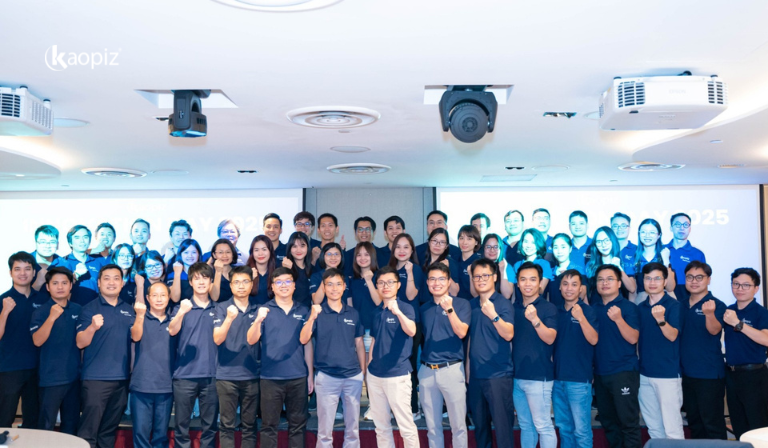
With a Singapore office, Kaopiz establishes local consulting and account management to serve Singapore’s mid-sized businesses and enterprises, bridging Singapore-side oversight with cost-efficient engineering delivery from Vietnam.
Why Choose Kaopiz
- Singapore presence, offshore efficiency. Local account manager handles compliance, communication, and stakeholder management. The engineering team operates from Vietnam at a blended rate of 40–60% below Singapore-only teams.
- Proven AI delivery track record. 1,000+ engineers, 1,000+ projects delivered across healthcare, finance, education, retail, logistics, and manufacturing. Recent work includes agentic AI platforms, computer vision systems, and generative AI integrations for enterprise clients across APAC.
- Internationally accredited standards. ISO 27001:2013, ISO 9001:2015, AWS Advanced Consulting Partner, and Clutch Top Software Developer 2026 and AI Company 2024 are the baseline certifications Singapore businesses in regulated industries require from vendors.
- Flexible engagement models. Fixed-price for well-scoped builds. Dedicated offshore teams for ongoing development. Hybrid onsite–offshore for projects requiring Singapore-side oversight at key milestones.
Our Case Study: AI-Powered Construction Inspection System
A construction company was losing time and project approvals to manual inspections, slow, inconsistent, and prone to human error.
Kaopiz built a computer vision system that allows field teams to capture site images via tablet or smartphone, with the AI automatically analyzing light output values, equipment safety, and workmanship quality against predefined standards, then generating instant approval recommendations.
Results:
- 40% reduction in inspection time, expediting project approvals
- 50% improvement in quality consistency, minimizing human error
- 30% increase in operational efficiency, reducing reliance on manual reviews
This is one example of how Kaopiz applies computer vision to real operational problems, from field inspection to fraud detection, document intelligence to predictive analytics, our AI team has delivered production systems across every major solution type covered in this guide.
If you are comparing vendors for an AI project in Singapore, the right starting point is a scoped discussion, not a quote. Kaopiz’s team delivered a functional AI chatbot prototype on time with clear communication, with clients noting their technical expertise and strategic insight as standout qualities.
Conclusion
AI development is not a single budget line, it is a series of decisions, each carrying its own cost implication. The numbers of AI development cost in Singapore in this guide give you a market benchmark. What they cannot give you is a precise estimate for your specific project, because that depends on your data, your systems, your compliance environment, and what you are actually trying to build.
The clearest next step is a scoped conversation before a quote. Understanding your data readiness, integration scope, and compliance requirements takes one meeting, and it is the difference between a budget that holds and one that doubles mid-project.
FAQs
- How Long Does AI Development Take in Singapore?
- Timelines range from 4 – 6 weeks for a basic chatbot to 4 – 18 months for custom ML models and enterprise platforms. The biggest timeline risk is undiscovered data readiness issues — a scoped discovery phase before development begins is the most reliable way to set an accurate delivery date.
- What Is a Realistic AI Budget for a Singapore SME?
- S$30,000 – S$80,000 covers most first AI projects — a RAG system, generative AI chatbot, or single-feature AI application. With the Enterprise Development Grant (EDG), eligible SMEs can claim up to 50% back, halving the effective cost.
- Can Singapore Government Grants Reduce My AI Development Cost?
- Yes. The EDG and Productivity Solutions Grant (PSG) both cover up to 50% of qualifying AI development costs for eligible SMEs. Both require approval before the project starts — factor in 4 – 8 weeks for grant processing when planning your timeline.
- Should I Hire a Local Singapore Agency or Outsource?
- Local agencies offer native PDPA and MAS compliance familiarity at S$95 – S$250/hour. Offshore teams in Vietnam deliver equivalent output at S$34 – S$81/hour. For most Singapore projects, a hybrid model — local account management with offshore engineering — delivers the best balance of cost and oversight.
- Does Kaopiz Develop AI Systems for Singapore Businesses?
- Yes. Kaopiz operates from Singapore, with a 1,000+ engineer delivery team in Vietnam. We have delivered AI projects across construction, healthcare, finance, and logistics, including computer vision, agentic AI, custom ML systems, and more.
Author

Lucie Tran
Head of Growth of Kaopiz Global
Table of Contents
Don’t miss what’s next!
Thank you! Your form has been submitted successfully.