
AI Chatbot Development Cost in Singapore: Full Breakdown (2026)
AI chatbot adoption is accelerating for a reason. Gartner predicts conversational AI will reduce contact center agent labor costs by $80 billion in 2026, with one in 10 agent interactions now automated. For Singapore businesses, where a customer service executive costs SGD 36,000–48,000 per year, the ROI case is clear.
In my experience working with Singapore businesses on AI chatbot projects, the most common budgeting mistake is not overspending; it is under-scoping. Businesses receive a quote, approve it, and then discover mid-project that integration with their OMS costs more than the bot itself, or that PDPA compliance was never included in the original scope. By the time the chatbot goes live, the final invoice looks nothing like the proposal.
This guide breaks down AI chatbot development costs in Singapore across every dimension that actually matters: chatbot type, development phase, industry, ongoing monthly costs, and true 3-year TCO. Whether you are building your first chatbot or evaluating vendors for a more complex deployment, the numbers here will help you ask the right questions before you sign anything.
Key Takeaways
- AI chatbot development in Singapore costs SGD 8,000–200,000+ depending on type and complexity
- 5 factors drive most of the cost variance: chatbot type, integrations, AI model choice, multilingual support, and PDPA compliance
- Integration is consistently the most underestimated cost, what looks like one integration is often four
- Ongoing monthly costs range from SGD 650–12,500+ and are rarely included in vendor quotes
- Hidden costs add 20–35% on top of the initial development figure
- EDG Grant can subsidise up to 50% of qualifying costs for Singapore-registered businesses
- The true 3-year cost is 3–4x the initial development quote, budget for this, not just the build
How Much Does AI Chatbot Development Cost in Singapore?
AI chatbot development cost in Singapore is SGD 8,000–200,000+, depending on chatbot type, industry, and the 5 development phases, with timelines ranging from 3 weeks to 24 weeks, integration consistently the biggest budget variable across all tiers, and industry-specific compliance requirements in banking and healthcare pushing costs to the top of the range.
AI Chatbot Development Cost Breakdown by Type
The cost of developing an AI chatbot in Singapore varies significantly depending on what the chatbot is designed to do. The type of chatbot you build is the single biggest factor in your budget, from a SGD 8,000 rule-based FAQ bot to a SGD 200,000+ enterprise AI system. Each tier represents a fundamentally different scope of engineering, integration, and compliance work. Understanding these tiers helps businesses budget accurately and avoid being over-quoted or under-scoped by vendors.
| Chatbot Type | Best For | Development Cost (SGD) | Timeline |
|---|---|---|---|
| Rule-Based FAQ Bot | SMEs, F&B, retail, internal HR | 8,000–20,000 | 3–5 weeks |
| AI-Powered FAQ Bot | Growing SMEs, SaaS, education | 15,000–35,000 | 4–7 weeks |
| Lead Qualification Bot | B2B services, real estate, renovation | 25,000–50,000 | 6–10 weeks |
| Customer Support Bot | E-commerce, fintech, SaaS | 45,000–90,000 | 10–16 weeks |
| Enterprise AI Chatbot | MNCs, healthcare, banking, property | 100,000–200,000+ | 16–24 weeks |
Rule-Based FAQ Bot: SGD 8,000 to 20,000
A rule-based bot follows predefined scripts and responds based on keyword matching or button selections. It handles a fixed set of questions reliably but breaks when users phrase queries outside the script.
- Best for: Retail, F&B, SME websites, internal HR queries
- Timeline: 3–5 weeks
- No AI model involved, keeps both development and monthly costs at the floor
- Cost drivers within this tier: Number of conversation flows, languages supported, and whether WhatsApp Business API is required alongside the website widget
AI-Powered FAQ Bot: SGD 15,000 to 35,000
This tier adds an LLM layer, meaning the bot understands intent rather than matching keywords. Users can phrase questions naturally, including in Singlish, and receive accurate answers via a RAG (Retrieval-Augmented Generation) pipeline over a structured knowledge base.
- Best for: Growing SMEs, SaaS companies, education providers
- Timeline: 4–7 weeks
- Recommended model: GPT-4o-mini for most FAQ use cases, strong quality at a fraction of GPT-4o cost
- Key advantage for Singapore: Handles language variation across English, Mandarin, and Singlish without breaking
- Cost drivers: Knowledge base size, number of languages, and prompt engineering complexity
Lead Qualification Bot: SGD 25,000 to 50,000
A lead qualification bot conducts a structured conversation, scores the user against predefined criteria, and routes qualified leads to the sales team via CRM update or direct handoff. It runs 24/7 across the website and WhatsApp simultaneously.

- Best for: B2B services, real estate, renovation companies
- Timeline: 6–10 weeks
- Core integration required: CRM platform (HubSpot, Salesforce, or custom) — typically adds SGD 7,000–18,000 to the build
- Cost drivers: Complexity of qualification logic and number of CRM integrations
- ROI signal: Well-suited for businesses where a single qualified lead represents significant revenue
Customer Support Bot: SGD 45,000 to 90,000
At this tier, the chatbot takes actions, not just answers. It checks order status, processes returns, creates support tickets, and escalates to human agents based on sentiment or complexity. WhatsApp Business API integration is standard for Singapore deployments at this tier.
- Best for: E-commerce, fintech, SaaS with high support volume
- Timeline: 10–16 weeks
- Typical integrations: OMS, CRM, ticketing platform, payment gateway, WhatsApp Business API
- Cost drivers: Number of integrations is the primary variable, 2 integrations sit at the lower end, 5–6 approach the upper end
- Most common deployment type among Singapore e-commerce and SaaS businesses in 2026
Enterprise AI Chatbot: SGD 100,000 to 200,000+
Enterprise chatbots operate across multiple channels, integrate with 5 or more business systems, and typically require custom AI model fine-tuning on proprietary data. What drives cost into this tier is not the AI; it is compliance, security architecture, and legacy system integration.
- Best for: MNCs, banks, healthcare providers, property management companies
- Timeline: 16–24 weeks
- Singapore-specific compliance adds cost: MAS TRM guidelines for finance; PDPA + FHIR integration for healthcare
- Cost drivers: Number of integrations, compliance requirements, legacy system complexity, and custom model fine-tuning
- Key consideration: Scope all integration and compliance requirements in detail before soliciting vendor quotes — vague requirements produce quotes that vary by 5x
AI Chatbot Development Cost Breakdown by Phase
Most vendor quotes present a single development number. What that number rarely reflects is how the budget distributes across 5 distinct phases, each with its own scope, timeline, and cost drivers.
AI chatbot development in Singapore spans 5 phases over 12–23 weeks, with total costs ranging from SGD 30,000 to SGD 143,000, and integration is consistently the phase that surprises businesses most with its scope and budget impact. Understanding this breakdown helps you identify where vendors are cutting corners and where you should push for more detail before signing.
| Phase | Key Activities | Timeline | Cost (SGD) |
|---|---|---|---|
| Discovery & Design | Use case mapping, conversation design, integration scoping | 2–4 weeks | 3,000–8,000 |
| Development | Bot logic, LLM integration, prompt engineering | 4–8 weeks | 15,000–50,000 |
| Integration | CRM, ERP, WhatsApp API, databases | 3–6 weeks | 7,000–70,000 |
| Testing & QA | User testing, edge cases, multilingual testing | 2–3 weeks | 3,000–10,000 |
| Deployment & Handover | Infrastructure setup, staff training, documentation | 1–2 weeks | 2,000–5,000 |
| Total | 12–23 weeks | 30,000–143,000 |
Discovery & Design: SGD 3,000 to 8,000
Discovery is the most frequently skipped phase, and the single biggest reason AI chatbots underperform after launch. Without it, teams build based on assumptions, producing a bot that handles edge cases no one asked for while failing at the questions that represent the majority of real user volume.
Timeline note: 2 weeks for a simple FAQ bot with a well-defined use case. 4 weeks for a customer support or enterprise bot requiring multiple integration scoping sessions and multilingual planning.
- Use case definition: What the chatbot must do, with enough specificity that no developer needs to guess
- Conversation flow mapping: Every dialogue path, including fallback responses and human escalation triggers
- Integration scoping: Every system the bot connects to, confirmed before any code is written
- Language requirements: For Singapore deployments, which combination of English, Mandarin, Malay, and Tamil is needed, and whether Singlish variations require specific NLP handling
At SGD 3,000–8,000, this is the lowest-cost phase. It is also the highest-leverage investment in the project.
Development: SGD 15,000 to 50,000
Development cost and timeline are both driven by AI model choice and conversation logic complexity.
Timeline note: 4 weeks for a rule-based or simple AI FAQ bot. 7–8 weeks for an LLM-powered bot with multi-turn handling, RAG pipeline, and multilingual prompt engineering.
- Rule-based bot with fixed flows: 4 weeks, SGD 15,000–20,000
- LLM-powered bot with multi-turn handling and RAG: 7–8 weeks, SGD 35,000–50,000
- Multilingual prompt engineering: Handling language switching across English and Mandarin adds SGD 5,000–10,000 and 1–2 weeks to this phase
- Model choice impacts long-term cost: GPT-4o-mini is sufficient for most FAQ and lead qualification use cases at a fraction of GPT-4o’s monthly API cost, a decision that compounds significantly over Year 2 and Year 3
Integration: SGD 7,000 to 70,000
Integration is where most Singapore chatbot projects exceed their original budget. What looks like one integration is often four, each with its own authentication, data format, error handling, and testing cycle.
Timeline note: 3 weeks for 1–2 standard integrations (CRM or WhatsApp API). 5–6 weeks for 4+ integrations or any legacy system connection requiring custom middleware.
| Integration Type | Timeline | Estimated Cost (SGD) |
|---|---|---|
| CRM (HubSpot, Salesforce) | 2–3 weeks | 7,000–18,000 |
| E-commerce (Shopify, WooCommerce) | 2–3 weeks | 10,000–24,000 |
| WhatsApp Business API | 1–2 weeks | 3,000–7,000 |
| ERP systems | 3–5 weeks | 14,000–38,000 |
| Legacy systems | 4–6 weeks | 18,000–70,000 |
A vendor who quotes integration costs without completing discovery first is guessing. Scope every integration in detail before development begins.
Testing & QA: SGD 3,000 to 10,000
AI chatbot QA goes beyond functional testing. For a bot handling 1,000 conversations per day, a 5% failure rate means 50 poor customer experiences daily.
Timeline note: 2 weeks for a single-language FAQ or lead qualification bot. 3 weeks for a multilingual or customer support bot requiring separate validation cycles per language and UAT with real users.
- Intent recognition accuracy: Does the bot correctly identify intent across different phrasings and typos?
- Edge case handling: How does the bot respond when users go off-script or provide incomplete information?
- Multilingual validation: English and Mandarin flows require separate testing cycles, tone and cultural context each need independent validation
- UAT with real users: Catches failure modes that internal QA teams miss, worth the additional 1–2 weeks before go-live
Deployment & Handover: SGD 2,000 to 5,000
The final phase covers infrastructure setup, load scaling, and PDPA compliance checks before go-live. Handover ensures your team can operate the bot independently after the vendor leaves.
Timeline note: 1 week for a straightforward website deployment. 2 weeks for multi-channel deployments (website + WhatsApp) or enterprise bots requiring compliance sign-off and extended staff training.
- Knowledge base documentation: How to update content without breaking conversation flows
- Analytics training: How to read deflection rates, failure points, and conversation drop-offs
- Escalation protocols: How to handle edge cases and route technical issues
- PDPA compliance check: Confirm consent mechanisms are live, and data residency requirements are met before go-live
Teams that skip proper handover documentation typically return to their vendor for paid support within 3 months of go-live.
AI Chatbot Development Cost by Industry
Industry context is one of the most significant and most overlooked cost variables in AI chatbot development. Costs range from SGD 15,000 for a straightforward real estate lead qualification bot to SGD 150,000 for a banking chatbot with MAS compliance and legacy system integration, driven not by the AI itself, but by the regulatory and infrastructure complexity surrounding it.
| Industry | Typical Use Cases | Development Cost (SGD) | Timeline |
|---|---|---|---|
| E-commerce & Retail | Product discovery, order tracking, returns | 15,000–80,000 | 8–16 weeks |
| Healthcare & Wellness | Appointment booking, patient intake, symptom triage | 30,000–100,000 | 12–20 weeks |
| Banking & Finance | Account queries, fraud alerts, loan pre-qualification | 50,000–150,000 | 16–24 weeks |
| Travel & Hospitality | Booking assistance, itinerary management, concierge | 20,000–70,000 | 8–14 weeks |
| Real Estate | Lead qualification, property search, viewing scheduler | 15,000–50,000 | 6–12 weeks |
E-commerce & Retail: SGD 15,000 to 80,000
The fastest-growing chatbot deployment category in Singapore in 2026. An e-commerce chatbot handles product discovery, order tracking, returns, and 24/7 customer support across website and WhatsApp.
- Timeline: 8 weeks for FAQ and order tracking with 2–3 integrations. 14–16 weeks for a full shopping assistant with personalized recommendations and cart recovery
- Typical integrations: Shopify or WooCommerce, OMS, Stripe, WhatsApp Business API
- Key features: Product search, order status, return initiation, cart recovery, personalized offers
- Cost drivers: Number of integrations, product catalog size, and personalization requirements
- ROI benchmark: Up to 25% reduction in cart abandonment; measurable increase in average order value through upsell conversations
Healthcare & Wellness: SGD 30,000 to 100,000
Healthcare chatbots handle patient intake, appointment scheduling, and medication reminders. The higher cost range reflects PDPA compliance for sensitive health data, consent management, and audit trail requirements, not feature complexity.
- Timeline: 12 weeks for appointment booking and FAQ with standard clinic integrations. 18–20 weeks for full patient intake with EHR integration and PDPA compliance architecture
- Typical integrations: EHR or clinic management system, appointment platform, PDPA consent management
- Key features: Appointment booking, prescription reminders, symptom triage, patient FAQ
- Cost drivers: PDPA compliance architecture, EHR integration complexity
- Key consideration: Bots handling clinical information require stricter validation cycles than administrative bots; budget accordingly
Banking & Finance: SGD 50,000 to 150,000
The highest-cost industry tier is driven by MAS Technology Risk Management compliance, strict audit trail requirements, and legacy core banking infrastructure. The AI itself is not the expensive part; the regulatory and integration layers are.
- Timeline: 16 weeks for account query and FAQ bot with standard API integrations. 20–24 weeks for a full-service bot with loan pre-qualification logic and MAS TRM compliance documentation
- Typical integrations: Core banking APIs, fraud detection systems, CRM, KYC platform
- Key features: Balance enquiry, transaction history, loan eligibility, fraud reporting
- Cost drivers: MAS TRM compliance, legacy system integration, security testing
- Key consideration: MAS TRM obligations alone can add SGD 20,000–40,000 to an otherwise mid-tier build, scope compliance requirements before requesting vendor quotes
Travel & Hospitality: SGD 20,000 to 70,000
High-ROI category given the volume of repetitive, time-sensitive queries that chatbots can deflect around the clock. WhatsApp-first deployment aligns naturally with how Singapore travelers communicate.
- Timeline: 8 weeks for hotel FAQ and booking bot with standard PMS integration. 12–14 weeks for a full travel assistant with GDS integration and multi-language support
- Typical integrations: PMS, GDS APIs (Amadeus, Sabre), OTA platforms, WhatsApp Business API
- Key features: Booking management, itinerary changes, flight status, upsell ancillaries
- Cost drivers: GDS API complexity, number of languages, voice support requirements
Real Estate: SGD 15,000 to 50,000
One of the more straightforward industry deployments, lower compliance requirements, and manageable integration complexity make this a good entry point for businesses building their first AI chatbot.
- Timeline: 6 weeks for lead capture and FAQ bot with CRM integration. 10–12 weeks for a full property search assistant with listing API integration and multilingual support
- Typical integrations: CRM, property listing APIs, calendar system, WhatsApp Business API
- Key features: Property search, lead capture, viewing scheduler, mortgage estimator, agent handoff
- Cost drivers: CRM complexity, property listing API connections, multilingual requirements
- ROI signal: Replaces manual top-of-funnel lead screening, particularly valuable in Singapore’s high-transaction-value property market
What Determines the Cost of an AI Chatbot in Singapore?
Not all chatbots cost the same, and not all vendors quote the same scope. Two businesses in the same industry can receive quotes that differ by 5x for what appears to be an identical requirement. These 5 variables explain most of that variance.
Chatbot Type and Complexity
The single biggest cost driver is what the chatbot is designed to do. A rule-based FAQ bot costs SGD 8,000–20,000. An enterprise AI agent that reasons across multiple systems and executes actions autonomously costs SGD 100,000–200,000+. That is not a difference in vendor markup; it is a difference in engineering scope.
Start with your highest-volume use case. Businesses that over-scope their first chatbot consistently report lower ROI than those that start focused and expand later.
Number and Complexity of Integrations
Integration is the most underestimated cost driver in chatbot projects. A chatbot answering “where is my order?” requires connection to an OMS, shipping carrier APIs, a customer database, and a returns platform. What looks like one integration is four, each with its own authentication, data format, and testing cycle.
AI Model Choice
Model choice affects both upfront development cost and monthly running costs, and the right choice depends on use case, not prestige.
- GPT-4o-mini: Best for FAQ and lead qualification, strong quality at roughly 6% of GPT-4o’s API cost. The right default for most Singapore SME deployments
- GPT-4o / Claude 3.5 Sonnet: Best for complex reasoning and multi-turn customer support, higher monthly cost but necessary for enterprise-grade interactions
- Custom fine-tuned model: SGD 20,000–40,000 additional upfront, but lower ongoing API costs at scale, viable above 10,000 conversations per month
A chatbot running GPT-4o when GPT-4o-mini would suffice adds SGD 3,000–8,000 per year in unnecessary API costs.
Multilingual Support Requirements in Singapore
Singapore has 4 official languages, English, Mandarin, Malay, and Tamil, plus Singlish as a colloquial register that cuts across all of them. For customer-facing chatbots, language handling is a core requirement, not an add-on.
- Each additional language adds: 15–25% to testing and prompt engineering costs
- Full 4-language support adds: SGD 15,000–30,000 to a mid-tier build
- WhatsApp Business API: Standard for Singapore deployments, 80%+ of customers prefer WhatsApp over website chat
- Key advice: Define language requirements in Discovery, retrofitting multilingual support post-launch costs significantly more than building it in from the start
PDPA Compliance and Data Residency
Every chatbot collecting or processing personal data from Singapore users must comply with PDPA. This is a cost many businesses discover only after the vendor quote is signed.
PDPA compliance work includes:
- Consent management: Explicit opt-in before data collection begins
- Data retention policy: Defined rules for storage duration and deletion
- Audit trail: Logging of data access for accountability
- Breach notification workflow: Process for reporting breaches within the required timeframe
Budget SGD 5,000–15,000 for PDPA compliance built into the initial build. Retrofitting after launch typically costs SGD 8,000–20,000 and adds 4–8 weeks to the project.
The True 3-Year Cost of an AI Chatbot in Singapore
The development quote a vendor sends you covers Year 1 build cost only. For most Singapore businesses, the total 3-year investment is 3–4x the initial development figure, and understanding where that money goes is what separates a well-planned chatbot budget from an unpleasant surprise in Year 2.
Ongoing Monthly Costs
Monthly costs begin the moment the chatbot goes live and continue for the lifetime of the deployment. Most businesses underestimate AI chatbot maintenance cost at the budgeting stage because vendors rarely include them in initial proposals.
| Cost Category | Simple FAQ Bot (SGD/month) | Customer Support Bot (SGD/month) | Enterprise Bot (SGD/month) |
|---|---|---|---|
| AI API & model usage | 150–400 | 500–1,500 | 2,000–5,000 |
| Hosting & infrastructure | 100–200 | 200–500 | 500–1,500 |
| WhatsApp Business API | 100–300 | 300–800 | 800–2,000 |
| Maintenance & support | 300–600 | 600–1,500 | 1,500–4,000 |
| Total monthly | 650–1,500 | 1,600–4,300 | 4,800–12,500 |
Monthly costs scale with conversation volume. A chatbot that starts at the lower end of each range will move toward the upper end as traffic grows, factor this into your Year 2 and Year 3 projections.
Hidden Costs Most Vendors Don’t Tell You
Beyond monthly running costs, most chatbot projects carry additional expenses that rarely appear in the initial vendor quote. These hidden costs typically add 20–35% on top of the original development figure.
- Knowledge base content creation: Someone needs to write, structure, and quality-check all the content the chatbot will use. This takes 20–40 hours of internal time or SGD 2,000–4,000 if outsourced to a copywriter. It is almost never included in vendor quotes.
- Staff training: Your team needs to know how to manage the chatbot, handle escalations, and update responses as your business changes. Budget 1–2 days of training per team at launch.
- First 3-month iterations: The first version will not be perfect. Real user conversations surface failure modes that testing never catches. Budget SGD 3,000–8,000 for improvements in the first 3 months post-launch.
- PDPA compliance audit: If compliance was not built in from the start, retrofitting it after launch costs SGD 8,000–20,000 and adds 4–8 weeks to the project.
- Annual model fine-tuning: When your products, pricing, or policies change, the chatbot needs to be updated and re-tested. Budget SGD 2,000–6,000 per year for ongoing model maintenance.
3-Year TCO Breakdown
The table below shows what Singapore businesses at the Customer Support Bot tier actually spend over 3 years, broken down by cost category.
| Cost Category | Year 1 (SGD) | Year 2 (SGD) | Year 3 (SGD) |
|---|---|---|---|
| Development (one-time) | 45,000–90,000 | — | — |
| AI API & model costs | 6,000–18,000 | 8,000–24,000 | 10,000–30,000 |
| Hosting & infrastructure | 1,200–3,000 | 1,200–3,000 | 1,200–3,000 |
| WhatsApp Business API | 1,200–4,800 | 1,200–4,800 | 1,200–4,800 |
| Maintenance & updates | 4,000–10,000 | 6,000–15,000 | 6,000–15,000 |
| PDPA compliance | 5,000–15,000 | 2,000–5,000 | 2,000–5,000 |
| Hidden costs & iterations | 5,000–12,000 | 3,000–8,000 | 3,000–8,000 |
| Total | 67,400–152,800 | 21,400–59,800 | 23,400–65,800 |
Development cost represents only 20–25% of the true 3-year investment. The table above is what a realistic CFO presentation should show, not just the vendor’s opening quote.
How Can Singapore Businesses Reduce AI Chatbot Development Costs?
The cost numbers above are not fixed. Singapore businesses have 3 legitimate ways to reduce upfront and ongoing chatbot investment.
Government Grants Available in Singapore
- EDG Grant: Up to 50% subsidy on qualifying costs, a SGD 60,000 project nets down to SGD 30,000. Administered by Enterprise Singapore
- SMEs Go Digital (IMDA): Pre-approved vendors with subsidised pricing. Best for standard solutions with lower procurement risk
- PSG: Covers pre-approved SaaS chatbot solutions only, not applicable for custom builds
Start with an MVP, Then Scale
Build for your top 3 use cases first. Launch in 4–6 weeks at SGD 15,000–25,000, validate ROI with real data, then expand. Avoids the most common mistake: over-scoping the first build.
Offshore Development with Singapore Oversight
Singapore local rates: SGD 120–200/hour. Vietnam-based engineers with Singapore project management: SGD 45–75/hour. Same quality, 30–50% lower cost, with local oversight handling compliance and client-facing delivery.
How Kaopiz Builds AI Chatbots for Singapore Businesses
Kaopiz is one of the leading AI outsourcing companies with offices in Singapore, Vietnam, and Japan. Over 12 years and 1,000+ projects, we have built AI chatbot solutions for clients across Singapore, Japan, Australia, and the US — from SME lead qualification bots to enterprise-grade conversational AI integrated with complex business systems.
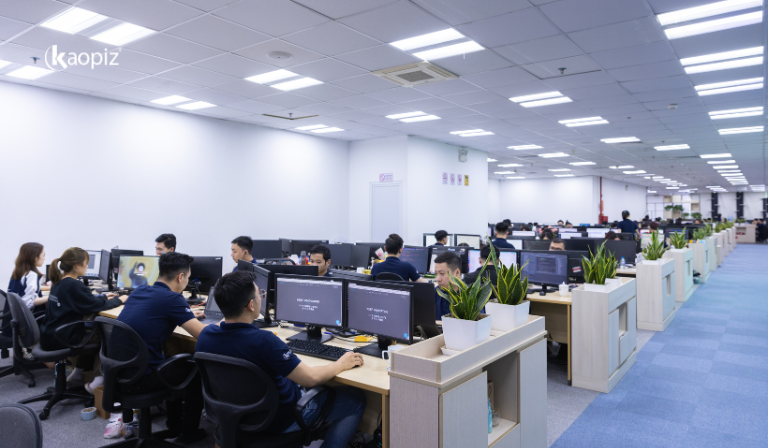
Our model is simple: Singapore-based project management and client communication, Vietnam-based engineering delivery. This gives Singapore businesses direct access to senior technical expertise at 40–60% lower cost than local vendors, without sacrificing delivery quality, compliance standards, or communication.
How We Approach Every Chatbot Project
- Discovery first: Every project begins with 2–3 weeks of discovery, use case mapping, integration scoping, and conversation design, before any code is written. This is the step most vendors skip, and the reason most chatbots underperform after launch
- Right-sized architecture: We recommend the model and stack that fits your use case and budget, not the most expensive option
- PDPA compliance built in: Not retrofitted. Every chatbot we build for Singapore clients includes consent management, data retention policy, and audit trail from day one
- Transparent cost breakdown: We provide phase-by-phase cost estimates, not a single lump sum, so you know exactly what you are paying for at each stage
If you are evaluating AI chatbot development for your Singapore business, we are happy to provide a detailed cost estimate based on your specific use case, delivered within 2 business days.
Our Case Study: Customer Support Chatbot for a Singapore E-commerce Business
A Singapore-based e-commerce company was handling over 1,500 customer inquiries per week, mostly repetitive queries about order status, delivery, and returns. Their support team was spending 70% of working hours on these interactions.
What Kaopiz built:
- AI-powered support bot integrated with OMS, shipping APIs, and returns platform
- WhatsApp Business API as the primary channel
- Bilingual support in English and Mandarin with Singlish handling
- Human escalation trigger based on sentiment detection
- PDPA-compliant data handling built in from day one
Results after 3 months:
- 73% of inquiries resolved without human intervention
- Average response time reduced from 4 hours to under 2 minutes
- Monthly support operational cost reduced by SGD 8,500
The project started with a 2-week discovery phase that identified order status as the highest-volume use case — 45% of total inquiry volume. Building OMS and shipping integrations first allowed the team to go live 3 weeks earlier than planned and validate ROI before committing the full budget.
Conclusion
AI chatbot development in Singapore costs SGD 8,000–200,000+ depending on type, integrations, and compliance requirements. The initial development quote is only 20–25% of the true 3-year investment, ongoing API costs, maintenance, and hidden costs make up the rest.
The businesses that get the best ROI from chatbots share 3 things: they start with a focused use case, scope integrations thoroughly before development begins, and treat PDPA compliance as a requirement from day one, not an afterthought.
FAQs
- How Long Does It Take to Build an AI Chatbot in Singapore?
- Timelines range from 3–5 weeks for a simple FAQ bot to 16–24 weeks for an enterprise chatbot. The most common deployment — a customer support bot with 3–4 integrations — typically takes 10–16 weeks from discovery to go-live.
- Can Singapore Businesses Get Grants for AI Chatbot Development?
- Yes. The EDG Grant subsidises up to 50% of qualifying costs for Singapore-registered companies — a SGD 60,000 project could net down to SGD 30,000. The SMEs Go Digital Programme and PSG also offer subsidised options for specific use cases and pre-approved vendors.
- What Hidden Costs Should I Budget For?
- The 5 most commonly missed costs: knowledge base content creation (SGD 2,000–4,000), staff training, first 3-month iterations post-launch (SGD 3,000–8,000), PDPA compliance if not built in from the start (SGD 8,000–20,000), and annual model fine-tuning (SGD 2,000–6,000/year). Combined, these add 20–35% on top of the initial development quote.
- How Much Does WhatsApp Chatbot Integration Cost in Singapore?
- WhatsApp Business API setup: SGD 3,000–7,000 one-time. Ongoing: SGD 300–600/month in platform fees. For a Singapore SME handling 2,000 conversations per month, total monthly WhatsApp costs typically land at SGD 400–700.
- Is a Custom AI Chatbot Better Than a SaaS Platform?
- SaaS platforms work well for simple use cases with low conversation volume and no internal system integration. Custom builds are the better choice when you need proprietary system integration, multilingual support, or business-specific conversation logic. The break-even between custom and SaaS typically appears in Year 2 as subscription costs accumulate.
Author

Lucie Tran
Head of Growth of Kaopiz Global
Table of Contents
Don’t miss what’s next!
Thank you! Your form has been submitted successfully.