
What Are AI Agents? A Complete Guide to How They Work, Examples, and Frameworks
Every technical team we talk to in Singapore is asking some version of the same question right now: what are AI agents, and how do they differ from chatbots or agentic AI systems in the same pitch deck? Vendors use these terms interchangeably in product demos, but they describe distinct levels of autonomy. Getting the distinction wrong sets the wrong scope, budget, or governance plan before a project even starts.
This guide breaks down what AI agents actually are, how they work under the hood, real examples across industries, the frameworks powering them in 2026, and what Singapore’s regulatory landscape means for any enterprise planning to deploy one.
Key Takeaways
- An AI agent perceives, reasons, and acts toward a goal with minimal human input — distinct from a chatbot’s single-response model and agentic AI’s multi-agent coordination.
- Every agent runs on the same loop: perceive, reason, act, remember, repeating until the goal is met or a human approval gate triggers.
- Popular 2026 frameworks include LangGraph, CrewAI, Microsoft Agent Framework, and the OpenAI/Claude Agent SDKs — the right choice depends on workflow complexity, not popularity.
- Singapore enterprises design around IMDA’s Model AI Governance Framework and PDPA from the start; retrofitting compliance later costs more.
- Building an agent comes down to five decisions: define the goal, pick a framework, scope tool access, add memory, and set guardrails before deployment.
What Are AI Agents?
An AI agent is a software system that perceives its environment, makes decisions, and takes action to complete a task with minimal human input. Unlike a program that waits for a command at every step, an agent holds a goal, evaluates the situation, and decides what to do next on its own. Most AI agents today run on large language models, connect to business tools through APIs, and operate with some form of memory that carries context from one action to the next.
A support agent shows this clearly. Instead of just answering a question, it reads the request, checks the customer’s order history, drafts a response, and logs the interaction in the CRM. Four steps complete without a human triggering each one individually.

An AI agent is not the same as a chatbot, and it is not the same as agentic AI. A chatbot responds to a single prompt and stops; an AI agent keeps working until the goal is met. Agentic AI goes a step further, coordinating multiple agents across a longer, more autonomous workflow. We cover both distinctions in detail in AI Agents vs. Chatbots and AI Agents vs. Agentic AI.
Key characteristics of an AI agent:
- Autonomy: Acts on a goal without step-by-step instructions.
- Memory: Retains context across multiple actions or sessions.
- Tool Use: Calls APIs, databases, or other software to complete tasks.
- Goal-Orientation: Measures progress against a defined outcome, not just a single response.
How AI Agents Work: Core Architecture
Every AI agent runs on the same four-stage loop: perceive, reason, act, and remember. The agent takes in information from its environment, a user message, a database update, a sensor reading, then an LLM-based reasoning layer interprets that input against the agent’s goal and decides on a next step. That step usually means calling a tool: an API, a search function, a piece of software the agent has access to. The result feeds back into memory, which shapes how the agent handles the next cycle.
This loop is what separates an agent from a standard script. A script executes a fixed sequence; an agent re-evaluates after every action and adjusts its plan if the outcome doesn’t match expectations. We see this most clearly in multi-step tasks, where an agent handling a shipping delay checks inventory, reroutes an order, and notifies the customer. Three decisions, each informed by the one before it.
| Component | Function |
|---|---|
| Perception | Captures input from users, systems, or data sources. |
| Reasoning (LLM) | Interprets input against the agent’s goal and plans the next action. |
| Tool Use / Action | Executes the decision through APIs, databases, or connected software. |
| Memory | Stores context from past actions to inform the next cycle. |
The loop repeats until the agent’s goal is met or it hits a defined stopping condition, such as a human approval gate for high-risk actions.
Types and Real-World Examples of AI Agents
Understanding the loop that powers an AI agent is one thing; seeing how that loop plays out in practice is another. The type of agent shapes how much autonomy it has, and the industry shapes what that autonomy actually looks like on the ground.
Types of AI Agents
AI agents fall into four main types, based on how much autonomy and learning capability they have. Reflex agents respond instantly to a fixed input, like a bot that flags a support ticket the moment it contains the word “refund.” Goal-based agents pursue a defined objective across multiple steps, such as an onboarding agent that keeps nudging a new user until they complete setup.
Utility-based agents go further, weighing different paths against a metric like time saved or customer satisfaction before picking one. Learning-based agents adjust their behavior from feedback over time, edging closer to what most people now call agentic AI.
| Type | How It Decides | Example |
|---|---|---|
| Reflex | Reacts to a fixed input with a fixed response. | FAQ bot triggered by specific keywords. |
| Goal-Based | Pursues a defined objective across steps. | Onboarding agent that follows up until setup is done. |
| Utility-Based | Weighs outcomes against a metric before acting. | Support agent optimizing for fastest resolution time. |
| Learning-Based | Adjusts behavior based on past feedback. | Sales agent that improves its outreach timing over time. |
Examples by Industry
These four types aren’t just theory; they show up differently depending on the function they’re built for. Here’s what that looks like across four industries where AI agents are already doing real work.
Customer Service Agents
A support agent reads an incoming ticket, checks the customer’s order history, and drafts a reply grounded in that context, not a generic template. If the issue needs an action, like issuing a refund or rebooking a delivery, the agent executes it directly through the connected systems and logs the resolution in the CRM, closing the loop without a human touching each step.
Finance and Operations Agents
In finance teams, agents reconcile transactions against ledger entries and flag anomalies for review, cutting down the manual matching work an ops team would otherwise do line by line. Some go further, cross-referencing vendor invoices against purchase orders and routing only the exceptions to a human; the matched majority never needs review at all.
Healthcare Scheduling Agents
Scheduling agents cross-check provider availability, insurance coverage rules, and patient preferences in one pass to book an appointment that would otherwise take a call center several calls to sort out. The agent handles the back-and-forth of finding a slot that satisfies all three constraints at once.
Software Development Agents
A coding agent reads a bug report, traces it to the relevant file in the codebase, proposes a fix, and opens a pull request. What used to start a developer’s morning, reproducing the bug, locating the cause, writing the patch, is already waiting for review by the time they log in.
What Are the Benefits of Using AI Agents?
AI agents improve business operations and customer experience at the same time, cutting costs on one side while raising service quality on the other. That dual effect is why adoption has moved past the pilot stage for most enterprise teams.
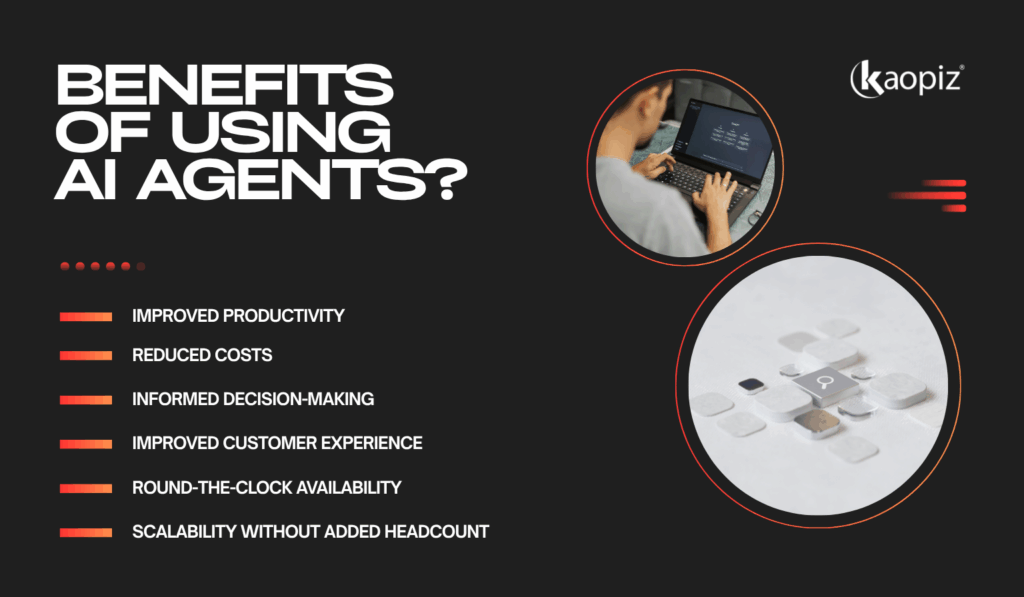
- Improved Productivity: Teams delegate repetitive tasks to agents and redirect their attention to work that actually needs human judgment, like de-escalating a complaint or negotiating a deal.
- Reduced Costs: Agents apply the same decision logic on every run, removing the inefficiencies, manual handoffs, and errors that come from process fatigue or inconsistent handling.
- Informed Decision-Making: Agents process live data at a scale no team could match manually, surfacing shifts, like an underperforming market segment mid-campaign, before the budget is already spent.
- Improved Customer Experience: Agents pull a customer’s order history and preferences into every response, delivering a personalized answer instead of a templated one, and usually faster.
- Round-the-Clock Availability: An agent doesn’t clock out, so a request at 2am gets the same response quality as one at 2pm, without staffing a night shift.
- Scalability Without Added Headcount: Handling twice the volume doesn’t require hiring twice the team, since an agent’s capacity isn’t tied to the size of the org chart.
These benefits aren’t automatic; they only show up when the agent is scoped correctly. Gartner predicts over 40% of agentic AI projects will be canceled by the end of 2027, due to escalating costs, unclear business value or inadequate risk controls, not weak AI models.
In practice, that means an agent given too broad a goal tends to create more problems than it solves. Getting the scope right, covered in the build section below, is what determines whether these benefits actually materialize.
What Are the Challenges of Using AI Agents?
AI agents introduce real operational risk alongside their benefits. The most common challenges are unreliable outputs, data and integration complexity, security exposure, and unclear accountability when something goes wrong. These aren’t reasons to avoid agents; they’re the reasons a scoped pilot succeeds while an unscoped one stalls.
- Reliability and Hallucination: An agent can act confidently on a wrong conclusion, and because it’s already executing rather than just suggesting, a bad decision can propagate before anyone catches it.
- Data and System Integration: Agents need clean, structured access to the systems they act on; legacy tools with inconsistent data or no API rarely connect without significant rework.
- Security and Identity Risk: An agent with broad system access becomes a new identity to secure, and a compromised agent moves across connected tools faster than a human attacker would.
- Accountability Gaps: When an agent makes a decision with real consequences, a refund, a rerouted shipment, it’s not always clear who signs off on that action or who’s responsible if it’s wrong.
- Cost Creep at Scale: A pilot handling a hundred requests a day behaves very differently at ten thousand; token costs, error rates, and edge cases all grow with volume in ways a small test doesn’t reveal.
Most of these challenges trace back to the same root cause: an agent given more autonomy or system access than its use case actually requires. That’s why the governance and build steps later in this guide focus as much on constraints as on capability.
Popular AI Agent Frameworks in 2026
Building any of the agents above starts with picking a framework, the toolkit that handles the reasoning loop, tool connections, and state management so a team isn’t writing that plumbing from scratch. The framework landscape in 2026 centers on a handful of options, each suited to a different shape of project.
- LangGraph: From the LangChain team, offers the widest integration library; best for complex, stateful workflows needing fine-grained control.
- CrewAI: Role-based approach, letting teams define agents as a “crew” with assigned tasks; fastest way to prototype multi-agent collaboration.
- Microsoft Agent Framework: Merges Semantic Kernel’s enterprise-grade session handling with AutoGen’s multi-agent orchestration into one production SDK for .NET and Python.
- OpenAI Agents SDK / Claude Agent SDK: Ships tool use, memory, and tracing without the abstraction overhead of a full framework; best for a single agent with one or two tools.
Each of these fits a different starting point, and the right pick depends on team language, workflow complexity, and how much control the project needs over agent behavior.
How to Build an AI Agent
Building an AI agent comes down to five decisions: define the goal, pick a framework, set up tool access, add memory, and put guardrails in place before deployment. Skipping any one of these is usually what turns a promising pilot into a stalled project.
- Define the Goal: A narrow, well-bounded objective like “resolve tier-1 support tickets” works better than “handle customer service,” because the agent needs a clear success condition to reason against.
- Pick a Framework: Match it to the task; a single-purpose agent with one or two tools rarely needs more than a vendor SDK, while a multi-step workflow spanning several systems calls for something like LangGraph or CrewAI.
- Set Up Tool Access: Decide exactly which APIs, databases, or internal systems the agent can call, and scope those permissions as tightly as the task allows.
- Add Memory: An agent handling one-off requests needs little more than session context, while one managing ongoing relationships needs persistent memory across sessions.
- Put Guardrails in Place: Any agent making irreversible decisions, refunds, order changes, financial transactions, needs a human approval gate before it acts, not after.
The step teams underestimate is guardrails. This is also where the deployment gets tested end-to-end, watching how the agent behaves on real inputs before it touches production data.
AI Agent Governance in Singapore: What Enterprises Should Know
Singapore was one of the first governments to publish a dedicated governance framework for agentic AI, and any enterprise deploying agents here builds around it, not bolts it on afterward. The IMDA published the Model AI Governance Framework (MGF) for Agentic AI in January 2026, targeted at any organization deploying agentic AI, whether building agents in-house or using third-party solutions.
The framework is voluntary, but it’s already shaping how enterprise buyers and vendors talk about readiness. For a vendor pitching an agentic AI product to a Singapore enterprise, alignment with the MGF is a practical way to signal readiness, not just a regulatory checkbox.
The MGF structures agent governance around four areas: bounding risks upfront, keeping humans accountable through approval checkpoints, testing and monitoring throughout deployment, and training end users to catch failure modes.
Two other pieces of context shape how agents get deployed in Singapore specifically:
- PDPA Compliance: Any agent that reads, stores, or acts on customer data falls under Singapore’s Personal Data Protection Act, with the same consent and data-minimization requirements as any other system, and the burden of proof on the deploying organization.
- National AI Strategy 2.0 and Adoption Support: IMDA’s NAIS 2.0 extends AI adoption support to SMEs through programs like the Digital Leaders Accelerator Bootcamp and the GenAI Navigator, which enterprises can use to offset part of the build cost.
For a CTO or CIO evaluating an agent deployment, the practical takeaway is to treat governance as a design input from day one, defining the approval gates and audit trail an agent needs before scoping its permissions, not after a pilot has already run.
How Kaopiz Helps Singapore Enterprises Build AI Agents
We’ve worked with Singapore enterprises across finance, construction, and logistics on projects where an AI agent wasn’t the ask on day one. It became the right answer once we understood the workflow well enough to know what could run autonomously and what needed a human checkpoint.
That’s the part most teams underestimate: the technical build is rarely the hard part. Scoping the agent correctly, and designing around the kind of governance IMDA’s framework now expects, is what determines whether it survives past the pilot.

Kaopiz is a trusted AI outsourcing company in Singapore with nearly 1,000 engineers and over a decade of software delivery across the region. We bring the same engineering discipline to agent projects that we do to any production system:
- Define a Narrow Goal: Scope the agent to a specific, measurable outcome instead of a broad function.
- Pick the Right Framework for the Task: Not the most popular one, but the one that fits the workflow’s complexity.
- Build in Approval Gates: For any action that touches customer data or an irreversible transaction, in line with PDPA requirements and the MGF’s emphasis on meaningful human accountability.
For enterprises still deciding between building in-house or bringing in outsourced engineering support, this is usually where we start the conversation: not with a framework recommendation, but with what the agent actually needs to be trusted with.
If you’re evaluating an AI agent project for your organization, get in touch with our team to talk through the scope before you commit to an architecture.
Conclusion
AI agents are software systems that perceive their environment, reason against a goal, and act through connected tools, without a human triggering each step individually. That’s what separates an agent from a chatbot, which stops after one response, and from agentic AI, which coordinates multiple agents across a longer workflow.
The pattern across this guide holds: agents built on a narrow goal outperform ones built to “handle everything.” In Singapore, where IMDA’s governance framework now shapes how enterprises evaluate readiness, scoping that goal correctly isn’t optional, it’s the difference between a pilot and a deployment.
FAQs
- Is ChatGPT an AI Agent?
- Not by itself. ChatGPT in its default form is a conversational assistant; it responds to prompts but doesn’t independently plan multi-step actions or call external tools without configuration. When connected to tools, memory, and a defined goal, it functions as an AI agent.
- What Is the Difference Between an AI Agent and Agentic AI?
- An AI agent completes a specific, bounded task, like resolving a support ticket. Agentic AI coordinates multiple agents across a longer, more autonomous workflow, adapting its plan as conditions change. Most enterprises use both: agents for high-volume repeatable tasks, agentic AI for complex cross-functional processes.
- What Programming Language Is Best for Building AI Agents?
- Python is the most common choice, since most agent frameworks, LangGraph, CrewAI, AutoGen, are built on it and offer the widest tool integrations. Microsoft’s Agent Framework also supports .NET for teams already standardized on that stack.
- Are AI Agents Safe for Enterprise Use in Singapore?
- They can be, provided the deployment follows IMDA’s Model AI Governance Framework for Agentic AI, scoping the agent’s permissions, keeping humans accountable at high-stakes checkpoints, and testing before and after deployment. Agents handling customer data also need to meet PDPA consent and data-minimization requirements.
- Do I Need to Hire a Data Science Team to Build an AI Agent?
- Not necessarily. Most enterprise agent projects are software engineering work, defining the goal, integrating tools and APIs, and setting up guardrails, rather than model training. A software team familiar with LLM APIs and agent frameworks can typically build and deploy a scoped agent without a dedicated data science hire.
Author

Lucie Tran
Head of Growth of Kaopiz Global
Table of Contents
Don’t miss what’s next!
Thank you! Your form has been submitted successfully.