
Choosing among AI agent development frameworks in 2026 is harder than it should be. Dozens of options claim to be “the best,” but few articles tell you which one actually fits your workflow, your compliance requirements, or your team’s existing skills.
This guide breaks down the 10 leading AI agent development frameworks, and walks through what Singapore enterprises specifically need to check before committing to one. By the end, you have a clear framework for the decision itself, not just a longer list of options.
Key Takeaways
- Six of the ten frameworks — LangGraph, CrewAI, LlamaIndex Workflows, Haystack Agents, Rasa, and Mastra — are model-agnostic, letting you swap the underlying LLM without rewriting orchestration logic.
- Company origin doesn’t predict openness: Microsoft Agent Framework, Google ADK, and OpenAI Agents SDK are all open source and either multi-provider or explicitly model-agnostic, despite coming from single AI labs.
- Claude Agent SDK is the only framework on this list locked to one model provider. Its code is MIT-licensed, but usage falls under Anthropic’s Commercial Terms of Service.
- LangGraph and Microsoft Agent Framework offer the most explicit, graph-based control over execution flow. CrewAI and Mastra get you to a working prototype fastest.
- LlamaIndex Workflows and Haystack Agents are the strongest fit when your agent’s primary bottleneck is retrieval over large document sets, not general-purpose orchestration.
- Rasa is the only framework purpose-built for conversational, business-rule-constrained agents rather than general task automation.
- Licensing details vary meaningfully even within “open source.” Check whether the production server runtime, enterprise features, or advanced observability sit behind a separate commercial tier before committing.
What Is an AI Agent Development Framework, and Why Do You Need One?
An AI agent is an LLM-powered system that pursues a goal on its own, reasoning through steps, calling tools, and adjusting its approach rather than just responding to a single prompt. An AI agent framework is the software layer that turns a large language model from a single-turn chatbot into a system that plans, uses tools, and completes multi-step tasks on its own. Without one, every agent handles memory, tool calls, and error recovery from scratch, and that code becomes harder to maintain as the use case grows.
The framework handles that orchestration layer directly. It manages how the agent decides what to do next, how it calls external tools like databases or APIs, and how it recovers when a step fails. This is what separates a production-ready agent from a demo that breaks the moment a user asks something unexpected.
At Kaopiz, we find the framework choice determines almost everything downstream: how fast a team ships, how the system behaves under real user load, and how much engineering time goes into fixing edge cases instead of building new features. Picking the right framework early avoids a costly rebuild later.
Key Criteria for Evaluating AI Agent Development Frameworks
Most comparisons rank AI Agent development frameworks by GitHub stars or feature count. Neither metric reveals whether a framework holds up once an agent handles real users and real failures. We evaluate every framework against five criteria before recommending one to a client.
- Orchestration model: How the framework decides what the agent does next. Graph-based models give explicit control over branches and approvals; role-based models reach a prototype faster but with less predictability at scale.
- State and memory management: Whether the agent retains context across a full multi-step task, not just within a single exchange. Weak state management is the most common reason agents work in testing but fail in production.
- Observability and debugging: Built-in tracing that shows the agent’s reasoning at each step, not just the final output. This is the difference between fixing a failure in an hour and spending a day reconstructing what happened.
- Learning curve and team readiness: How quickly an existing team ships with the framework. Match it to the team’s current skill level, not the skill level planned for a year from now.
- Ecosystem and community support: How actively the framework is maintained and how many real production deployments reference it, not just how many tutorials exist.
These five criteria carry through the rest of this guide. Every AI Agent development framework in the next section is evaluated against them.
10 Best AI Agent Development Frameworks in 2026
Choosing the right AI agent development framework comes down to two questions: does it need to work with any LLM, or is locking into one provider’s ecosystem an acceptable trade for deeper integration? The ten frameworks below split roughly into two profiles: six are open and model-agnostic, while four come from a single model vendor. Three of those four, however, are more open than their reputation suggests. Each entry that follows breaks down model compatibility, strengths, weaknesses, and best-fit use case in detail. The table below gives the fast comparison first.
| Framework | Company | Type | Model Compatibility | Open Source |
|---|---|---|---|---|
| LangGraph | LangChain | Graph-based orchestration | Any LLM | Yes (MIT core; server runtime under Elastic License 2.0) |
| CrewAI | CrewAI Inc. | Role-based multi-agent orchestration | Any LLM | Yes (MIT) |
| LlamaIndex Workflows | LlamaIndex Inc. | Event-driven orchestration | Any LLM | Yes (MIT) |
| Haystack Agents | Deepset | Composable pipeline framework | Any LLM | Yes (Apache 2.0) |
| Rasa | Rasa Technologies GmbH | Conversational AI framework | Any LLM | Yes, core (Apache 2.0); Rasa Pro is commercial |
| Mastra | Mastra | TypeScript-first agent framework | Any LLM | Yes, core (Apache 2.0); enterprise features are source-available |
| Claude Agent SDK | Anthropic | Agent SDK built on Claude Code | Claude only | No — code is MIT-licensed but usage falls under Anthropic’s Commercial Terms of Service |
| Microsoft Agent Framework | Microsoft | Unified multi-agent orchestration | Multi-provider (Azure OpenAI, Foundry, OpenAI, others via MCP) | Yes (MIT) |
| Google ADK | Code-first agent framework | Model-agnostic, optimized for Gemini | Yes (Apache 2.0) | |
| OpenAI Agents SDK | OpenAI | Lightweight multi-agent orchestration | Provider-agnostic (OpenAI + 100+ other LLMs) | Yes (MIT) |
LangGraph
- Type: Graph-based agent orchestration framework
- Company: LangChain
- Model Compatibility: Any LLM
- Open Source: Core framework yes (MIT License); the production server runtime (langgraph-api) runs under Elastic License 2.0 and requires a commercial license key for self-hosted production use
LangGraph is LangChain’s framework for building agents as directed graphs, where developers define nodes and conditional edges to control exactly how the agent moves between steps. It is built for durable, stateful execution, the graph structure lets a team pause, resume, and audit a workflow at any node.
Strengths:
- Precise, explicit control over execution flow, every step is a defined node, not an inferred sequence
- Built-in checkpointing and durable execution, so a workflow pauses, resumes, and recovers mid-run without losing state
- LangSmith integration gives full tracing into the agent’s reasoning at each node, making production debugging tractable
- Human-in-the-loop approval gates sit at any specific point in the graph, not just at the start or end
- One of the most production-battle-tested options among graph-based frameworks, with active enterprise adoption
Weaknesses:
- Steepest learning curve on this list, teams need to think in terms of graphs and state machines, not simple task sequences
- More setup overhead for simple, linear tasks that don’t need conditional branching
- The MIT-licensed core and the Elastic-licensed server runtime create a licensing boundary teams must understand before committing to self-hosting
- Debugging is powerful once instrumented, but the initial instrumentation work is heavier than role-based frameworks
- Not the fastest path to a working demo, CrewAI and similar role-based frameworks reach a first prototype quicker
LangGraph fits production systems with complex routing logic best: customer support agents with escalation paths, multi-step approval workflows, or any process that needs to guarantee the agent recovers correctly after a failure.
CrewAI
- Type: Role-based multi-agent orchestration framework
- Company: CrewAI Inc.
- Model Compatibility: Any LLM
- Open Source: Yes (MIT License), the core framework is fully open source; CrewAI also offers a separate commercial enterprise suite (AMP Suite) for managed deployment, observability, and governance
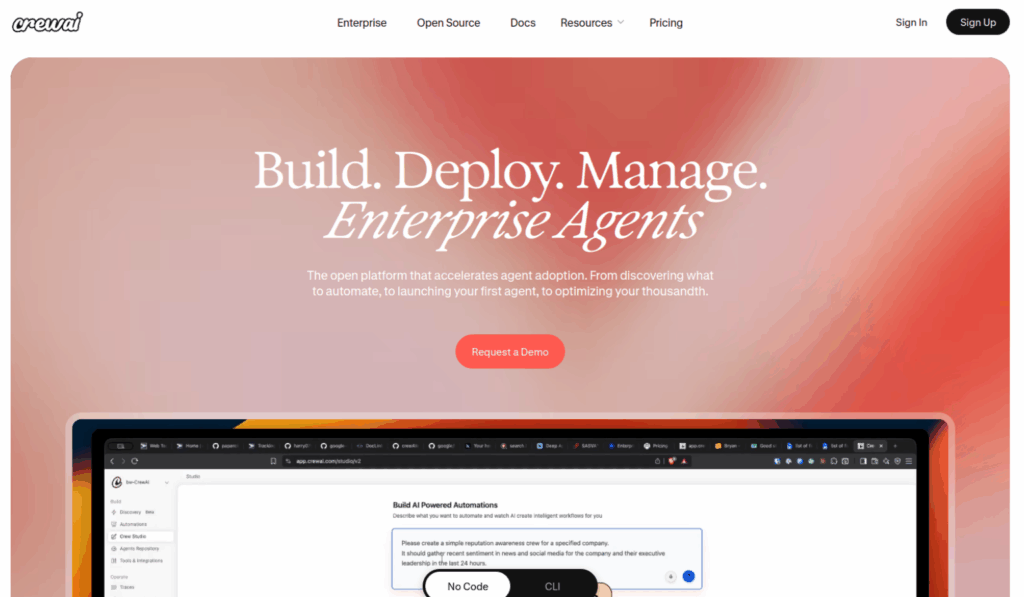
CrewAI is a standalone Python framework for orchestrating role-playing, autonomous AI agents, built without dependency on LangChain or other agent frameworks. Each agent gets a role, a goal, and a backstory, and CrewAI coordinates how they collaborate as a “crew” to complete a task, inferring execution order rather than requiring an explicit definition.
Strengths:
- Fastest time-to-working-demo of any framework on this list, the role-based abstraction gets a prototype running with minimal setup
- Role definitions read clearly to non-engineers, which helps when explaining an agent’s behavior to non-technical stakeholders
- Supports both simple sequential processes and more complex hierarchical delegation between agents
- Standalone architecture with no external framework dependencies keeps it lean and fast
- Large, active community and growing ecosystem of templates and examples
Weaknesses:
- Less precise control over exact execution flow compared to graph-based frameworks like LangGraph
- Because execution order is inferred rather than explicitly defined, debugging “why did the crew take this path” gets harder at production scale
- State management across long-running, multi-session workflows is more limited than LangGraph’s built-in checkpointing
- The core framework is open source, but deeper observability and governance tooling sits behind the commercial enterprise suite
- Works best with human review at key checkpoints, since hierarchical delegation produces sequences that are harder to predict in advance
This AI agent development framework fits content pipelines (research, write, edit, publish), lead qualification workflows, and any process that maps cleanly to distinct roles, plus fast prototyping where reaching a working demo matters more than fine-grained control over execution order.
LlamaIndex Workflows
- Type: Event-driven agent orchestration framework
- Company: LlamaIndex Inc.
- Model Compatibility: Any LLM
- Open Source: Yes (MIT License), fully open source with no restrictions on production or commercial use
Workflows is LlamaIndex’s orchestration layer for building multi-step agentic applications as a sequence of event-driven steps rather than a chain or graph. It reached its 1.0 stable release as a standalone package independent of the core llama_index library, so teams can adopt it for general-purpose orchestration even without using LlamaIndex for retrieval. Workflows start, pause, and resume statefully, and each step is type-safe, so data passed between steps is validated rather than inferred.
Strengths:
- Deep native integration with retrieval-augmented generation (RAG), a natural fit when an agent needs to reason over large document sets
- Provider-agnostic: the same workflow switches between OpenAI, Anthropic, Gemini, or local models with a single line of code change
- Type-safe step composition catches data-passing errors early rather than at runtime
- Standalone package independent of the core LlamaIndex library, so it can be adopted purely for orchestration
- Broad integration ecosystem, LlamaHub connects to 300+ data sources and every major vector database
Weaknesses:
- Best-fit use case is narrower than LangGraph or CrewAI, it excels specifically at document-heavy, retrieval-intensive pipelines rather than general-purpose agent orchestration
- Smaller mindshare outside RAG-specific use cases compared to LangGraph and CrewAI, meaning fewer production case studies for non-document workloads
- Teams already invested in a different retrieval stack gain less from LlamaIndex’s core advantage
- Operational overhead runs higher than a managed single-provider API for simple, single-shot Q&A over a handful of documents
LlamaIndex Workflows fits document-heavy, data-intensive pipelines best: enterprise knowledge base agents, research assistants pulling from large document sets, or any workflow where retrieval quality is the primary bottleneck.
Haystack Agents
- Type: Composable pipeline framework with agent components
- Company: Deepset
- Model Compatibility: Any LLM
- Open Source: Yes (Apache 2.0 License)
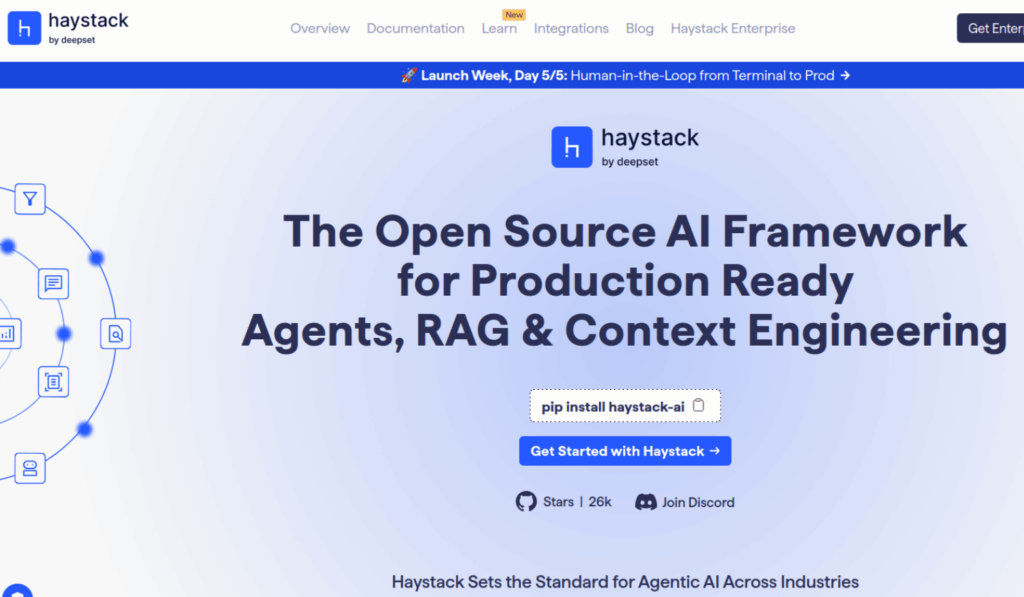
Haystack is Deepset’s open-source orchestration framework for building production LLM applications as modular pipelines, retrievers, generators, rankers, and other single-purpose components connected through typed, explicit connections. Agents in Haystack build on this same pipeline foundation: an LLM-powered component that calls tools, with lifecycle hooks for guardrails and built-in tracking of step count, token usage, and tool calls. The 2.x rewrite added a directed-graph runtime that supports cycles, enabling agent loops within the same architecture used for RAG.
Strengths:
- Deep heritage in retrieval and RAG, Haystack predates the LLM-framework wave and its document store integrations are mature
- Explicit, typed connections between components make pipelines easier to test and debug piece by piece
- Built-in production monitoring for agents: token usage, step count, and tool calls are tracked out of the box, not bolted on separately
- Ready-made agent templates (Agent Pack) for common patterns like deep research or advanced RAG agents shorten setup time
- Provider-agnostic chat model support, so the same agent component works across model vendors
Weaknesses:
- Smaller ecosystem and community mindshare than LangGraph or CrewAI, meaning fewer third-party tutorials and production references
- The typed-pipeline approach carries more upfront structuring work than role-based frameworks like CrewAI
- Advanced observability and evaluation tooling live in the separate commercial Haystack Enterprise Platform, not the open-source core
- Strongest fit is retrieval and document-heavy use cases, teams needing general-purpose multi-agent orchestration outside RAG may find the pipeline model less natural than a graph or role-based model
Haystack Agents fits teams building extensive RAG and document-processing workflows: semantic search, enterprise knowledge Q&A, or agents that need production-grade monitoring of token spend and tool usage from day one.
Rasa
- Type: Conversational AI framework (dialogue management + NLU)
- Company: Rasa Technologies GmbH
- Model Compatibility: Any LLM
- Open Source: Yes, Rasa Open Source (Apache 2.0 License); Rasa Pro (enterprise analytics, security, observability) and the Rasa Platform are commercial, open-core layers on top
Rasa is purpose-built for text- and voice-based conversational agents, combining LLM-driven dialogue understanding with explicit, code-defined business logic. Its CALM engine lets the model interpret what the user wants while defined flows enforce what it’s allowed to do, a split that matters for regulated, high-stakes conversations needing LLM flexibility without letting it decide business rules on its own.
Strengths:
- Built specifically for layered, back-and-forth conversation with memory, a stronger fit for chat/voice agents than general-purpose orchestration frameworks
- CALM engine separates LLM language understanding from hardcoded business rules, reducing the risk of the agent taking an unauthorized action mid-conversation
- Deploys on a team’s own infrastructure while Rasa handles conversation orchestration, guided flows, and external agent/knowledge integration
- Long production track record in enterprise customer service and virtual assistants, predating the current agent-framework wave
- Supports real-time voice with low-latency streaming speech recognition and responsive turn-taking
Weaknesses:
- Narrower scope than LangGraph, CrewAI, or LlamaIndex Workflows, Rasa is built for conversational agents specifically, not general multi-step task orchestration
- Advanced analytics, security, and observability sit behind the commercial Rasa Pro tier, not the open-source core
- Defining explicit business flows requires more upfront design work than a purely LLM-driven agent, trading some flexibility for reliability
- Less suited to non-conversational agent use cases like research, content generation, or backend task automation
Rasa fits customer-facing chat and voice agents that need enterprise-grade reliability best: banking, telecom, and support use cases where the conversation must follow strict business rules while still feeling natural to the user.
Mastra
- Type: TypeScript-first agent and application framework
- Company: Mastra, founded by the team behind Gatsby
- Model Compatibility: Any LLM
- Open Source: Core framework yes (Apache 2.0 License); enterprise features (observability platform, Memory Gateway) are source-available under a separate Mastra Enterprise License and require a paid license for production use
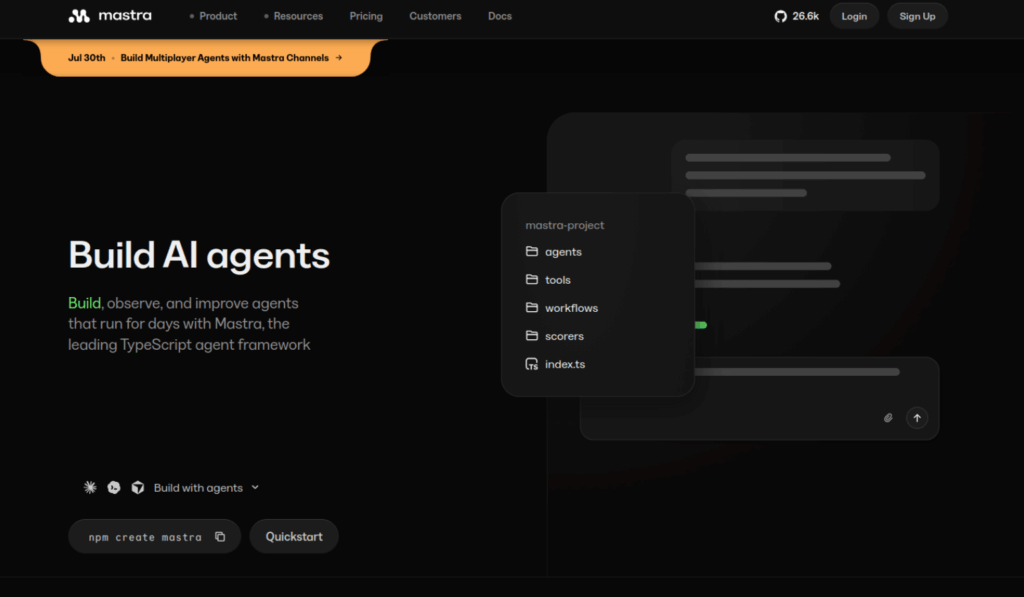
Mastra is built specifically for TypeScript developers, filling a gap where most major frameworks, LangGraph, CrewAI, LlamaIndex, are Python-first with JS ports added later. It covers the full agent lifecycle in one package: agents, workflows, memory, MCP tool integration, and observability, embedding directly into Next.js, Express, or Node.js apps rather than requiring a separate service.
Strengths:
- Native TypeScript design, not a translated port, integrates directly into JavaScript web stacks (Next.js, Express, Hono, SvelteKit) without a language-boundary tax
- Covers agents, workflows, memory, and observability as one cohesive framework rather than requiring separate tools stitched together
- Durable agent execution with built-in run recovery after a restart, useful for long-running production agents
- Backed by an experienced team with a track record shipping developer tools at scale
- Growing adoption among engineering teams already standardized on a JavaScript/TypeScript stack
Weaknesses:
- Ecosystem and third-party integrations are smaller than LangChain’s, which matters at a scale where breadth of pre-built connectors counts
- Lacks execution replay and time-travel debugging, a capability LangGraph already has
- No SOC 2 compliance as of early 2026, which may matter for enterprise procurement requirements
- Newer and less production-tested than Python-first frameworks with a longer track record
- Not a fit if a team or existing AI stack is Python-based, the TypeScript-first design is a strength only when that’s the team’s language
Mastra fits teams building AI agents inside an existing TypeScript/JavaScript product best: customer-facing assistants, internal copilots, or DevOps automation embedded directly into a Next.js or Node.js application, without introducing a separate Python service.
Claude Agent SDK (Anthropic)
- Type: Agent SDK built on Claude Code’s underlying infrastructure
- Company: Anthropic
- Model Compatibility: Claude only
- Open Source: No, the code is MIT-licensed, but usage is governed by Anthropic’s Commercial Terms of Service, including when powering a customer-facing product
The Claude Agent SDK gives developers the same infrastructure that powers Claude Code, as a library. Anthropic spent over six months solving problems like long-task memory, permission systems, and subagent coordination, and the SDK exposes those as building blocks. Rather than building a custom tool-execution loop, developers define what the agent can do and Claude handles the reasoning and tool calls. It supports Python and TypeScript, with Agent Skills, subagents, and session forking for parallel task decomposition.
Strengths:
- Built on the same production infrastructure running Claude Code internally at Anthropic, not a separate lighter-weight wrapper
- Handles the full tool-execution loop internally, meaning less orchestration code for developers to write and maintain themselves
- Subagents and session forking support complex, parallel task decomposition natively
- Skills system allows dynamic loading of instructions, scripts, and resources without bloating the base context
- Deep integration with Claude’s safety architecture, useful for safety-critical use cases like healthcare, finance, or legal workflows
Weaknesses:
- Teams needing multi-provider flexibility should look at a model-agnostic framework instead, since switching away from Claude means switching SDKs entirely
- Usage falls under Anthropic’s Commercial Terms of Service rather than a permissive open-source license, which enterprise legal/procurement teams should review before adopting
- Lighter on general-purpose orchestration features (explicit graph control, visual workflow builders) compared to LangGraph
- Newer as a general-purpose agent framework, it evolved from a coding-specific tool, so production patterns for non-coding use cases are less established
The framework fits teams already building on Claude who want deep model integration without assembling their own tool-execution loop, particularly safety-critical applications in healthcare, finance, or legal, and any workflow requiring subagent coordination or computer-use-style interaction.
Microsoft Agent Framework
- Type: Unified multi-agent orchestration framework (merger of AutoGen and Semantic Kernel)
- Company: Microsoft
- Model Compatibility: Multi-provider, Azure OpenAI, Microsoft Foundry, OpenAI directly, and other models via MCP; using non-Azure/third-party models falls under Microsoft’s “Third-Party Systems” terms, meaning the developer assumes the risk and cost
- Open Source: Yes (MIT License)
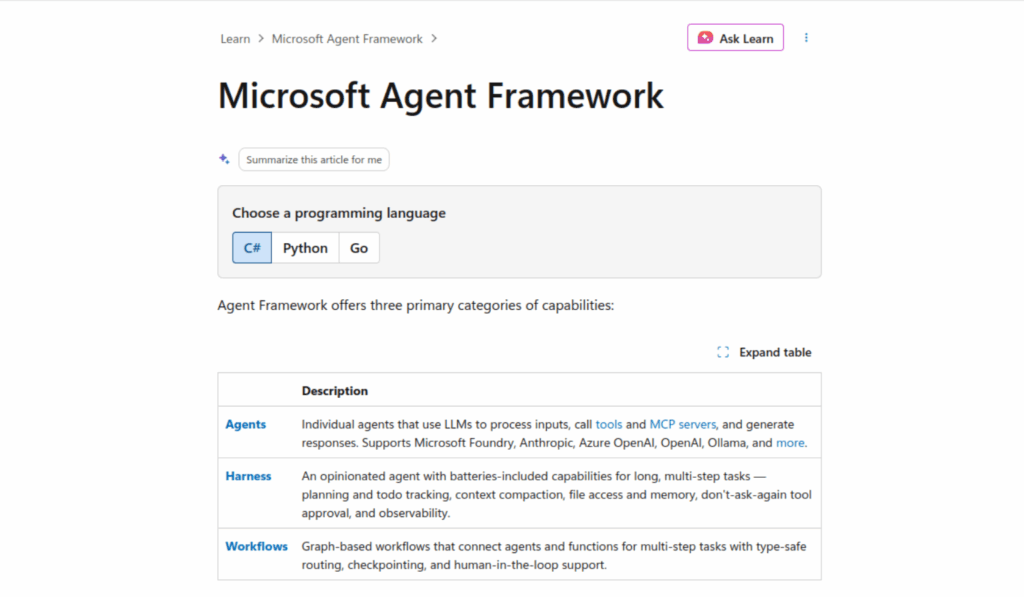
Microsoft Agent Framework reached version 1.0 in April 2026, unifying Semantic Kernel’s enterprise foundations with AutoGen’s multi-agent orchestration patterns into one SDK. Before this merger, teams had to choose between AutoGen’s flexible group-chat orchestration and Semantic Kernel’s production stability and compliance tooling, not both without a rewrite. The unified framework supports Python and .NET, with declarative YAML/JSON agent definitions and native support for open standards like MCP and A2A messaging.
Strengths:
- Combines AutoGen’s orchestration patterns (group chat, debate, reflection) with Semantic Kernel’s enterprise durability in one SDK, ending the previous prototype-to-production rewrite problem
- Fully open source under MIT, with active Microsoft investment and long-term support commitment
- Built-in observability via OpenTelemetry and Azure Monitor integration, plus Entra ID authentication for enterprise identity management
- Open standards support (MCP, A2A, OpenAPI-first tool import) gives cross-runtime portability rather than locking workflows into one execution environment
- Existing AutoGen and Semantic Kernel applications continue receiving bug fixes and security patches during the migration window, reducing pressure to rewrite immediately
Weaknesses:
- Newest of the major frameworks in its current unified form, with less production track record than LangGraph specifically in its post-merger shape
- Deepest feature integration (Foundry, Microsoft Graph, SharePoint, Entra ID) assumes an Azure-centric infrastructure; teams outside that ecosystem gain less from those specific connectors
- Using non-Azure models or third-party systems shifts data-handling and compliance responsibility explicitly onto the developer, per Microsoft’s terms
- Teams migrating from legacy AutoGen or Semantic Kernel codebases face a real migration effort, even with guides provided
The ramework fits enterprise teams on the Microsoft/Azure stack who need production-grade multi-agent orchestration with built-in compliance and identity tooling, especially those already using Entra ID, Azure Monitor, or Microsoft Foundry.
Google ADK
- Type: Code-first agent development framework
- Company: Google
- Model Compatibility: Model-agnostic, optimized for Gemini and the Google ecosystem, but not restricted to it; supports other models and integrates with other frameworks
- Open Source: Yes (Apache 2.0 License)
Agent Development Kit (ADK) is Google’s flexible, modular framework for building AI agents, designed to feel closer to conventional software development. Behavior, orchestration, and tool use are defined directly in code for testability. Its architecture centers on two classes: Agent (instructions, tools, behavior) and Workflow (a graph-based engine for routing, fan-out/fan-in, loops, retries, and human-in-the-loop steps).
Strengths:
- Model-agnostic despite Gemini optimization, offering genuine flexibility rather than a locked-in ecosystem, unlike some other vendor SDKs
- Graph-based Workflow Runtime gives explicit control over complex execution patterns (routing, fan-out/fan-in, retries), similar in philosophy to LangGraph
- Rich tool ecosystem: pre-built tools, custom functions, OpenAPI spec auto-import that removes the need to hand-write a function for every API endpoint, and MCP support
- Structured agent-to-agent delegation via its Task API, including multi-turn task mode and human-in-the-loop checkpoints
- Built-in developer UI (adk web) for testing, evaluating, and debugging agents without external tooling
Weaknesses:
- Deepest value is realized when paired with Google Cloud and Gemini, teams outside that ecosystem get a solid framework but not the full integration advantage
- The newer major version (2.0) introduced breaking changes to the agent API, event model, and session schema, meaning teams on older versions face a real migration step
- Some features remain in Pre-GA status under Google’s Pre-GA Offerings Terms, meaning limited support and “as is” availability for those specific capabilities
- Smaller third-party production track record than LangGraph or CrewAI, given its comparatively recent traction
This framework fits teams on Google Cloud who want fine-grained, code-first control over agent orchestration, especially workflows needing structured multi-agent delegation, OpenAPI-based tool integration, or deployment flexibility from laptop to production.
OpenAI Agents SDK
- Type: Lightweight multi-agent orchestration framework
- Company: OpenAI
- Model Compatibility: Provider-agnostic, supports OpenAI’s Responses and Chat Completions APIs plus 100+ other LLMs
- Open Source: Yes, MIT-licensed on GitHub; OpenAI states it is committed to continuing development as an open-source framework
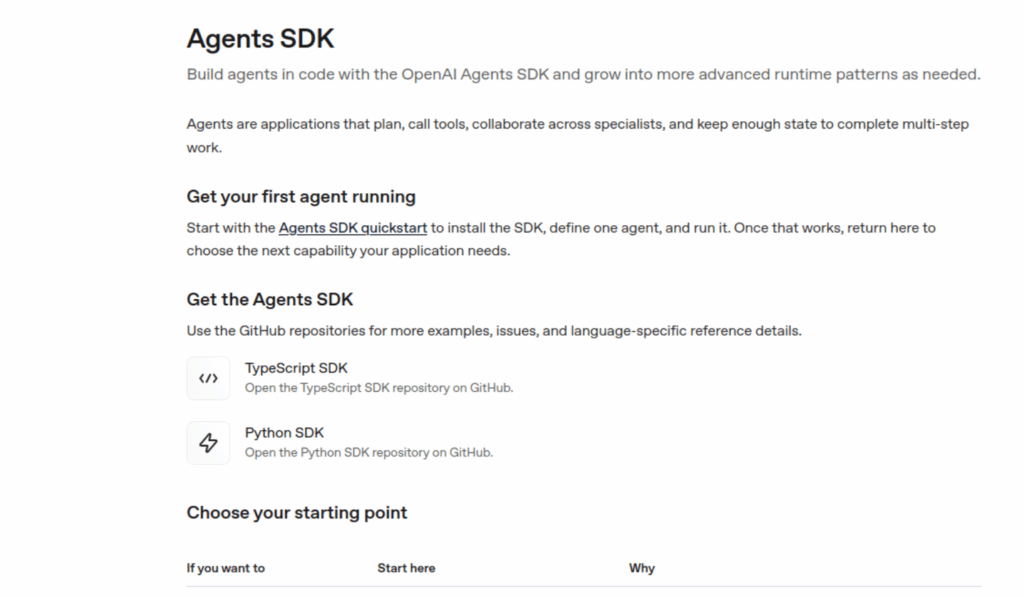
The OpenAI Agents SDK is designed to be lightweight rather than comprehensive. Agents are LLMs configured with instructions, tools, guardrails, and “handoffs” to other agents, without the heavier abstraction layers found in frameworks like LangGraph. It also supports Sandbox Agents, preconfigured to work inside a container for tasks that run over longer time horizons, plus built-in voice and Redis-backed session support as optional extensions.
Strengths:
- Provider-agnostic despite the OpenAI name, genuinely usable with 100+ other LLMs, not locked to one vendor
- Lightweight core design means less abstraction overhead and a shorter path from install to working agent
- Built-in tracing and guardrails ship as first-class features, not bolted-on additions
- Sandbox Agents extend naturally into long-running, container-based tasks without a separate framework
- Native voice agent support in the JS/TS version, useful for real-time conversational use cases
Weaknesses:
- Lighter feature set than LangGraph or Microsoft Agent Framework for complex, explicit graph-based orchestration
- Smaller ecosystem of pre-built integrations compared to LangChain’s broader connector library
- Newer entrant relative to LangGraph and CrewAI, with less production history for non-OpenAI-centric deployments specifically
- Optional features (voice, Redis sessions) require separate install groups, adding minor setup steps depending on use case
OpenAI Agents SDK fits teams that want a lightweight, low-overhead framework for multi-agent workflows with built-in tracing and guardrails, particularly when the workflow benefits from simple agent-to-agent handoffs rather than complex explicit graph control, or when long-running sandboxed tasks are part of the requirement.
How to Build an AI Agent with an LLM: A High-Level Architecture
Every framework in the previous section solves the same problem differently: how does an LLM go from answering one question to completing a multi-step task reliably? The architecture stays consistent even when the framework changes. Four decisions determine whether an agent survives contact with production.
- Define scope and tools: List exactly what the agent needs to touch, database, CRM, internal API, and turn each into a tool. Start with the minimum set required; add more only when testing reveals a real gap.
- Choose an orchestration framework: Match the framework to the task shape: graph-based (LangGraph, Microsoft Agent Framework) for conditional branches and approval gates, role-based (CrewAI) for fast prototyping, retrieval-focused (LlamaIndex, Haystack) for document-heavy reasoning. This choice is the hardest to reverse later.
- Add memory and observability: Memory must persist state across the full task, not just one exchange, so the agent resumes after a pause or failure. Observability must capture reasoning at each step, not just the final output, so failures get diagnosed from a trace instead of guesswork.
- Test and deploy: Test against edge cases first, ambiguous instructions, failed tool calls, conflicting data. Once the agent fails gracefully in testing, roll out incrementally with monitoring rather than launching to every user at once.
The framework changes how each step gets implemented. It doesn’t change that all four need to happen.
What Singapore Enterprises Should Consider Before Choosing a Framework
A technically excellent framework can still be the wrong choice if it doesn’t fit Singapore’s regulatory environment. Three factors matter specifically here: data transfers, agentic AI governance, and sector-specific rules.
- PDPA and data transfers: Cross-border transfers are permitted when the recipient provides a comparable standard of protection through contractual safeguards, certification, or consent. If a framework routes data through an overseas cloud provider, this obligation applies regardless of which one gets chosen.
- New agentic AI governance guidance: IMDA published a Model Governance Framework for Agentic AI in May 2026, calling for defined safety boundaries, human override mechanisms, and audit trails for all agent actions. Choose a framework with built-in observability and human-in-the-loop support rather than adding it later.
- PDPA applies to agent activity directly: The PDPC is separately developing guidelines on personal data use in generative AI, including safeguards for agent activity data specifically. Expect firmer guidance to follow as this consultation closes.
- Sector-specific rules for financial institutions: MAS AI guidelines are effectively mandatory for financial institutions, beyond the voluntary general framework. Fintech and banking teams should treat this as a compliance decision, not just a technical one.
A framework with strong native observability and audit logging satisfies these expectations by default, instead of requiring compliance tooling bolted on afterward.
Build vs. Outsource: Making the Right Call for Your Team
The real question isn’t which framework to pick. It’s whether to build in-house or bring in a partner who already has framework experience. The right call depends on three factors: team familiarity, time to ship, and ongoing maintenance capacity.
- Team familiarity: If engineers already know the chosen framework, building in-house avoids onboarding time. If it’s new to the team, the learning curve applies either way, the question is who absorbs it.
- Time to ship: A partner with prior framework experience compresses the timeline, since the setup mistakes have already been made once elsewhere. Building while learning simultaneously extends it, especially for graph-based frameworks.
- Ongoing maintenance: Production agents need monitoring and updates as models and frameworks evolve. In-house keeps that responsibility internal; outsourced or managed engagements shift it to the partner.
Neither path is inherently right. A team with strong framework fluency often builds faster in-house. A team without it, working against a deadline, usually loses more time learning the framework than it would take to select the right partner.
Why Choose Kaopiz for AI Agent Development
Every decision covered in this guide, which framework fits a given use case, how to architect the build, what Singapore’s regulatory environment requires, still needs a team that can execute it. This is where Kaopiz fits in.
We’ve spent over a decade delivering software for enterprise clients across Singapore, Australia, and Japan, with an engineering team of nearly 1,000 people across these markets. That means we staff an AI agent project with engineers who already understand the target framework, rather than starting a hiring search once the roadmap calls for it.
Three things separate how we work from a generic development shop:
- We architect for compliance from day one, not after an audit flags it. PDPA data-transfer obligations and IMDA’s Agentic AI governance expectations, audit trails, human override mechanisms, safety boundaries, get built into the agent’s architecture at the design stage, not bolted on before launch.
- We match engagement model to your actual constraint: a dedicated offshore development center for long-term embedded capacity, staff augmentation for one specific framework skill on one sprint, or a fully managed build when someone else needs to own the outcome entirely.
- We’ve made the framework evaluation mistakes already, on other projects. The comparison work in this guide, LangGraph vs. CrewAI, open-source vs. vendor-locked SDKs, compliance-first architecture, reflects decisions we’ve already worked through, so your team doesn’t have to re-derive them under deadline pressure.
If you’re weighing build versus outsource for your next AI agent project, talk to our team about your specific use case.
Conclusion
Choosing among AI agent development frameworks in 2026 comes down to three questions: does your workflow need explicit graph control or fast role-based prototyping, does your team need model flexibility or is a vendor-native SDK acceptable, and does your architecture satisfy Singapore’s PDPA and agentic AI governance requirements from the start?
Get those three right, and the framework choice stops being a guess and becomes a fit-for-purpose decision. If you’re ready to move from evaluation to execution, talk to the Kaopiz team about your specific use case. We’ll help you pick the right framework and build it correctly the first time.
FAQs
- What Is the Best AI Agent Framework in 2026?
- There is no single best framework — the right choice depends on your use case. LangGraph is the strongest fit for complex, stateful workflows requiring explicit control. CrewAI is fastest for role-based prototyping. LlamaIndex Workflows and Haystack Agents suit document-heavy, retrieval-focused agents. Vendor-native SDKs like Claude Agent SDK make sense when deep integration with one model provider outweighs the need for flexibility.
- Should I Choose LangGraph or CrewAI for My Project?
- Choose LangGraph if your workflow needs conditional branching, durable execution, or approval gates at specific steps. Choose CrewAI if you need to prototype a role-based, multi-agent system quickly and precise execution control matters less than speed to a working version.
- Are AI Agent Frameworks Free to Use?
- Most are open source and free at the core. LangGraph, CrewAI, LlamaIndex Workflows, Haystack Agents, Rasa, and Mastra all offer free, openly licensed frameworks. However, several offer separate commercial tiers for enterprise features like advanced observability, security, or managed deployment. Vendor-native SDKs such as Claude Agent SDK are free to use but governed by the provider’s commercial terms of service.
- Do I Need to Know How to Code to Build an AI Agent?
- Yes, all frameworks covered in this guide are code-first and require Python, TypeScript, or another supported language. No-code or low-code agent builders exist as a separate category but trade away the control and customization these frameworks provide.
- Can I Switch AI Models After Building My Agent?
- It depends on the framework. Model-agnostic frameworks like LangGraph, CrewAI, LlamaIndex Workflows, and Microsoft Agent Framework let you swap the underlying LLM without rewriting your orchestration logic. Vendor-native SDKs like Claude Agent SDK are tied to their provider’s models, so switching means adopting a different framework entirely.
Author

Table of Contents
Don’t miss what’s next!
Thank you! Your form has been submitted successfully.