

Best Finance AI Chatbots in 2026: Benefits, Use Cases, & Top 10 Solutions
Financial institutions are under mounting pressure to serve clients faster, smarter, and at lower cost, and finance AI chatbots have become a central part of how leading banks, fintechs, and insurance providers are meeting that challenge. In 2026, the global conversational AI market in banking is projected to exceed $6.8 billion, with chatbot adoption growing fastest in customer service, fraud prevention, and personal finance management.
This guide covers the best AI chatbots for finance available today, what they do, where they shine, and how to choose the right platform for your organization. Whether you are a retail bank looking to deflect support volume, a fintech building a personalized money app, or an enterprise automating back-office workflows, there is a solution here designed for your context.
Key Takeaways
- Finance AI chatbots automate routine banking tasks, reduce support costs, and deliver personalized client experiences at scale.
- Top platforms include ChatGPT (customizable), Kasisto (finance-native), Kore.ai (enterprise), Cleo (personal finance), and Haptik (full customer journey).
- Core use cases: customer support, expense tracking, fraud detection, account monitoring, and bill reminders.
- Selecting the right chatbot depends on your security requirements, system integrations, compliance needs, and target audience.
- Custom-built solutions offer the strongest fit for banks and fintechs with complex workflows or strict regulatory environments.
What Is a Financial AI Chatbot?
A financial AI chatbot is an artificial intelligence-powered virtual assistant designed specifically for the finance industry. It leverages technologies like natural language processing (NLP), machine learning, and predictive analytics to understand user queries, provide real-time responses, and automate financial services.

Unlike traditional chatbots with rigid scripts, AI chatbots for finance can interpret complex financial language, deliver personalized experiences, and continuously improve through interaction. These chatbots are used by banks, fintech companies, insurance providers, and investment firms to serve both customers and internal teams.
Why Use an AI Chatbot in Finance?
Digital transformation has raised customer expectations across every industry — but finance is particularly demanding. Clients expect instant answers to account questions at 2 a.m., proactive alerts before a payment bounces, and personalized advice that reflects their actual financial behavior. AI chatbots make all of this economically viable at scale.
The core benefits break down across three dimensions: customer experience, operational efficiency, and risk management.
- Customer experience: Chatbots deliver immediate, consistent responses 24/7 without wait queues. They can personalize every interaction using account history and behavioral data, creating an experience that feels attentive rather than automated.
- Operational efficiency: Routine queries, balance checks, transaction history, bill payment questions, account for a significant share of inbound support volume. Automating these frees human agents for complex, high-value conversations and reduces cost per interaction substantially.
- Risk and compliance: AI chatbots can monitor transactions for anomalous patterns in real time, trigger fraud alerts before damage occurs, guide users through regulatory disclosures, and maintain auditable logs of every interaction — a meaningful advantage in regulated markets.
What Are the Key Use Cases of AI Chatbots in the Finance Sector?
AI chatbots are transforming how financial institutions engage with customers, manage risk, and streamline internal processes. From customer service to fraud detection, the versatility of finance AI chatbots makes them indispensable for modern banking and fintech operations.
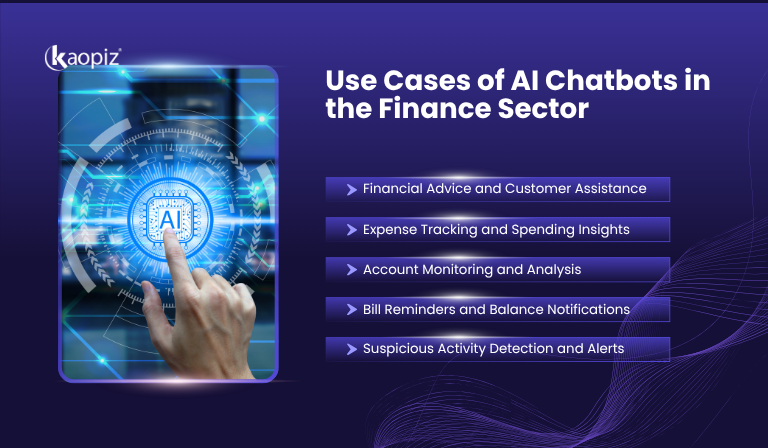
Here are 5 of the most common and impactful use cases for AI chatbots in the finance industry:
Financial Advice and Customer Assistance
AI chatbots can be configured to provide basic financial advice and answer frequently asked questions. While they don’t replace human financial advisors, they efficiently handle:
When a customer’s query goes beyond the chatbot’s scope (e.g., investment advice), it can seamlessly escalate the conversation to a human advisor.
Example: Talkbank’s chatbot “Buffet” (named after Warren Buffett) helps users with everyday financial questions before routing complex cases to human agents.
Expense Tracking and Spending Insights
Personal finance chatbots help users manage their budgets and keep spending in check by:
This empowers users to take control of their finances, without having to contact a bank or financial advisor every time. Chatbots reduce agent workloads and enable users to view expense summaries instantly within the chat interface.
Account Monitoring and Analysis
Finance chatbots can enhance transparency by giving customers instant access to account information:
With 61% of banking consumers interacting with their bank via digital channels weekly, this capability allows institutions to meet customers where they are — with fast, conversational service.
Imagine a customer simply typing “How much did I spend on groceries this month?” and receiving an instant, accurate breakdown from the chatbot.
Bill Reminders and Balance Notifications
One of the most appreciated features of AI chatbots for finance is proactive notification:
This helps users avoid late fees, stay within budget, and maintain good credit, while reducing awkward collections calls for staff. Bots can also let users set custom reminders based on due dates or spending limits.
Suspicious Activity Detection and Alerts
Security is critical in finance, and AI chatbots play a key role in fraud prevention. Chatbots can:
Example: A chatbot can immediately flag a transaction made from an unfamiliar location and ask the user, “Did you authorize this?” — helping prevent fraud before damage occurs.
Top 10 AI Chatbots for Finance in 2026
Let’s be honest — while there are plenty of chatbot platforms on the market, very few are purpose-built for the finance industry. The needs of financial institutions are unique, requiring high levels of security, compliance, and domain-specific functionality. So, which platforms truly stand out?
We’ve rounded up 10 of the best AI chatbots for business — from general-purpose models with strong financial use cases to specialized solutions tailored specifically for banking, fintech, and insurance.
| Chatbot | Best For | Key Strength | Pricing |
|---|---|---|---|
| ChatGPT (OpenAI) | Flexible enterprise use | Maximum customizability via API | From ~$20/month; enterprise custom |
| Copilot (Microsoft) | Microsoft 365 environments | Real-time web data + Azure security | Included in M365 / Copilot plans |
| Gemini (Google) | Research & analyst teams | Live market data + Google Workspace integration | Free; Gemini Advanced from $19.99/month |
| AlphaChat | Multilingual customer support | Pre-built finance templates, cross-channel | Custom pricing |
| Kasisto (KAI) | Banks & fintechs | Finance-native NLP, personalised insights | Custom pricing |
| Cleo | Personal finance / Gen Z | Engaging UX, spending insights, budgeting | Free; Cleo Plus from $5.99/month |
| Tidio | SME financial businesses | Easy no-code setup, lead generation | Free plan; paid from $29/month |
| Kore.ai | Large enterprise finance teams | End-to-end automation (customer + back-office) | Custom pricing |
| TARS | Lead gen & client onboarding | 320+ finance templates, conversion-focused | From $99/month |
| Haptik | Full customer lifecycle | Advanced analytics, pre-built service flows | Custom pricing |
ChatGPT by OpenAI
ChatGPT is a powerful conversational AI developed by OpenAI, known for its advanced language understanding and flexibility. While it’s not built specifically for finance, it can be customized to handle a wide range of financial use cases through API or ChatGPT Enterprise.
Features:
Pros and cons:
| Pros | Cons |
|---|---|
| Highly customizable | Not finance-specific by default |
| Scalable for internal and customer use | Requires setup and fine-tuning |
| Secure and enterprise-ready | Higher cost at scale |
| Fast integration across platforms |
Verdict:
A top choice for companies seeking a flexible, secure, and intelligent AI chatbot foundation for finance applications.
Copilot by Microsoft
Copilot is Microsoft’s conversational AI built on OpenAI’s GPT-4, integrated with the Bing search engine and Microsoft Edge. While not designed exclusively for finance, it offers strong capabilities for customer engagement, document summarization, and internal automation, especially for organizations already using Microsoft’s ecosystem (like Azure or Microsoft 365).
Features:
Pros and cons:
| Pros | Cons |
|---|---|
| Seamless integration with Microsoft 365 | Limited customization for finance-specific tasks |
| Real-time data from web search | Less control over chatbot behavior |
| Strong security via Azure | Not suited for complex financial workflows |
| Easy to deploy in Microsoft environments | Requires Microsoft ecosystem alignment |
Verdict:
Ideal for financial institutions already using Microsoft products that want a fast, secure, and intelligent chatbot with access to real-time information.
Gemini by Google
Gemini is Google’s conversational AI-powered formerly Bard. Known for its ability to pull real-time data from the web, Gemini can be a valuable tool for financial professionals looking for quick insights, stock updates, or help with economic terminology.
Features:
Pros & Cons:
| Pros | Cons |
|---|---|
| Real-time financial and economic data | Not tailored for deep finance workflows |
| Google Workspace integration | Limited API support for full customization |
| Strong for quick research and summaries | Less enterprise-grade control and governance |
| Easy to use for financial professionals | Requires manual fine-tuning for secure use |
Verdict:
Best suited for finance teams or analysts needing real-time insights, quick definitions, and market updates — especially within a Google-centric workflow.
AlphaChat
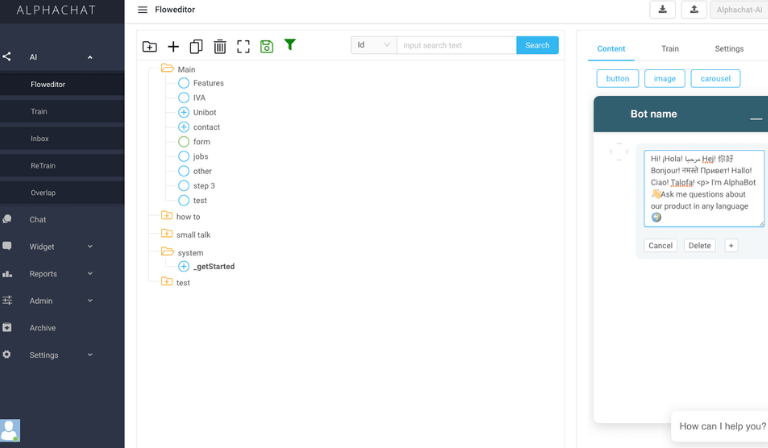
AlphaChat is an AI-driven chatbot platform built to enhance customer support in the finance industry. It helps users manage accounts, process payments, and get real-time answers to common financial queries.
It also includes analytics and intent detection, allowing financial institutions to identify common pain points and optimize service delivery. Deployment is flexible across multiple channels like WhatsApp, Messenger, and Apple Business Chat.
Features:
Pros & Cons:
| Pros | Cons |
|---|---|
| Thousands of pre-built conversation topics | Limited intent functions (e.g., scheduling not supported) |
| Easy-to-use visual editor for chatbot content | No visual flow of the customer’s chat journey |
| Strong analytics and reporting capabilities |
Verdict:
A great choice for finance companies needing a user-friendly, multilingual chatbot with cross-platform capabilities and powerful customer support automation.
Kasisto (KAI)
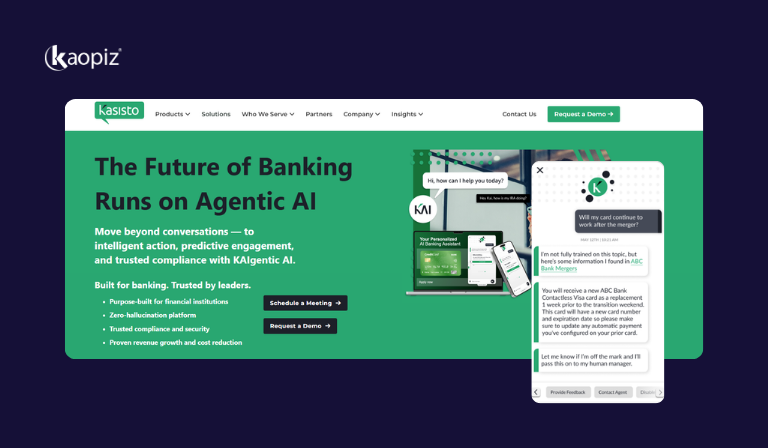
Kasisto (KAI) is a leading AI chatbot platform built specifically for the finance sector, trusted by banks and fintech companies worldwide. Known for its NLP and financial expertise, Kasisto delivers personalized financial advice, helps users manage their accounts, and responds to common banking inquiries — all while improving digital engagement.
Features:
Pros & Cons:
| Pros | Cons |
|---|---|
| Built specifically for finance institutions | Occasional bugs reported by users |
| Strong intent builder and customization options | Limited reporting and analytics tools |
| Supports multiple interaction modes (text, voice, touch) | Primarily focused on customer service |
| Provides actionable, personalized financial insights |
Verdict:
Kasisto is one of the best finance-specific AI chatbots, ideal for banks and fintechs seeking personalized, real-time customer service and engagement rooted in financial expertise.
Cleo
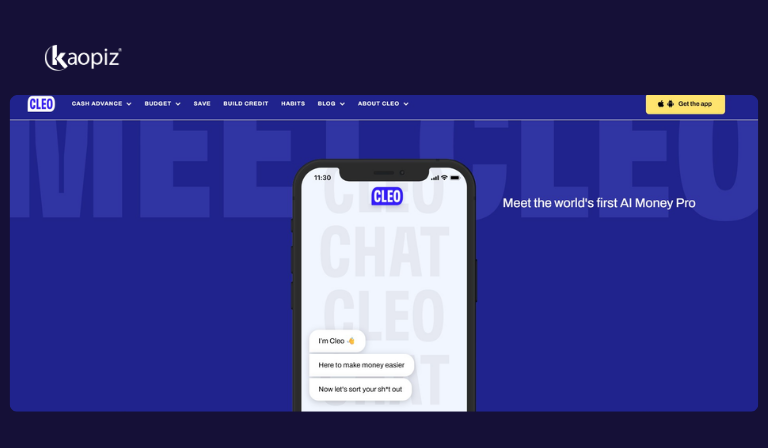
Cleo is a personal finance AI chatbot designed to help users manage their money in a fun, conversational, and engaging way. It offers budgeting tools, spending analysis, and financial tips — all delivered with a touch of humor and personality. Cleo is especially popular among younger users who prefer a casual, mobile-first approach to managing their finances.
Features:
Pros & Cons:
| Pros | Cons |
|---|---|
| Engaging and humorous user experience | Not suitable for complex financial tasks |
| Great for budgeting and spending awareness | Limited features for enterprise or B2B use |
| Popular among Gen Z and millennials | No deep investment or credit analysis |
| Easy to use and quick to set up |
Verdict:
Cleo is ideal for individuals, especially younger users, who want a light, engaging way to stay on top of their finances. It’s not a tool for enterprises, but it excels at promoting financial literacy and budgeting discipline in a user-friendly format.
Tidio
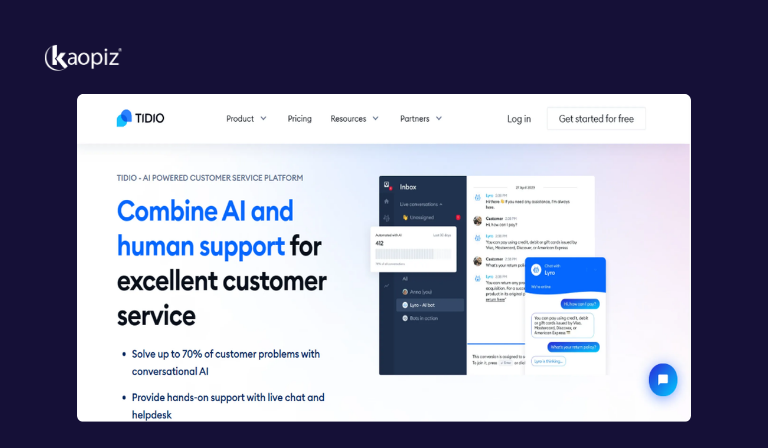
Tidio is an all-in-one customer service and chatbot platform that helps financial institutions improve client support, capture leads, and increase engagement. Its AI-powered chatbots can be customized for finance-specific use cases, such as booking consultations, handling FAQs, or collecting client data — all in real time.
Features:
Pros & Cons:
| Pros | Cons |
|---|---|
| Easy to set up with visual chatbot builder | More focused on sales and support, not deep finance workflows |
| Finance-ready templates (e.g., meeting scheduling) | Limited financial analytics and advisory features |
| Multichannel support across web and social media | May require third-party tools for advanced CRM needs |
| Free plan available to test features |
Verdict:
Tidio is a great choice for financial businesses looking to improve customer engagement and lead generation through customizable, real-time chatbots, without heavy technical effort.
Kore.ai
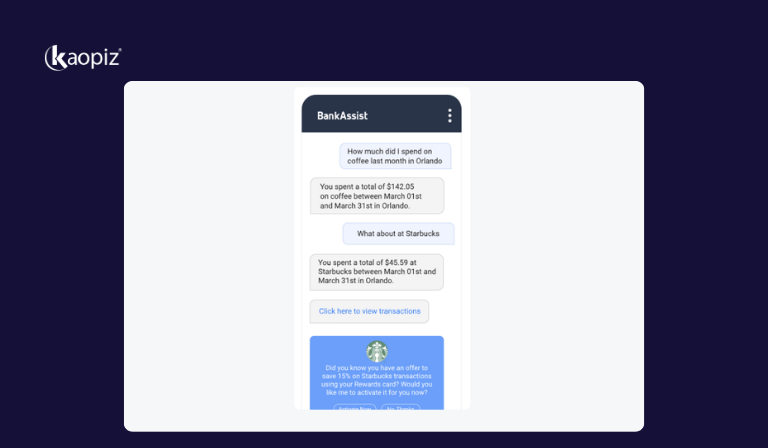
Kore.ai is a leading enterprise conversational AI platform, named a Leader in the 2023 Gartner Magic Quadrant. It empowers financial institutions to automate accounting, procurement, and customer support tasks using intelligent finance bots.
Designed for both back-office efficiency and customer-facing service, Kore.ai supports automated invoice processing, expense tracking, and balance notifications. It also functions as a conversational banking assistant, helping clients manage payments and stay updated on their financial status.
Features:
Pros & Cons:
| Pros | Cons |
|---|---|
| Intuitive visual builder for easy chatbot creation | Reporting and analytics features are limited |
| Powerful NLP capabilities across three engines | Chat/session management can be improved |
| Broad integration options with messaging platforms |
Verdict:
Kore.ai is a strong choice for banks and finance teams looking to automate workflows, improve customer service, and enhance financial operations through advanced conversational AI.
TARS
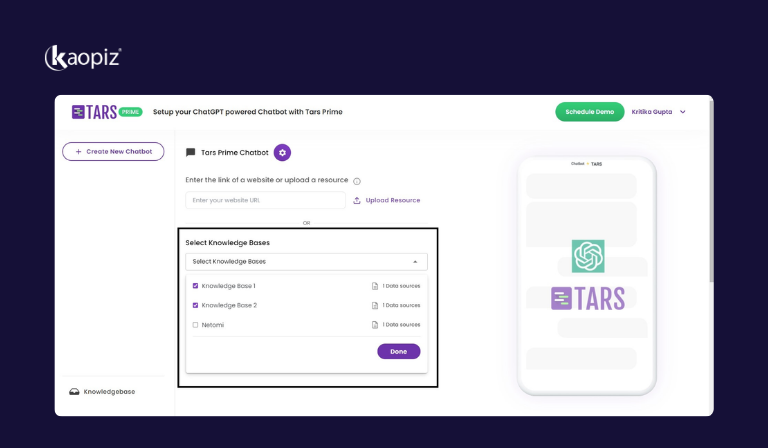
TARS is a chatbot platform designed to optimize conversion funnels, improve customer experience, and automate customer service interactions for online businesses — including financial institutions. When a visitor lands on your banking site, TARS greets them with a conversational prompt, creating a more personal and human-like interaction.
Features:
Pros & Cons:
| Pros | Cons |
|---|---|
| Extensive finance/banking chatbot templates | Limited customization options for advanced use |
| Simple and fast configuration | Some users report integration issues with analytics |
| Supports personalized experiences with geolocation features |
Verdict:
TARS is a great option for financial institutions looking to deploy quick, low-code chatbots that engage users, guide them through services, and boost conversion — all without overwhelming the end-user.
Haptik
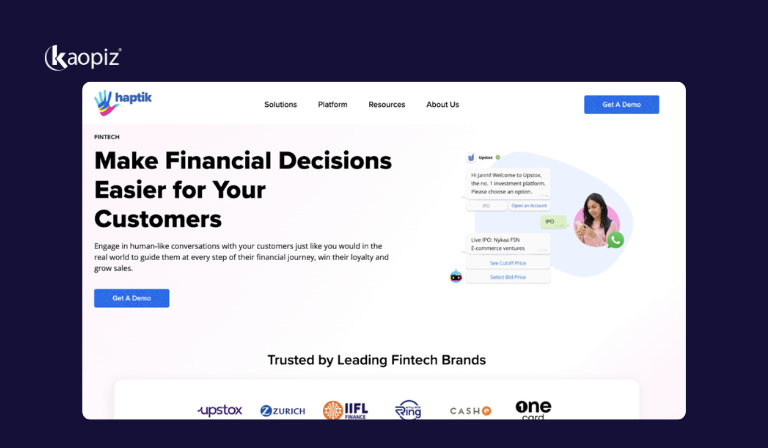
Haptik is a conversational AI platform that helps businesses manage the entire customer journey — from discovery and purchase to post-sale support. Tailored for industries like finance and insurance, Haptik’s virtual assistants are built to boost operational efficiency, increase revenue, and deliver personalized customer experiences.
Features:
Pros & Cons:
| Pros | Cons |
|---|---|
| Robust analytics platform for performance tracking | Limited onboarding guidance for Smart Agent Chat |
| Fast and responsive customer support | No real-time issue reporting |
| Pre-built flows for common financial use cases |
Verdict:
Haptik is a strong choice for financial institutions that want to deliver a personalized, sales-driven chatbot experience while supporting customers across the entire service lifecycle.
How Do You Choose the Right Finance AI Chatbot?
With a broad range of platforms available, the decision comes down to five questions that map your specific context to the capabilities that matter most.
- What tasks does the chatbot need to handle? Define your primary use cases before evaluating platforms. A bank automating inbound support volume has different requirements from a personal finance app targeting spending behavior change or an enterprise treasury team automating invoice processing.
- What are your security and compliance requirements? Confirm that any platform you evaluate supports the standards relevant to your market — GDPR for Europe, PDPA for Southeast Asia, SOC 2 for general enterprise trust, and PCI-DSS if payment card data flows through the chatbot. Purpose-built finance platforms (Kasisto, Kore.ai) have these built in; general platforms require verification.
- How does it integrate with your existing systems? A chatbot that cannot connect to your core banking system, CRM, or KYC module creates more friction than it resolves. Evaluate the depth of integration support, native connectors, REST API availability, and webhook flexibility, before committing to a platform.
- What is the total cost of ownership? Published pricing rarely reflects real costs. Factor in setup and configuration, integration development, staff training, ongoing maintenance, and model retraining. Basic SaaS plans start around $50–$200 per month; enterprise custom deployments range from $10,000 to $100,000+ depending on complexity.
- What does the user experience feel like? Run the chatbot through your most common user scenarios. Response latency, escalation smoothness, and the quality of fallback handling (what happens when the bot doesn’t understand a query) have a direct impact on customer satisfaction and adoption rates.
What Are the Future Trends in Finance AI Chatbots?
The finance AI chatbot category is evolving rapidly. Five trends are shaping the next generation of platforms.
- Hyper-personalization at scale. Chatbots will move beyond rule-based personalization to dynamic, real-time personalization driven by full transaction histories, behavioral signals, and life event detection. A customer who just received a large transfer will see different prompts than one whose balance has been declining for three months.
- Voice-enabled financial assistants. Integration with smart speakers, in-car systems, and mobile voice assistants will make conversational banking accessible in contexts where screens are unavailable. Banks are already piloting voice-based balance checks and payment confirmations through Amazon Alexa and Google Assistant.
- Agentic AI, beyond conversation to action. The next frontier is not chatbots that answer questions but agents that take actions: initiating transfers, filing insurance claims, rebalancing investment portfolios, or disputing transactions on the user’s behalf. Several platforms are already in early-stage deployment of agentic finance features.
- Biometric authentication integration. Security in chatbot interactions will advance beyond PINs and passwords to voice ID, facial recognition, and behavioral biometrics, enabling high-assurance transactions through conversational interfaces without sacrificing the user experience.
- Regulatory AI and compliance automation. Chatbots will increasingly handle compliance-adjacent tasks, guiding users through KYC verification flows, delivering MiFID II or GDPR disclosures in plain language, and maintaining auditable conversation logs automatically, reducing the compliance burden on human staff.
Build Custom Finance AI Chatbots with Kaopiz
At Kaopiz, we help financial institutions and fintech companies build tailor-made AI chatbots that go beyond basic automation. Whether you’re a bank, insurance provider, or personal finance app, our team works closely with you to develop secure, scalable, and intelligent chat solutions that meet your specific needs.

Why Choose Kaopiz for Finance Chatbot Development?
- Our solutions are built with strict attention to security standards (e.g., SOC 2, GDPR, PCI-DSS) and data protection best practices.
- We integrate chatbots with your existing systems — CRMs, core banking software, KYC modules, and third-party APIs — to ensure a connected experience.
- Using NLP and machine learning, we develop chatbots that understand financial language, user intent, and provide real-time personalized insights.
- Kaopiz builds bots that operate across platforms like web, mobile, WhatsApp, and Facebook Messenger, with support for multiple languages.
- Our bots come with performance dashboards and logging capabilities, allowing your team to monitor KPIs, optimize interactions, and enhance UX over time.
Whether you need a chatbot to improve customer service, reduce operational costs, or drive more conversions, Kaopiz is your trusted partner for custom finance AI chatbot development.
Conclusion
AI chatbots are transforming the financial industry by automating routine tasks, improving customer engagement, and delivering personalized financial support — all while ensuring efficiency and compliance.
As you explore chatbot solutions, focus on platforms that align with your goals, integrate with your systems, and prioritize security. Whether you’re a bank, fintech startup, or insurance provider, investing in the right AI chatbot can enhance your service delivery and give your business a competitive edge.
At Kaopiz, we specialize in building custom financial AI chatbots tailored to your needs — secure, scalable, and smart. If you’re ready to elevate your digital customer experience, our team is here to help.
FAQs
- How Secure Are AI Chatbots for Banking?
- Enterprise finance chatbots are built with encryption, role-based access controls, and secure APIs — and most hold certifications like SOC 2, ISO 27001, or PCI-DSS. Security also depends on implementation quality and ongoing monitoring, so always verify a vendor’s certifications and run your own assessment before deploying in a regulated environment.
- Can AI Chatbots Provide Financial Advice?
- AI chatbots handle general guidance, product information, and budgeting tips well — but they are not a substitute for licensed advisors on investment, tax, or legal decisions. Most platforms are designed to escalate complex queries to a human agent when needed.
- How Much Does It Cost to Implement a Finance AI Chatbot?
- Costs vary widely. SaaS plans start at $50–$200/month for standard functionality. Enterprise deployments with system integration typically run $10,000–$50,000. Fully custom solutions for large institutions range from $50,000 to $150,000+, plus roughly 15–25% of the build cost annually for maintenance.
- Are AI Chatbots in Finance Subject to Regulation?
- Increasingly, yes. Regulators are issuing guidance covering explainability, data privacy (GDPR, CCPA, PDPA), and consumer protection. The EU AI Act classifies certain financial AI applications as high-risk. Always conduct a regulatory assessment for your specific market before launch.
- What Is the Difference Between a Finance Chatbot and a Robo-Advisor?
- A finance chatbot is a conversational interface for customer service and routine transactions. A robo-advisor automatically builds and manages investment portfolios based on user goals. The two are increasingly overlapping but serve different primary purposes and face different regulatory requirements.
Author

Lucie Tran
Head of Growth of Kaopiz Global
Leave a Comment
Table of Contents
Don’t miss what’s next!
Thank you! Your form has been submitted successfully.

Pingback:From SERP to LLM: Mapping the New Customer Journey in a GEO World - Kingy AI
Pingback:How to Create Your Own AI Bot: Full Guide with Current Trends, Tools, and Expert Advice
Pingback:What Is a Chatbot? Benefits of Chatbots for Websites. – Natraj IT Solutions Blog