
How to Build Smart Manufacturing Systems with AI: A Step-by-Step Guide for Singapore Manufacturers
Singapore’s manufacturers are facing a quiet but widening gap. AI adoption among non-SME manufacturers jumped from 44% to 62.5% in a single year. The factories pulling ahead are not necessarily larger or better-funded. They simply started — and in the right place.
Most plant managers and engineering leads I speak with already know AI matters. The question is how to actually build a system that works without burning budget on a pilot that never reaches production.
I have spent the last decade helping 500+ companies across Singapore, Japan, and Vietnam implement enterprise technology. In manufacturing, the same failure pattern repeats: wrong use case first, data readiness skipped, legacy system integration underestimated. It is rarely a technology problem. It is a sequencing problem.
This guide gives you a concrete five-step implementation roadmap on how to build smart manufacturing systems with AI — from choosing your first use case to scaling past the pilot. It also covers something most guides ignore entirely: how to use Singapore’s EDG, PSG, and Enterprise Compute Initiative to co-fund a significant portion of your project.
Key Takeaways
- Smart manufacturing AI works across three layers: data and connectivity, AI/ML engine, and decision and action, all three must be in place for the system to function
- Predictive maintenance is the safest first use case for most Singapore manufacturers, historical data usually already exists and ROI is straightforward to measure
- Data and legacy system readiness, not model complexity, is the most common reason AI pilots fail
- A 90-day pilot structured across three phases, foundation, build and test, deploy and measure — is enough to produce board-level evidence for scaling
- Singapore manufacturers can co-fund a significant portion of AI implementation through EDG, PSG, or the Enterprise Compute Initiative, apply before signing any vendor contract
What a Smart Manufacturing System with AI Actually Looks Like
Before knowing how to build smart manufacturing systems with AI, it helps to be precise about what you are actually building.
“Smart manufacturing” gets used to describe everything from a single dashboard to a fully autonomous production line. For the purposes of this guide, and for most manufacturers starting out in 2026, a smart manufacturing system with AI means three layers working together:
- Layer 1 — Data and connectivity: Sensors and IIoT devices on your machines feed real-time data, temperature, vibration, cycle time, output rate, through industrial protocols like OPC-UA or MQTT into a central or cloud environment. This is your raw material. Without it, there is no AI.
- Layer 2 — The AI/ML engine: Models trained on your historical and real-time data to do one of four things: detect anomalies before they become failures, predict when a machine needs maintenance, classify product defects by visual inspection, or forecast demand and inventory needs. This is where the intelligence lives.
- Layer 3 — Decision and action: The AI output surfaces as alerts, dashboards, or automated triggers that connect into your MES or ERP. This is where the system actually changes what happens on the floor.
One distinction worth making clearly: this is not traditional automation. A PLC follows fixed rules you program once. An AI model learns from your data, adapts to changing conditions, and improves its accuracy over time, without manual reprogramming.
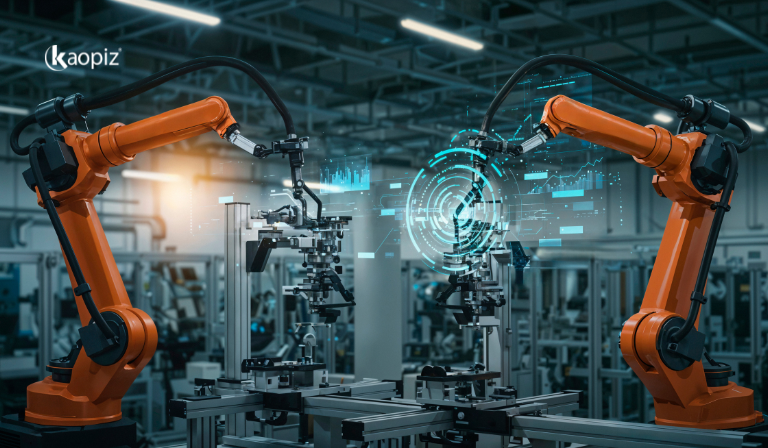
Singapore’s manufacturing sector is increasingly adopting Industry 4.0 and 5.0 principles, integrating IoT, cobots, and AI across production operations. In most facilities we work with, the hardware infrastructure, the sensors, the controllers, the connectivity, is largely already in place. The gap is almost always in the integration layer: getting data flowing cleanly into a model and getting model output flowing back into real decisions.
How to Build Smart Manufacturing Systems with AI: A Step-by-Step Guide in 2026
In the digital transformation of manufacturing, most manufacturers know they need to act. The missing piece is not budget or technology. it is a clear, sequenced path from where they are today to a running system in production.
The five steps below give you a sequenced path from initial use case selection through to full deployment. Each step builds on the last. Skipping ahead, jumping straight to tech stack selection before your data is ready, for example, is the most common reason pilots fail to reach production. Work through them in order. The 90-day pilot in Step 4 is achievable from a standing start on how to build smart manufacturing systems with AI.
Step 1: Choose The Right AI Use Case for Your Factory
One decision shapes everything that follows: which problem you ask AI to solve first.
Choose the wrong use case, too complex, too data-sparse, or disconnected from a measurable outcome, and the pilot fails. In my experience, a failed first pilot is the single biggest reason manufacturers abandon AI investment entirely.
The 4 use cases below account for the majority of successful first deployments we have seen across Singapore and Asia:
| Use Case | Best Fit (Singapore) | Typical ROI | Complexity |
|---|---|---|---|
| Predictive maintenance | Precision engineering, semiconductor equipment | 20–40% downtime reduction | Low–Medium |
| AI quality control | Electronics assembly, PCB inspection | 50–90% faster defect detection | Medium |
| Demand forecasting | Export-oriented manufacturers | 15–30% inventory cost reduction | Medium |
| Energy optimization | High energy-intensity plants | 10–20% energy savings | Low |
If you are unsure where to start, predictive maintenance is almost always the right answer. Historical sensor data usually already exists, the ROI is easy to quantify, and the scope is contained.
Before committing, answer three questions: Do we have at least 6–12 months of relevant data? Is this problem costing us measurable money today? Is there someone internally who will own the outcome after go-live? A use case that scores yes on all three is ready. Anything less needs more groundwork first.
Step 2: Assess Your Data and Infrastructure Readiness
The most common reason AI pilots fail has nothing to do with the model. It has to do with the data feeding it. Before selecting a single tool or writing a line of code, run an honest assessment across five areas:
- Sensor coverage: Are the right machines instrumented and generating the data your use case needs?
- Data quality: Is it consistent, correctly labelled, and sampled at a useful frequency?
- Connectivity: Can data reach a central or cloud environment reliably and in near real-time?
- Historical depth: Most predictive models require 6–12 months of clean historical data to train effectively.
- Internal ownership: Who manages the data pipeline after the implementation partner leaves?
The area most manufacturers underestimate is legacy system integration. Most factories in Singapore’s older industrial estates run PLC and SCADA systems that were never designed to communicate with AI platforms. Bridging that gap, through middleware, OPC-UA adapters, or custom API layers, takes real time and budget.
In several projects we have delivered across Asia, this phase alone consumed 35–40% of total project time. Scope it early, not halfway through.
Step 3: Choose Your AI Tech Stack
You do not need the most sophisticated stack. You need the right one for your team’s current capabilities and your factory’s existing infrastructure.

Match your tool choices to the three-layer architecture covered earlier, connectivity, intelligence, and action:
IoT / Connectivity layer
- AWS IoT Core: Best for factories planning a cloud-first architecture; well-supported in Singapore given AWS’s local region presence
- Azure IoT Hub: Strong if you are already running Microsoft Dynamics or 365; integrates cleanly with Power BI
- On-premise edge computing (NVIDIA Jetson, industrial PCs): For latency-sensitive or air-gapped environments
AI / ML layer
- Python + scikit-learn / PyTorch: For teams with a data scientist on staff
- AWS SageMaker / Azure Machine Learning: Managed ML with a lower expertise barrier; well-suited for Singapore SMEs with lean IT teams
- Computer vision (YOLO, OpenCV, AWS Rekognition): Specifically for electronics and PCB defect inspection
Visualization / Action layer
- Grafana: Open source, strong for real-time sensor dashboards
- Power BI: Good fit if Microsoft stack is already in place
- Custom dashboard: When deep MES/ERP integration is required
On the build vs buy vs partner question: building in-house requires three or more data engineers and a 12-month runway, uncommon for most Singapore SMEs. Off-the-shelf SaaS tools are fastest to deploy but carry vendor lock-in risk.
Partnering with an AI development firm sits in the middle, faster than building, more customizable than buying, and eligible for EDG co-funding. For manufacturers with fewer than 500 employees, this is almost always the most practical path.
Step 4: Run a 90-day Pilot Project
A 90-day timeline works for one reason: it is short enough to get board and CFO approval, and long enough to produce results that justify scaling.
Structure the pilot across three months:
- Month 1 — Foundation: Finalize the data pipeline from source machines to your model environment. Establish baseline KPIs — current downtime rate, defect rate, or energy cost per unit. Do not move to model training until the baseline is clean and agreed upon. This is the phase most teams rush, and the one that causes the most problems later.
- Month 2 — Build and test: Train the initial model on historical data and run it in shadow mode — the AI operates in parallel with your existing process but controls nothing yet. Measure false positive and negative rates and refine accordingly. Involve operators at this stage; their feedback is more valuable than any accuracy benchmark.
- Month 3 — Deploy and measure: Go live on one production line or machine group. Track against your Month 1 baseline daily. The deliverable at the end of Month 3 is not just a result — it is a go/no-go recommendation for scaling, with evidence.
On ROI: keep measurement simple and use-case specific. Predictive maintenance tracks downtime reduction and maintenance cost per machine. Quality control tracks defect escape rate and inspection hours saved. Singapore SMEs using AI-enabled solutions under the Productivity Solutions Grant achieved average cost savings of 52% in 2024, a well-scoped pilot should show clear directional signal toward that range within the first deployment month.
Step 5: Scale from Pilot to Full Deployment
A successful pilot proves the concept. Scaling it proves the system.

Most manufacturers underestimate how different full deployment is from a controlled pilot. Four failure points appear almost exclusively at this stage:
- Data drift: The model was trained on relatively clean pilot data. Production at scale is messier. Without a scheduled retraining pipeline, model accuracy degrades quietly over weeks and months without obvious warning signs.
- MES/ERP integration: Connecting AI output to actual production scheduling, procurement, and reporting requires systems integration work that is almost always more complex than anticipated. Scope this before you scale, not after.
- MLOps: Model versioning, performance monitoring, and automated retraining need to be designed into the architecture before full deployment. Teams that bolt these on afterward spend months firefighting instead of scaling.
- Change management: Operators need to understand and trust AI recommendations or they will override them. This is the most consistently under-resourced phase in manufacturing AI projects. No one trains the shop floor team. No one owns the model after the vendor leaves. The technology succeeds and the adoption fails.
Scale one production line at a time rather than the entire facility at once. Validate that each line performs against the same KPI baseline used in the pilot before expanding further. This pacing also gives your internal team time to build the operational muscle, monitoring, retraining, and troubleshooting that sustains the system long after implementation is complete.
How Singapore Manufacturers Can Fund AI Implementation
Understanding how to build smart manufacturing systems with AI is a significant investment, but in Singapore, you are not making it alone.
Three grants are most relevant for manufacturing AI projects:
- Enterprise Development Grant (EDG): Covers up to 50% of qualifying project costs, including consultancy, software, and internal manpower. Manufacturing AI projects qualify under the Innovation and Productivity pillar. The most flexible option for custom implementation work.
- Productivity Solutions Grant (PSG): Covers AI solutions, including automation tools and predictive analytics, funding up to 50% of costs capped at S$30,000/year. Faster to apply than EDG and more straightforward — the right choice if you are adopting a pre-approved AI tool rather than building a custom system.
- Enterprise Compute Initiative (ECI): Backed by S$150 million from Budget 2025, it provides cloud credits and consultancy support to help companies develop a Minimum Viable Product. Well-suited for manufacturers at Step 3 or 4 who have a defined use case but need compute resources to move from concept to working prototype.
One rule applies to all three: apply before signing any vendor contract. Singapore’s no-retrospective-funding rule is strictly enforced; any payment made before grant approval is ineligible.
Most manufacturers we work with are surprised by how much of a project can be co-funded once the scope is structured correctly.
Common Mistakes Singapore Manufacturers Make When Building AI Systems
Most AI projects do not fail because the technology does not work. They fail because of decisions made before a single model is trained.
Five mistakes account for the majority of failed manufacturing AI projects we have seen in Singapore:
| Mistake | What Goes Wrong | How to Avoid It |
|---|---|---|
| Buying AI software before preparing data | Vendor demos run on clean datasets — your production data has gaps, noise, and legacy formatting issues | Complete the data readiness checklist in Step 2 before evaluating any tools |
| Choosing a use case too complex for a first pilot | Overscoped pilots miss deadlines, exhaust budget, and never reach production | Limit the first project to one use case, one machine group, 90 days |
| No internal champion after go-live | Retraining gets skipped, the system degrades quietly, vendor engagement ends | Identify the internal owner before the project starts, not at handover |
| Treating legacy integration as an afterthought | Discovering PLC/SCADA incompatibility in Month 2 is expensive and delays everything | Scope legacy system integration in Week 1 of the project |
| Applying for grants after signing vendor contracts | Payments made before grant approval are ineligible under Singapore’s no-retrospective rule | Run the grant application in parallel with scoping, not after procurement |
The pattern across all five is the same: problems that surface late in a project almost always had early warning signs that were deprioritized. The five steps for the smart building management system in this guide are sequenced specifically to surface those warning signs before they become project failures.
How Kaopiz Helps Singapore Manufacturers Build Production-Ready AI Systems
Understanding how to build smart manufacturing systems with AI requires more than technical capability; it requires a partner who understands industrial operations, legacy infrastructure, and how to deliver systems that hold up in production, not just in demos.
Why Choose Kaopiz
Kaopiz has spent 12+ years delivering enterprise technology for manufacturers across Singapore, Japan, Vietnam, and more.
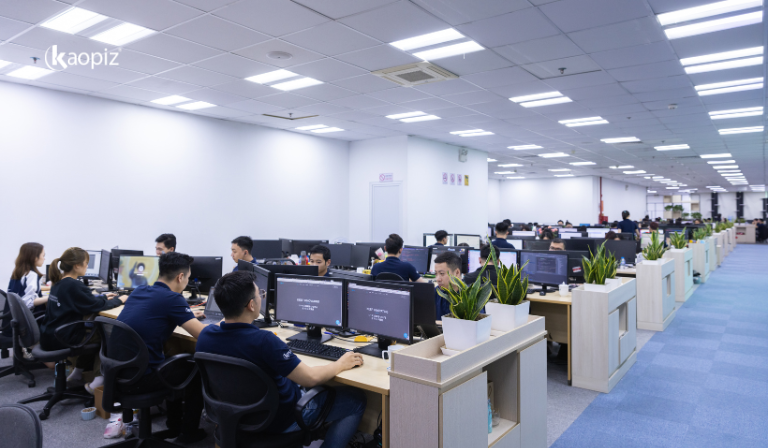
Our delivery track record speaks for itself:
- 1,000+ engineers with deep expertise across AI, IoT, and industrial systems
- 500+ global clients across manufacturing, logistics, and infrastructure
- 98% client satisfaction rate across all delivered projects
- End-to-end capability — from use case discovery and data readiness through custom AI development, production deployment, and ongoing MLOps support
We build custom AI systems, not off-the-shelf software, which matters significantly for manufacturers dealing with legacy PLC and SCADA infrastructure or non-standard production processes.
For Singapore manufacturers specifically, we also help structure projects to align with EDG, PSG, and ECI grant requirements from the start, so co-funding is built into the project plan rather than applied for retrospectively.
Real-World Results: AI Computer Vision for Industrial Manufacturing
A large-scale engineering and manufacturing company needed to automatically detect hazardous zones on active work sites using live video footage, replacing manual inspection that was inconsistent and difficult to record.
Kaopiz built a computer vision system that analyzes on-site video in real time, automatically identifies safety barriers and markers, and generates visual hazard zone overlays with shareable detection records. The outcome: automated hazard identification that eliminated manual visual checks, improved on-site safety management, and significantly reduced reporting burden for site supervisors.
The same computer vision approach applies directly to quality inspection on Singapore electronics and precision engineering lines, detecting defects, foreign objects, or assembly errors from live camera feeds without manual checking.
If you are planning to build AI into your manufacturing operations, our team offers a free 30-minute AI scoping session. We will review your current setup, identify the highest-ROI starting point, and outline which Singapore grants apply to your project.
Conclusion
Understanding how to build smart manufacturing systems with AI is one thing; executing it in the right sequence is another. Start with the right use case, validate your data, choose a stack that fits your team, run a focused 90-day pilot, and scale deliberately.
Singapore manufacturers are better positioned than most to move on this. The grant funding is there. The manufacturing clusters, electronics, precision engineering, and aerospace MRO, are exactly where AI delivers the fastest ROI.
FAQs
- How Long Does It Take to Build a Smart Manufacturing System With AI?
- A well-scoped pilot typically takes 90 days from kickoff to first measurable result. Full deployment across multiple production lines usually takes 6–12 months depending on legacy system complexity and the number of use cases being implemented.
- How Much Does It Cost to Implement AI in a Manufacturing Facility in Singapore?
- A focused pilot — one use case, one production line — typically ranges from S$50,000 to S$150,000 before grant co-funding. With EDG or PSG support, net cost can be reduced by up to 50%. Larger full-facility deployments vary significantly based on scope and existing infrastructure.
- What Singapore Government Grants Are Available for Manufacturing AI Projects?
- The three most relevant schemes are the Enterprise Development Grant (EDG), Productivity Solutions Grant (PSG), and Enterprise Compute Initiative (ECI). EDG covers up to 50% of qualifying project costs including consultancy and software. Apply before signing any vendor contract — Singapore’s no-retrospective rule is strictly enforced.
- Do I Need a Data Scientist In-house to Build an AI Manufacturing System?
- Not necessarily. Managed cloud ML platforms such as AWS SageMaker and Azure Machine Learning significantly reduce the in-house expertise requirement. Partnering with an AI development firm is the most practical path for most Singapore SMEs without a dedicated data science team.
- What Is the Difference Between Smart Manufacturing and Traditional Automation?
- Traditional automation follows fixed, pre-programmed rules. AI-powered smart manufacturing learns from data patterns, adapts to changing conditions, and improves accuracy over time — without manual reprogramming each time conditions change.
Author

Leo Nguyen
Chief Executive Officer of Kaopiz Global
Table of Contents
Don’t miss what’s next!
Thank you! Your form has been submitted successfully.