Software Development Life Cycle vs Product Life Cycle: 8 Key Differences (2026 Guide)
The software development life cycle vs product life cycle question matters more than most roadmaps admit. A product can ship on time, pass every test, and still fail in the market. That happens because shipping belongs to one cycle, and commercial success belongs to another.
The SDLC governs how each release is planned, built, tested, and deployed. The product life cycle governs the product’s life in the market, from launch to retirement. In this guide, we compare the two cycles across eight dimensions, explain how they connect, and in Section 6 map the right SDLC approach and team model to each product stage.
Key Takeaways
- The SDLC is an engineering process that repeats with every release; the product life cycle is a business journey that runs once per product.
- One product life cycle contains dozens or hundreds of SDLC loops.
- Maintenance can make up as much as 90% of software total cost of ownership, so the SDLC does not end at deployment.
- Each product stage needs a different SDLC model, release cadence, KPIs, and team model.
- Teams that plan only for launch underfund the years that generate most of the product’s value.
What Is the Software Development Life Cycle (SDLC)?
The software development life cycle is a structured process for planning, building, testing, deploying, and maintaining software. Its goal is predictable quality, cost, and delivery time for every release. The international reference for SDLC processes is ISO/IEC/IEEE 12207, which defines the activities an organization runs across the life of a software system.
The SDLC is a technical playbook. It does not decide whether a feature will sell. It decides whether the feature is built right, documented, secured, and maintainable.
The 7 Phases of the SDLC
Most teams work through seven phases, whether they run them once or in two-week loops:
- Planning: scope, budget, timeline, and risks are agreed.
- Requirements analysis: business needs become functional and non-functional requirements.
- Design: architects produce the system architecture, data model, and UI specifications.
- Implementation: developers write and review code against the design.
- Testing: QA verifies functionality, performance, and security before release.
- Deployment: the release goes to production, often through an automated CI/CD pipeline.
- Maintenance: the team fixes defects, adapts to new environments, and ships enhancements.
Which SDLC Models Do Teams Use Most?
Four SDLC models dominate modern delivery.
- Waterfall runs each phase once, in sequence, and suits fixed-scope, highly regulated projects.
- Agile (Scrum or Kanban) repeats all phases in short sprints and suits products where requirements change.
- DevOps and continuous delivery merge development and operations so teams release small changes daily or weekly.
- Iterative or spiral models add risk analysis to each loop and suit large, high-risk systems.
What Is the Product Life Cycle (PLC)?
The product life cycle is the commercial journey of a product from market launch to withdrawal. The model comes from marketing theory; Theodore Levitt popularized it in a 1965 Harvard Business Review article, arguing that companies should plan for each stage before it arrives.
For software, the PLC curve is shaped by more than market demand. Release quality, pricing, integrations, and support all extend or shorten each stage. A well-maintained SaaS platform can stay in maturity for a decade, while a neglected one slides into decline within two years.
The 4 Stages of the Product Life Cycle
Take a B2B booking platform as an example. In the introduction stage, it launches to early adopters, revenue is low, and the team learns what customers actually use. Next, in the growth stage, sign-ups accelerate, competitors appear, and the platform must scale. In the maturity stage, growth flattens, and the focus shifts to retention, efficiency, and margin. In the decline stage, usage drops as needs change or better alternatives arrive.
Software adds two stages around the classic four. Development comes before introduction, and end-of-life, when the product is retired or its users and data are migrated, comes after decline.
Product Life Cycle vs Product Development Life Cycle: Are They the Same?
No. Many articles treat them as one, but they cover different periods. The product development life cycle (PDLC) takes a new product from idea to launch. The product life cycle starts at launch and tracks the product’s market life. The SDLC sits inside both, building each software release.
| Aspect | SDLC | PDLC | PLC |
|---|---|---|---|
| Scope | Each software release | A new product, idea to launch | The product’s market life |
| Starts | With a release plan | With an idea | At market launch |
| Ends | At the next release (loops) | At launch | At withdrawal or end-of-life |
| Owner | Engineering | Product and business teams | Executives and product leadership |
| Key question | How do we build it right? | Should we build it, and what? | How do we maximize its value over time? |
SDLC vs Product Life Cycle: 8 Key Differences
The SDLC and the product life cycle differ in purpose, owner, time horizon, repetition, and how success is measured. The table below compares them across eight dimensions.
| Dimension | Software Development Life Cycle | Product Life Cycle |
|---|---|---|
| Purpose | Deliver working, high-quality software | Maximize the product’s commercial value |
| Key question | How do we build it right? | Is it still worth investing in, and how? |
| Owner | Engineering leads, architects, QA | Product managers, business owners, executives |
| Start and end | Starts with a release plan, ends at deployment and maintenance | Starts at market launch, ends at withdrawal |
| Time horizon | Weeks to months per loop | Years to decades |
| Repetition | Repeats with every release | Runs once per product |
| Success metrics | Lead time, defect rate, deployment frequency, change failure rate | Revenue, market share, churn, customer lifetime value |
| Main budget decision | How much to spend on this release | How much to invest in this product at this stage |
Three of these differences cause most planning errors. The first is time horizon. An SDLC loop is measured in sprints, while the PLC is measured in years. Teams that size budgets by release lose sight of the multi-year cost of keeping the product competitive.
The second is repetition. The SDLC is not a one-time project. Each feature, patch, and upgrade runs through the same phases again, which is why engineering capacity is a recurring cost rather than a launch expense.
The third is success metrics. DORA’s four delivery metrics (deployment frequency, lead time, change failure rate, and time to restore service) show whether the SDLC is healthy. Its 2025 report found 90% of tech professionals now use AI at work, which speeds delivery but exposes weak testing. Still, a team can deploy daily and watch churn rise, so track engineering and business metrics on the same dashboard.
How Do the SDLC and Product Life Cycle Work Together?
The product life cycle sets the direction, and the SDLC executes it, one release at a time. Each PLC stage changes what the business needs from engineering, and each SDLC loop changes the product’s position on the PLC curve.
One Product Life Cycle Runs Many SDLC Loops
Every feature, update, integration, or modernization project is a new SDLC loop inside the same product life cycle. A SaaS product in maturity that ships every two weeks runs about 26 full SDLC loops a year. Over a ten-year PLC, that is more than 250 loops, each with its own planning, design, build, test, and deployment.
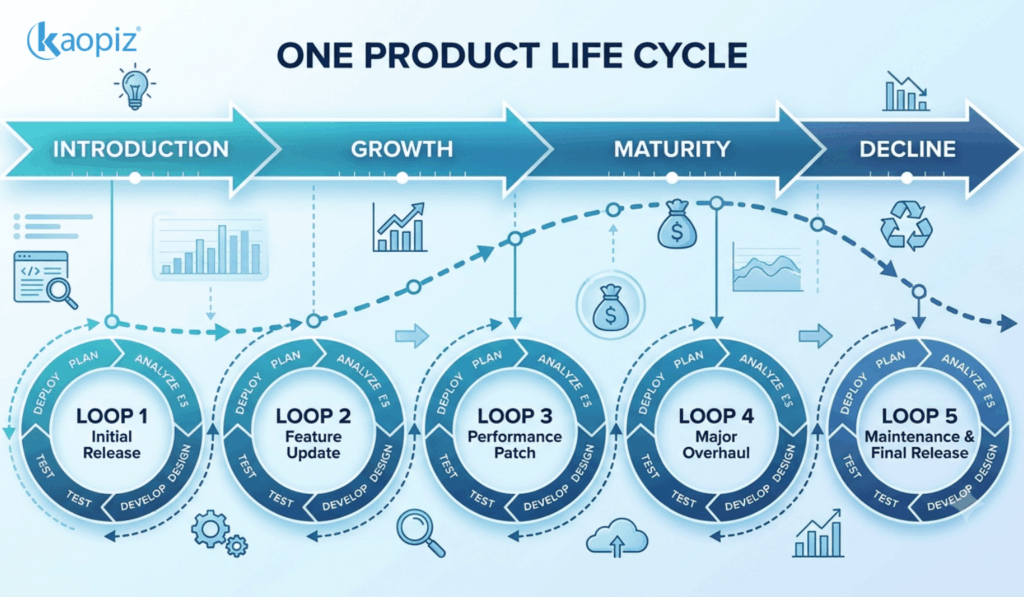
This is why a product’s market success is cumulative. No single release creates it. Consistent delivery quality across hundreds of loops keeps the product in growth or maturity longer, while a run of weak releases pushes it toward decline.
Why Deployment Is Not the Finish Line
Most budgets treat the first launch as the main expense. Current data shows the opposite. ScienceSoft’s 2026 cost guide states that maintenance can make up as much as 90% of a software product’s total cost of ownership.
In Ensono’s 2025 survey of 500 IT decision-makers, 49% said actual legacy maintenance costs exceeded plan in the past year, and 57% said their IT teams spend most of their time maintaining systems.
The pressure continues in 2026. Ensono’s follow-up research found that 71% of modernization initiatives exceeded their planned budgets, and 97% of respondents said talent shortages had raised modernization costs.
The lesson is clear. The SDLC keeps running for as long as the product life cycle does, and most of the money is spent after launch. Plan engineering capacity for the full PLC, not just the release date.
The Lifecycle Alignment Map: Matching Your SDLC to Each Product Stage
Running the same SDLC at every product stage wastes money: each stage needs a different model, release cadence, set of KPIs, and team. We built the Lifecycle Alignment Map from our delivery work to make that match explicit.
| PLC stage | SDLC model | Release cadence | Priority KPIs | Budget focus | Team model |
|---|---|---|---|---|---|
| Introduction | Lean Agile, MVP-first | 1–2 week sprints | Activation, retention, time to learn | Discovery and prototypes | Small dedicated squad |
| Growth | Scaled Scrum with CI/CD | Weekly or daily | Deployment frequency, change failure rate, uptime | Scalability and automation | Core team plus staff augmentation |
| Maturity | Kanban or DevOps | Stability-driven, steady | Cost per feature, defect rate, churn | Optimization and technical debt | Stable blended onshore–offshore team |
| Decline | Maintenance or migration project | Minimal, planned | Support cost, migration progress | Sunset, migration, or reinvention | Lean maintenance crew plus specialists |
Introduction Stage: Validate Before You Scale
In the introduction stage, the biggest risk is building something nobody needs. CB Insights’ March 2026 analysis of 431 VC-backed startups that shut down since 2023 found that 43% failed because of poor product-market fit, even though running out of capital (70%) was usually the final blow.
The SDLC here should be lean: short sprints, heavy discovery, and an MVP that tests the riskiest assumption first. A small cross-functional squad moves fastest.
Signal to move on: retention holds and organic demand grows without paid push.
Growth Stage: Scale Without Breaking Quality
Growth turns speed into a liability if quality slips. The SDLC must add CI/CD pipelines, automated testing, and architecture built for load. Track deployment frequency and change failure rate alongside revenue. Demand for engineers often outpaces hiring here, so a core team supported by staff augmentation scales capacity without long recruitment cycles.
Signal to move on: growth slows, and feature requests turn into optimization requests.
Maturity Stage: Optimize Cost and Pay Down Technical Debt
Maturity is the longest and most profitable stage, and the one where maintenance cost dominates. Kanban or DevOps flows suit the steady stream of enhancements. Refactoring, cloud cost optimization, and modernization protect margins. In our experience, this is the stage where a stable blended team, with long-tenured offshore engineers who know the codebase, delivers the best cost-to-quality ratio.
Signal to move on: usage declines despite enhancements, or the tech stack blocks new requirements.
Decline Stage: Sunset, Migrate, or Reinvent?
A product in decline has three options. Sunset it when users can move to another product with minimal disruption. Migrate it when the business logic is valuable but the platform is obsolete. Reinvent it when the market need still exists, which restarts the product development life cycle. Whichever path you choose, plan data migration, security, and customer communication as a formal SDLC project, not an afterthought.
5 Mistakes Teams Make When They Confuse the Two Cycles
Confusing the SDLC with the product life cycle leads to five predictable mistakes, each with a simple fix.
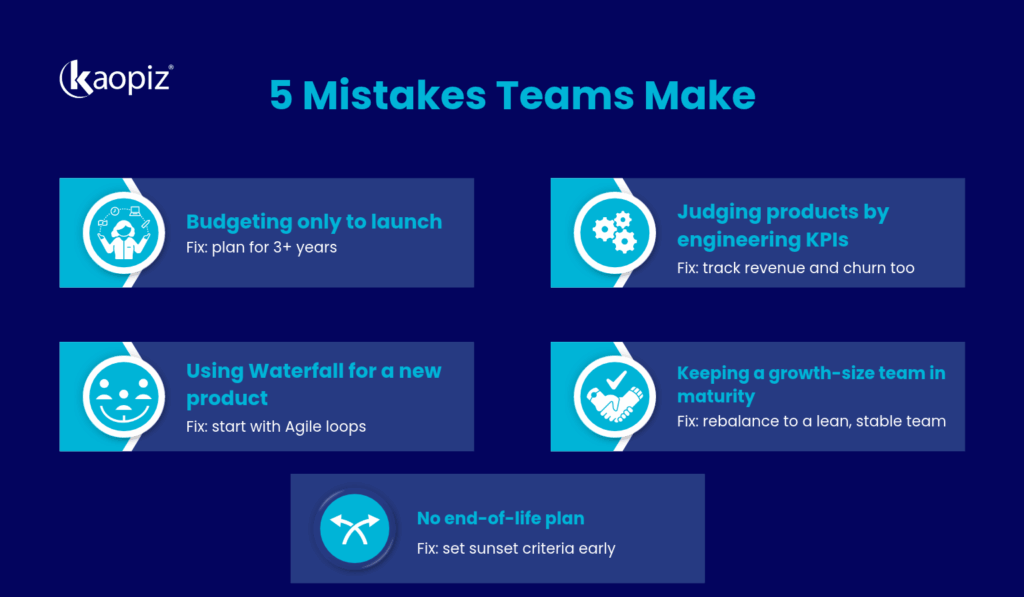
- Budgeting only to launch. Teams fund the first release and treat everything after it as overhead. Fix it by budgeting engineering capacity for at least the first three years of the PLC.
- Measuring product success with engineering KPIs. On-time delivery and low defect rates prove the SDLC works, not that the product sells. Pair DORA metrics with revenue, retention, and churn.
- Running Waterfall in the introduction stage. Fixed, upfront specifications lock in assumptions before customers have tested them. Use short Agile loops until product-market fit is clear.
- Keeping the launch team size in maturity. A team sized for rapid growth becomes expensive once the product stabilizes. Rebalance toward a smaller, stable team with deep codebase knowledge.
- Having no end-of-life plan. Products in decline still hold customer data and security obligations. Define sunset or migration criteria while the product is still in maturity.
How Should You Staff Each Stage of the Product Life Cycle?
Match the team model to the product stage: a dedicated squad to validate, augmented capacity to scale, and a stable blended team to optimize. Staffing is where SDLC and PLC decisions meet, because the team runs the SDLC, but the PLC stage decides how large and how flexible that team should be.
In the introduction stage, a small dedicated team of five to eight people covers product, design, engineering, and QA. Continuity matters more than headcount, because the same people carry customer learning from one sprint to the next.
In the growth stage, demand for engineers spikes faster than local hiring allows, especially in tight markets like Singapore and Australia. IT staff augmentation adds vetted developers to your core team in weeks, and you scale them down when demand settles.
In the maturity stage, cost efficiency and codebase knowledge matter most. Many companies move part of the work offshore at this point; outsourcing to Vietnam gives access to a large engineering talent pool in a time zone close to Singapore and Australia. If you are comparing vendors, our list of IT outsourcing partners for Singapore businesses explains what to check.
Why Partner With Kaopiz Across the SDLC?
Kaopiz covers every phase of the SDLC, from planning and requirements analysis to testing, deployment, and long-term maintenance, and adapts each loop to your product’s stage. Founded in 2014, we have grown to nearly 1,000 staff across Vietnam (Hanoi and Da Nang), Japan, and Singapore, serving enterprise clients primarily in Singapore and Australia.

Our engineers run the full SDLC loop, not just the coding phase.
- Business analysts and solution architects lead planning, requirements, and design.
- Developers and QA engineers own implementation and testing.
- DevOps engineers automate deployment.
- Maintenance teams keep the product secure and current after launch.
We also adapt the SDLC model to the product stage: lean Agile for a new MVP, CI/CD at scale during growth, and stable DevOps flows for mature platforms.
Quality and security are certified, not just promised. Kaopiz holds ISO 9001 for quality management and ISO 27001 for information security management, so every SDLC loop follows audited processes for code quality, data protection, and access control.
“The clients who get the most from their software are the ones who plan for year five on day one. Our job is to make each release stronger than the last, for as long as the product lives.” – Lucie Tran, Head of Growth, Kaopiz Global
Tell us which stage your product is in, and we will propose the team to match. Talk to our team today.
Plan for the Whole Life Cycle, Not Just the Launch
The software development life cycle vs product life cycle comparison comes down to one point: the SDLC builds each release, and the product life cycle decides whether those releases create lasting value. Plan them together, match your SDLC model and team to each product stage, and budget for the years after launch, where most of the cost and value sit.
FAQs
- Is the SDLC Part of the Product Life Cycle?
- Yes. The SDLC runs inside the product life cycle. Every release, update, and modernization project is an SDLC loop, and those loops repeat from launch until the product is retired. The PLC sets business priorities; the SDLC delivers them as working software.
- Which Comes First, SDLC or Product Life Cycle?
- The SDLC comes first. The first SDLC loop builds the initial release before the product enters the market, which is when the product life cycle begins. After launch, both cycles run in parallel, with new SDLC loops supporting each PLC stage.
- Is Agile an SDLC Model or a Product Management Approach?
- Agile is primarily an SDLC model, because it organizes how software is planned, built, and tested in short iterations. Its principles, such as frequent feedback and incremental delivery, also shape product management decisions, which makes Agile a bridge between the two cycles.
- How Long Is the Product Life Cycle of Software?
- It varies by product type. Consumer apps can move from introduction to decline in two to three years. Enterprise platforms and B2B SaaS products often stay in maturity for a decade or longer when they receive steady maintenance and modernization.
- What Is the Difference Between PDLC and SDLC?
- The PDLC covers building a new product from idea to market launch, including market research, concept testing, and business analysis. The SDLC covers building the software itself, release by release, through planning, design, coding, testing, deployment, and maintenance.
Author

Lucie Tran
Head of Growth of Kaopiz Global
Table of Contents
Don’t miss what’s next!
Thank you! Your form has been submitted successfully.