4 Types of Software Maintenance: Examples and Budget Guide in 2027
The 4 types of software maintenance are corrective, adaptive, perfective and preventive, and each one protects your system in a different way. Many teams spend most of their budget fixing bugs and postpone the other three, then pay for it later in outages and rushed upgrades. In this guide, we explain each type with real examples, show how to split your maintenance budget by system stage, and look at how AI coding tools are changing maintenance work.
Key Takeaways
- Corrective maintenance fixes defects, adaptive keeps up with OS, API and regulatory changes, perfective improves working software, and preventive removes hidden weaknesses.
- The right budget split depends on whether your system is new, growing or legacy.
- AI coding tools speed up maintenance tasks but increase the need for preventive work.
- A good outsourcing contract matches each type to an SLA, a retainer or change requests.
What Is Software Maintenance in the SDLC?
Software maintenance is the work of changing a software product after release to fix faults, adapt it to a new environment, improve it, or prevent future failures. It starts the day a system goes live and continues until the system is retired. The standard that governs this work is ISO/IEC/IEEE 14764, published in its third edition in January 2022, which also establishes definitions for the different types of maintenance.
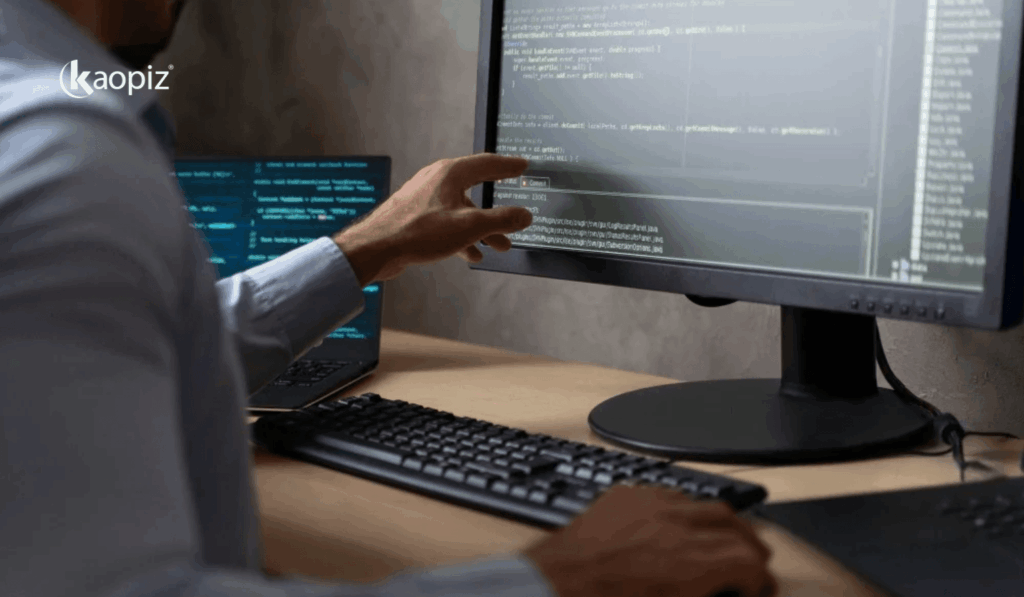
When it comes to maintenance in the software development life cycle, it is the final phase and also the longest one. Initial development usually finishes in under three years, while maintenance can run for decades. For that reason, we plan maintenance as a budget line from the first sprint. It should never be treated as an afterthought once the product ships.
The cost of weak maintenance is easy to measure in Singapore. Tricentis’ 2025 Quality Transformation Report found that 74% of Singapore organizations believe poor software quality costs them between S$660,000 and S$6.6 million or more each year. The same report found that 61% of Singapore organizations face a significant risk of a software outage within the following year. For most companies, the real question is therefore not whether to fund maintenance. It is which type of maintenance to fund first.
What Are the 4 Types of Software Maintenance (+Examples)?
The 4 types of software maintenance are corrective, adaptive, perfective and preventive. Corrective maintenance reacts to problems that have already reached users, while the other three are proactive and keep a system fit for a changing environment, changing needs and future risks. The table below compares the different types of software maintenance with real examples.
| Type | Trigger | Goal | Approach | Typical Urgency | Example |
|---|---|---|---|---|---|
| Corrective | Bug reports, failed transactions, error alerts | Restore intended behavior | Reactive | High (hours to days) | Fixing a checkout page that rounds order totals incorrectly |
| Adaptive | OS, browser, cloud, API or regulatory changes | Keep software working in a new environment | Proactive | Medium, tied to external deadlines | Updating desktop apps after Windows 10 support ended |
| Perfective | User feedback, usage data, performance monitoring | Make working software faster, easier or cleaner | Proactive | Low to medium, planned | Cutting dashboard load time from 9 to 2 seconds |
| Preventive | Code reviews, static analysis, dependency scans | Remove hidden weaknesses before they fail | Proactive | Low, scheduled per sprint | Upgrading an outdated library before a vulnerability is exploited |
Corrective Maintenance
Corrective maintenance is the work of finding and fixing defects after software has been released, so the system behaves as it was designed to. It is the most reactive type of maintenance, and it is also the one users notice first. Typical triggers are bug reports from customers, failed transactions, error alerts from monitoring tools and issues uncovered during audits.
A common example is an e-commerce checkout page that starts rounding order totals incorrectly after a currency update. The feature worked at launch, so the fix restores the intended behavior rather than adding anything new. Logic errors, broken integrations and crashes on specific inputs all fall into the same category.
Track mean time to resolve (MTTR) for each severity level, because that is the number your users actually feel. A critical payment bug fixed in four hours earns trust, while the same bug left for four days costs customers. Urgent fixes made outside the normal release process to keep a system running are a separate category in the ISO standard, called emergency maintenance.
Adaptive Maintenance
Adaptive maintenance is the work of modifying software so it keeps running correctly when its environment changes, even though the software itself has no defect. The trigger always comes from outside the code. Common triggers are operating system and browser updates, cloud platform changes, third-party APIs being retired, new hardware and new regulations.

Microsoft ended support for Windows 10 on October 14, 2025, which pushed companies to test and update desktop applications for Windows 11. Regulation creates the same pressure: Australia’s 2024 Privacy Act amendments and updates to Singapore’s PDPA both require changes to how systems collect, store and report personal data. A payment gateway retiring an old API version is another typical case, because checkout fails on the deadline unless the integration is updated.
Adaptive work is predictable, yet many teams still treat it as an emergency. Our rule of thumb is to keep one calendar of vendor end-of-life dates, API deprecation notices and regulatory deadlines for every system you run. Reviewing it each quarter turns a panicked fix into a scheduled sprint task.
Perfective Maintenance
Perfective maintenance is the work of improving software that already functions correctly, so it runs faster, feels easier to use or is simpler to maintain. Nothing is broken, and the environment has not changed. The trigger is usually user feedback, usage analytics, performance monitoring or a business goal such as higher conversion.
Typical examples include cutting a reporting dashboard’s load time from nine seconds to two, reducing a five-step checkout to three steps, and removing a module that almost nobody uses. Improving code readability and updating documentation also count as perfective work, because they make every future change cheaper.
This type competes directly with new feature development for the same engineers, so it is easy to postpone. Let usage data decide what gets improved first: the slowest pages and the steps where most users drop off usually deliver the biggest return. Keep one boundary clear when planning: improving an existing function is perfective, while adding a capability the system never had is additive maintenance under the ISO standard.
Preventive Maintenance
Preventive maintenance is the work of finding and fixing hidden weaknesses in software before they turn into failures that users experience. The ISO standard calls these weaknesses latent faults: code that works today but is likely to break under higher load, new data or a future change. Code reviews, static analysis, dependency scans and performance testing are the usual ways to uncover them.

Common examples include refactoring tangled code, upgrading outdated libraries, adding automated tests to fragile modules and fixing a memory leak that only appears at scale. Renewing SSL certificates before they expire is preventive work too, as is patching a vulnerable dependency before an exploit circulates. The Log4Shell vulnerability in December 2021 showed the cost of skipping this, as teams worldwide had to patch one widely used library within days.
Preventive maintenance is usually the first budget line cut, because its payoff is an incident that never happens. In our projects, preventive work gets a fixed share of every sprint, agreed in advance with product owners. That way it cannot be traded away whenever a new feature request arrives.
The classic 4-type model covers most day-to-day work, but the latest ISO/IEC/IEEE 14764:2022 standard defines 6 types: corrective, preventive, adaptive, additive, perfective and emergency maintenance. These 2 additional types are useful when comparing the different types of maintenance in software engineering: additive maintenance adds capabilities the system never had, while emergency maintenance covers urgent, unscheduled fixes that keep a system running. We use both terms later when discussing budgets and contracts.
How Should You Split Your Maintenance Budget Across Types?
The right split of your maintenance budget depends on the system’s stage: new products spend most on corrective and perfective work, growing products on perfective and additive work, and legacy systems on adaptive and preventive work. The breakdown below shows where each stage’s budget should go and the warning signs that your mix is out of balance.
New Products (Years 0–2)
In the first two years, most of the maintenance budget goes to corrective and perfective work. Real users find bugs that testing missed, and usage data reveals which flows confuse people or slow them down. This is normal, and a high volume of fixes early on is a sign the product is being used, not that it has failed.
Corrective work should still peak and then fall. The warning sign at this stage is corrective work that keeps rising after six months of launch. That pattern usually points to rushed code or thin test coverage, so the fix is to move part of the budget to preventive work before new features are added on top of an unstable base.
Growing Products
Once a product has found its users, the maintenance budget shifts toward perfective and additive work. Customers ask for faster workflows, integrations with their other tools and capabilities the product never had. Corrective work should now be smaller and steadier, because the most visible bugs were fixed during the first two years.

The risk at this stage is speed. Each release adds code on top of older code, and preventive work keeps getting postponed because new features feel more urgent. The warning sign is that every release breaks something that used to work. Treat preventive work as a protected item in the roadmap, so delivery speed does not collapse as the codebase grows.
Legacy Systems
For legacy systems, adaptive and preventive work take over most of the maintenance budget. Vendors drop support for the operating systems, frameworks and databases the system was built on. Each of those changes forces an update just to keep the system running. Skills become harder to find too, so even small fixes take longer and cost more.
The warning sign at this stage is a budget spent almost entirely on keeping the system alive, with little left for improvements users ask for. When that happens, more maintenance rarely solves the problem. At this point, it is worth assessing whether to modernize the legacy system, because a planned migration often costs less over time than patching an aging platform year after year.
How Do AI Coding Tools Change Software Maintenance?
AI coding tools make individual maintenance tasks faster, but they also produce code that needs more preventive maintenance later. The gains are clearest in work that starts with understanding existing code:
- Corrective maintenance: AI assistants help engineers trace the root cause of a bug across large codebases and suggest a fix for review.
- Adaptive maintenance: AI speeds up repetitive migration work, such as updating API calls or deprecated syntax after a framework upgrade.
- Legacy code: AI explains undocumented modules in minutes, which shortens onboarding for engineers who did not write the original system.
- Testing: AI drafts regression tests quickly, so fixes ship with better coverage.
The cost shows up in the codebase. GitClear’s 2026 Maintainability Gap report found that refactoring dropped from 21% of changed lines in 2022 to just 3.8% in 2026. Teams generate new code quickly but rarely clean up old code, so duplicated logic and hidden faults pile up for future maintainers.
When AI raises delivery speed, the preventive share of the budget has to rise with it. Code review, duplication checks and scheduled refactoring become more important, not less.
This is why we built Kaopiz AI-SDLC around governance rather than raw speed. The framework runs five AI agents, called KARI, on the same project data, so requirements, code and tests stay consistent as the system changes.
For maintenance work, KARI Inspector drafts test cases for every fix, which, based on our internal estimates, cuts test design effort by up to 60% depending on the project. Each phase also has a mandatory Human Review Gate, so no AI-generated change reaches production without an engineer’s approval, and every action is logged for audit.
Kaopiz: Your Trusted Outsource Software Maintenance Partner in Singapore
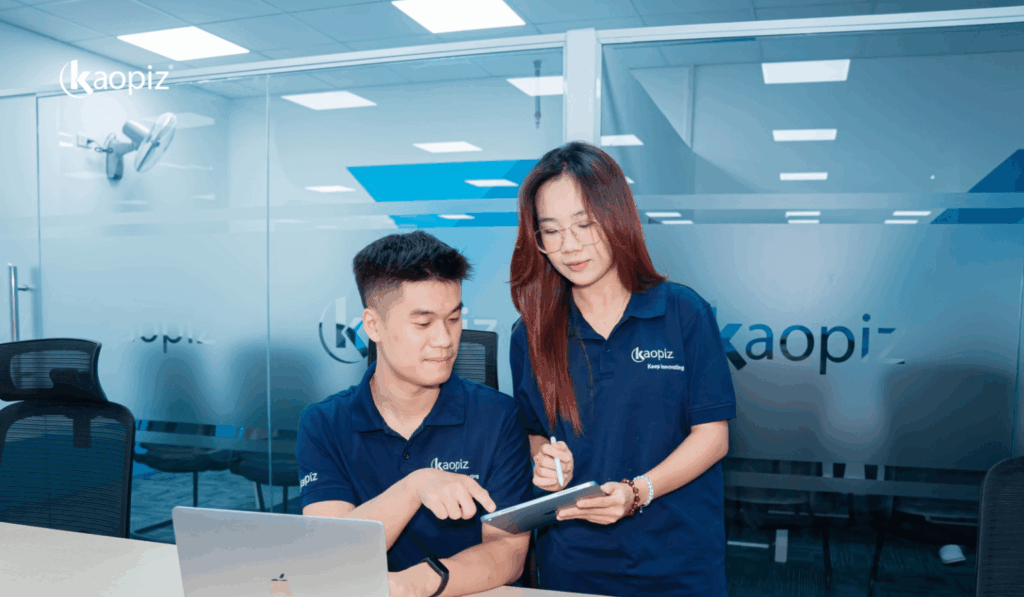
Outsourcing software maintenance makes sense when your in-house team is busy building new features, lacks skills in an older technology stack, or cannot cover incidents outside office hours.
The key to a good maintenance contract is matching each type of maintenance to the right commercial terms:
- Corrective and emergency maintenance: covered by an SLA with response and resolution times for each severity level.
- Preventive and adaptive maintenance: covered by a monthly retainer, so planned work is never traded away for urgent requests.
- Perfective and additive maintenance: handled through change requests, with scope and cost agreed before work starts.
Kaopiz provides software maintenance as part of our managed IT services. Founded in 2014, Kaopiz has nearly 1,000 staff and has delivered more than 1,000 projects for over 500 clients worldwide. We hold ISO 9001 and ISO 27001 certifications, so quality and information security processes apply to every fix, update and release. Our engineers use Kaopiz AI-SDLC, which keeps an engineer’s approval on every AI-assisted change and protects client data with six security layers, including separate data for each project.
Ready to review your maintenance mix? Talk to our maintenance team for an assessment of your system.
Conclusion
Understanding the types of software maintenance turns maintenance from a cost you absorb into a budget you control. Corrective work protects your users today, while adaptive, perfective and preventive work protect your system for the years ahead. Review where your maintenance budget goes each quarter, and move funding toward proactive work before the warning signs appear.
FAQs
- Which Type of Software Maintenance Costs the Most?
- Perfective maintenance usually takes the largest share of the budget, because improvement requests never stop. Corrective maintenance costs less overall but the most per incident. In legacy systems, adaptive work often becomes the biggest cost.
- What Is the Difference Between Software Maintenance and Software Support?
- Software maintenance changes the software itself, while software support helps users run it. Maintenance covers fixing code, adapting to new environments and improving features. Support covers help desk tickets, user guidance and incident triage. A support ticket often becomes a maintenance task once the team confirms that the code needs to change.
- How Much Does Software Maintenance Cost per Year?
- A common planning rule is 15–25% of the original development cost each year. Wavect’s 2026 benchmark of 24 DACH SaaS products maintained from 2023 to mid-2026 found median annual spend of 24% of the original build cost in year one, 21% in year two and 26% in year three. The actual cost depends on complexity, integrations and system age.
- What Is the Difference Between Preventive and Perfective Maintenance?
- Preventive maintenance removes hidden weaknesses before they cause failures, while perfective maintenance improves software that already works well. Upgrading an outdated library before a vulnerability is exploited is preventive work. Cutting a dashboard’s load time from nine seconds to two is perfective work. The first reduces risk, and the second increases value for users.
- Is Software Maintenance Part of the SDLC?
- Yes, software maintenance is the final phase of the software development life cycle and usually the longest one. It starts once the system goes live and continues until the system is retired. Planning for maintenance during design and development lowers its cost later, because clean code and good documentation make every future change easier.
Author

Table of Contents
Don’t miss what’s next!
Thank you! Your form has been submitted successfully.