STLC vs SDLC: Key Differences and How They Work Together (2027 Guide)
The real difference in STLC vs SDLC is scope: SDLC is the full process of building software, while STLC is the process of proving that software works. Many teams still treat testing as the step after coding, even though STLC starts during requirements analysis. That misunderstanding is why defects surface late and release dates slip.
Below, you’ll find a side-by-side table of the 10 key differences, a phase-by-phase map of how the two cycles connect, and five questions to ask any software partner about their testing process.
Key Takeaways
- Scope: SDLC covers the entire software life, from idea to retirement. STLC covers only verification and validation.
- Timing: STLC does not start after development. It begins during requirements analysis and runs alongside every SDLC phase.
- Output: SDLC delivers working software. STLC delivers the evidence that the software is ready to release.
- Ownership: A project manager owns SDLC and a test lead owns STLC, but quality is shared across the whole team.
- AI impact: AI speeds up coding faster than testing, which makes STLC the main safeguard in an AI-assisted SDLC.
SDLC Overview
SDLC is the big picture: every step a team takes to plan, build, release, and maintain software. Understanding its six phases makes it easier to see exactly where testing, and STLC, fit in.
What Is SDLC?
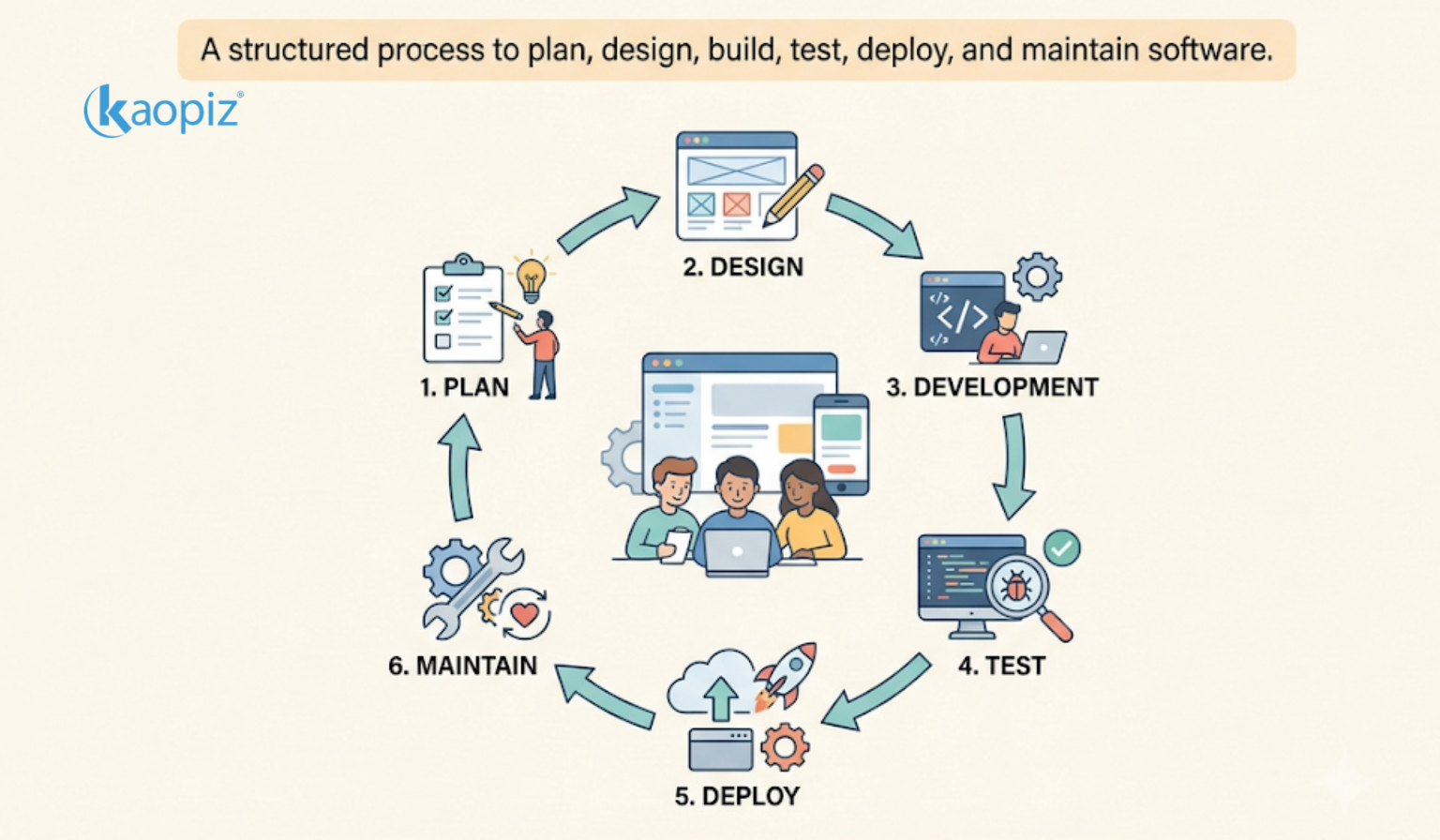
The software development life cycle (SDLC) is a structured process that defines how a team plans, designs, builds, tests, deploys, and maintains software. It gives every project a clear sequence of phases, each with its own goals, owners, and deliverables, so the team knows what to do next and when a phase is finished.
The goal of SDLC is to deliver software that meets business requirements on time and within budget. It covers the whole product journey, from the first requirement to the last update before retirement.
The 6 Phases of SDLC
Most SDLC models break the work into six phases. Each phase ends with a clear output that becomes the input for the next one.
- Planning and requirements analysis: The team defines the project scope, budget, timeline, and business goals, then gathers detailed requirements from stakeholders. The output is a software requirements specification (SRS).
- Design: Architects and designers turn the requirements into a technical blueprint covering system architecture, database structure, interfaces, and security. The output is a set of design documents.
- Development: Developers write the code based on the approved design, usually in small, reviewed increments. The output is working source code.
- Testing: The team verifies that the software works as specified and fixes the defects it finds. The output is a build that is ready for release.
- Deployment: The software is released to the production environment, either all at once or in stages. The output is a live product that real users can access.
- Maintenance: The team monitors performance, fixes issues, and releases updates for as long as the software is in use. The output is a stable, up-to-date product.
On paper, testing is just phase 4. In practice, testing activities begin much earlier, and that is where STLC comes in.
STLC Overview
STLC zooms in on the quality side of SDLC: every activity a team carries out to plan, run, and close out testing. Here’s what it covers and how its six phases are structured.
What Is STLC?
The software testing life cycle (STLC) is a structured sequence of testing activities that confirms software meets its requirements before it reaches users. It covers the full testing process, from analyzing requirements and planning tests to running them and reporting the results.
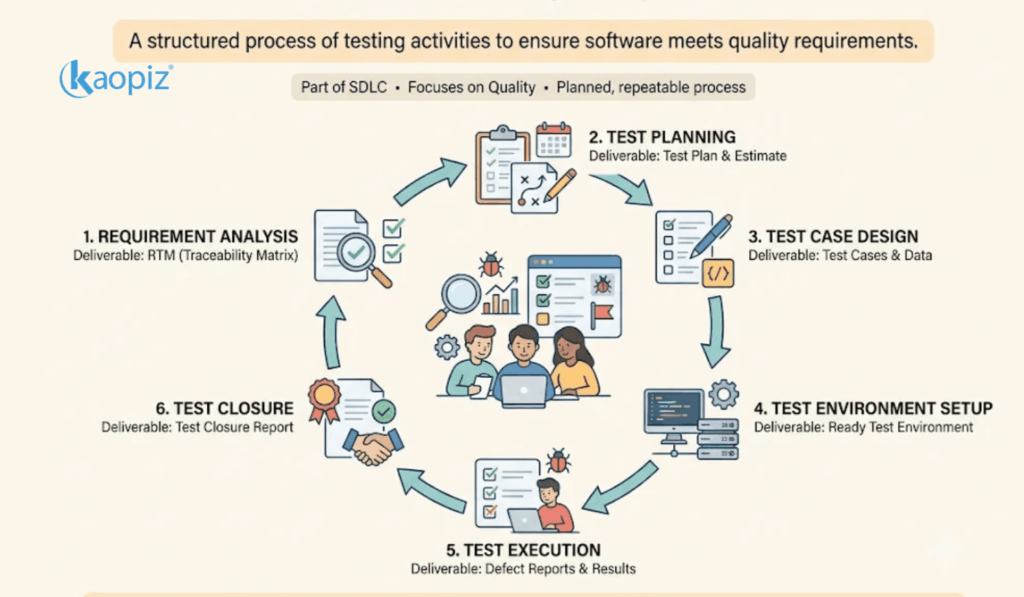
Each STLC phase has entry criteria, which are the conditions that must be met before the phase starts. It also has exit criteria, which define when the phase is complete, and a defined deliverable, such as a test plan or a defect report. This structure turns testing from an ad hoc activity into a repeatable process that a team can measure and improve.
STLC is a subset of SDLC in scope, since it focuses only on quality. It is not a subset in time. Testing work starts as soon as requirements exist and continues through every release.
The 6 Phases of STLC
STLC follows six phases. Each phase has a clear deliverable that shows the team when it can move on to the next.
- Requirement analysis: Testers review the requirements to find out what can be tested and to flag anything vague or missing. The deliverable is a requirements traceability matrix (RTM), which links each requirement to the tests that will cover it.
- Test planning: The test lead sets out the scope, approach, resources, schedule, and risks for testing. The deliverable is a test plan, often with an effort estimate.
- Test case design: Testers write test cases and scripts and prepare the test data, covering both expected and edge-case behavior. The deliverables are reviewed test cases and test data.
- Test environment setup: The team configures the hardware, software, and network conditions needed to run tests in conditions close to production. The deliverable is a test environment ready for execution, usually confirmed by a smoke test.
- Test execution: Testers run the test cases, compare actual results with expected results, and log every defect for the developers to fix. The deliverables are execution results and defect reports.
- Test closure: The team reviews coverage, open defects, and lessons learned, then recommends whether the build is ready to release. The deliverable is a test closure report.
You may see STLC described with five, six, or seven phases depending on the source. Some guides merge requirement analysis into test planning. Others split defect reporting into its own phase after execution. The activities are the same in every version; only the grouping changes.
STLC vs SDLC: 10 Key Differences in 2027
SDLC and STLC share the same goal of releasing reliable software, but they differ in purpose, timing, ownership, and how success is measured. The table below gives a quick view of the difference between SDLC and STLC, and the sections after it explain each point with a real-world example.
| Aspect | SDLC | STLC |
|---|---|---|
| Purpose | Build software that meets business needs | Prove the software works as intended |
| Scope | The entire software life, from idea to retirement | Testing activities: verification and validation |
| Starting point | Planning | Requirements analysis, before coding begins |
| End point | Software retirement | Test closure, repeated for each release |
| Ownership | Project manager or delivery lead | Test lead or QA manager |
| Participants | Whole delivery team: BAs, designers, developers, DevOps, QA | QA engineers, supported by developers, product owners, and DevOps |
| Deliverables | Requirements spec, design documents, source code, live product | Test plan, test cases, traceability matrix, defect reports, closure report |
| Success metrics | Schedule, budget, deployment frequency, lead time | Test coverage, defect density, defect leakage |
| Tools | IDEs, version control, project trackers, CI/CD pipelines | Test management tools, automation frameworks, defect trackers |
| Risk focus | Delivery risk: scope, timeline, budget | Product risk: defects, coverage gaps, security flaws |
1. Purpose
SDLC exists to build software that meets business needs on time and within budget, while STLC exists to prove that the software works as intended. SDLC answers “What should we build, and how?” STLC answers “Does it actually work, and where could it fail?”
Take a checkout feature. SDLC delivers the ability to pay by card. STLC checks what happens when a card is declined, has expired, or is charged twice.
2. Scope
SDLC covers the entire life of the software, from the first idea to retirement, while STLC covers only the activities that verify and validate it. SDLC includes planning, design, coding, deployment, and maintenance, and testing is just one part of it. STLC narrows the focus to testing, but it runs almost as long as the project itself.
A mobile banking app is a good example. SDLC covers everything from market research to the final app store update. STLC covers every test needed to confirm that logins, transfers, and notifications work, for as long as the app keeps changing.
3. Starting Point
SDLC starts with planning, and STLC starts during requirements analysis, long before any code is written. This is the most misunderstood difference between the two cycles. Many teams still treat testing as something that begins once development is finished, which is when defects cost the most time and money to fix.

Here is how early testing pays off. A tester reviewing requirements spots the line “the search feature should be fast” and flags it as untestable. The team rewrites it as “search returns results in under two seconds.” That one change gives developers a clear target and gives testers a measurable pass or fail condition, without writing a single line of code.
4. End Point
SDLC ends only when the software is retired, while each STLC cycle ends with test closure and starts again with the next release. SDLC is one long cycle that can span years. STLC repeats many times inside it, once for every major release, sprint, or significant change.
Even after launch, STLC does not stop completely. During the maintenance phase, the team runs regression tests on every update to confirm that new fixes have not broken features that already worked. For example, a security patch to the login module triggers a fresh round of tests on payments, profiles, and notifications.
5. Ownership
A project manager or delivery lead owns SDLC, while a test lead or QA manager owns STLC. The SDLC owner answers for scope, schedule, and budget across the whole project. The STLC owner answers for the test strategy, test coverage, and the quality evidence behind every release decision.
In practice, the two owners work as partners. When a deadline gets tight, the project manager decides what can ship. The test lead states which risks remain untested if it ships early. Owning a cycle is also different from taking part in it, since both cycles draw on people from across the team.
6. Participants
SDLC involves the whole delivery team, while STLC centers on QA engineers but cannot succeed without developers and product owners. SDLC brings together business analysts, designers, developers, DevOps engineers, and testers. STLC is led by QA, yet much of its work depends on other roles.

It is a common belief that STLC needs only a small group of testers. In modern teams, developers write unit tests and fix defects. Product owners define the acceptance criteria that tests check against. DevOps engineers maintain the pipelines where automated tests run. STLC has fewer dedicated roles, but it draws on almost everyone.
7. Deliverables
SDLC produces the software itself, while STLC produces the evidence that the software is ready to release. SDLC deliverables include the requirements specification, design documents, source code, and the deployed product. STLC deliverables include the test plan, test cases, the requirements traceability matrix, defect reports, and the test closure report.
These two sets of outputs serve different readers. Users interact with what SDLC delivers, while decision-makers rely on what STLC delivers. When a release manager asks “Can we go live on Friday?”, the answer comes from the test closure report, which shows what was tested, what passed, and which known risks remain.
8. Success Metrics
SDLC is judged on delivery performance, while STLC is judged on how well it catches defects before users do. Common SDLC metrics include schedule adherence, budget variance, deployment frequency, and lead time for changes. STLC tracks test coverage, defect density, and defect leakage.
Defect leakage is the metric leaders should watch most closely. It measures the share of bugs that escape testing and are first found in production. For example, if a team finds 90 defects during testing and users report 10 more after release, the defect leakage rate is 10%. A rising rate is an early warning that STLC is not keeping pace with development, even when SDLC metrics look healthy.
9. Tools
SDLC relies on tools that build and ship software, while STLC relies on tools that test it and track defects. On the SDLC side, teams use IDEs such as Visual Studio Code, version control such as Git, project trackers such as Jira, and CI/CD pipelines such as GitHub Actions or Jenkins. On the STLC side, they use test management tools, automation frameworks such as Selenium and Playwright, and defect trackers.

The two toolsets increasingly overlap. Many teams track user stories and defects in the same Jira board. Automated tests also run inside the same CI/CD pipeline that deploys the code, so a failed test can block a release automatically.
10. Risk Focus
SDLC manages delivery risk, while STLC manages product risk. Delivery risks threaten the project itself: scope creep, missed deadlines, budget overruns, and staff shortages. Product risks threaten the software: missed defects, gaps in test coverage, performance bottlenecks, and security flaws.
The two do not always move together. A project can finish on time and within budget and still fail because nobody tested how the system behaves under peak load. Strong teams track both risk lists side by side. Then a shortcut taken to protect the schedule shows up immediately as a new product risk.
How Do STLC Phases Map to SDLC Phases?
STLC does not wait for SDLC to reach the testing phase: every STLC phase runs alongside a matching SDLC phase. This parallel timing is the most practical difference between the SDLC and STLC life cycles. Seeing the two cycles side by side shows exactly when testing work should happen.
| SDLC phase | STLC activity running in parallel |
|---|---|
| Planning and requirements analysis | Requirement analysis: testers review requirements for testability and build the traceability matrix |
| Design | Test planning and test case design based on the architecture and user flows |
| Development | Test environment setup, test data preparation, and unit and integration tests written alongside the code |
| Testing | System and acceptance test execution, defect logging, and retesting of fixes |
| Deployment | Smoke tests in production, release sign-off, and test closure |
| Maintenance | Regression testing on every update, patch, or new feature |
Read the table from top to bottom, and the pattern is clear. By the time developers write their first line of code, the testers already have a plan, the test cases are taking shape, and vague requirements have been fixed. When the formal testing phase arrives, the team is ready to execute tests, not still working out what to test.
Teams that skip this alignment usually pay for it at the end. Testing gets squeezed into the last weeks before release. Untestable requirements surface too late to change cheaply. Testers end up designing test cases while the release date is already fixed.
On one AI development project, our QA team flagged a reporting requirement as untestable during the requirements review, because it had no defined data source or accuracy threshold. We clarified it with the client in a 30-minute call. If we had found the gap during system testing, it would have meant reworking two sprints of code.
How the SDLC and STLC Relationship Changes by Model
The SDLC model a team chooses decides when STLC starts and how often it repeats. In Waterfall, testing is one late block of work. In DevOps, it runs on every code change. The table below compares the four most common models.
| Model | When STLC starts | How the two cycles interact | Best for |
|---|---|---|---|
| Waterfall | Formally after development, though planning can start earlier | Sequential: each phase finishes before the next begins, so most test execution happens at the end | Small projects with fixed, well-defined requirements |
| V-Model | During requirements analysis | Paired: every development phase has a matching test level, such as requirements with acceptance tests and design with integration tests | Regulated or safety-critical systems, such as healthcare and finance |
| Agile (Scrum) | In every sprint, from backlog refinement onward | Iterative: a compact STLC runs inside each sprint, with testers working alongside developers | Products with changing requirements and frequent releases |
| DevOps (CI/CD) | Continuously, from the first commit | Automated: tests run in the pipeline on every code change, and a failed test blocks the release | Teams that release often and need fast feedback |
The trend across these models is clear. As teams move from Waterfall toward DevOps, STLC stops being a phase and becomes a constant layer of the delivery process. Testing moves from a final checkpoint to a continuous safety net.
Choosing the right model depends on how stable your requirements are and how often you need to release. A fixed-scope compliance system may suit the V-Model. A customer-facing app that ships weekly needs Agile or DevOps, with automated testing built into the pipeline from day one.
SDLC vs STLC in Software Testing: Who Owns What?
In software testing, SDLC and STLC share the same people but give them different responsibilities. Each role builds the product in one cycle and helps prove its quality in the other. Clear ownership in both cycles keeps defects from falling through the gaps between teams.
Roles Across Both Cycles
Most roles contribute to both cycles. The table below shows what each role owns in SDLC and what it contributes to STLC.
| Role | SDLC responsibilities | STLC responsibilities |
|---|---|---|
| Product owner / business analyst | Define requirements and priorities | Write acceptance criteria and approve user acceptance testing |
| Developer | Design and write the code | Write unit tests, fix defects, and support integration testing |
| QA engineer / test lead | Review requirements and design for testability | Own the test strategy, design and run tests, and report on quality |
| DevOps engineer | Build and maintain the deployment pipeline | Run automated tests in CI/CD and manage test environments |
| Project manager | Manage scope, schedule, and budget | Allocate time for testing and act on quality risks in release decisions |
Entry and Exit Criteria: Where the Two Cycles Hand Off
Entry criteria are the conditions that must be met before a testing phase can start, and exit criteria define when it is complete. They are the formal handoff points between SDLC and STLC, and they stop either side from moving ahead too early.
For example, test execution should start only when the build passes a smoke test, the test environment is stable, and the test data is ready. Release should happen only when all planned test cases have been run and no critical defects remain open. Agree on these criteria with the client at the start of the project, so “ready” means the same thing to everyone.
How Is AI Changing SDLC and STLC?
AI is speeding up development faster than it is speeding up testing, which makes STLC the main safeguard in an AI-assisted SDLC. As coding assistants generate more code in less time, the bottleneck moves from writing software to verifying it.
The data shows this shift clearly. Google’s 2025 DORA report surveyed nearly 5,000 technology professionals. It found that about 90% now use AI at work, and that AI adoption is linked to higher delivery throughput but also higher delivery instability. In short, teams ship more, and they also break more.
Testing teams are moving more slowly. According to the World Quality Report 2025–26, nearly 90% of organizations are pursuing generative AI in quality engineering. Only 15% have scaled it across the enterprise. Most organizations still use AI to write code faster than they use it to test that code.
Closing this gap changes how teams run STLC in three practical ways:
- AI-generated test cases: AI drafts test cases directly from requirements and user stories, so test design keeps pace with faster development.
- Self-healing automation: Test scripts adapt automatically when the user interface changes, which cuts the maintenance work that slows regression testing.
- Human checkpoints where judgment matters: People still review requirements, approve test strategies, and sign off on releases, because AI-generated code needs accountable human review before it reaches users.
5 Questions to Ask a Software Partner About Their STLC
A partner’s answers about their testing process tell you more about future quality than any portfolio does. Before you sign with a software development partner, ask these five questions and listen for specific, measurable answers.
- When does testing start on our project? Good partners start testing during requirements analysis, not after development, so defects surface early instead of pushing back your timeline.
- What are your entry and exit criteria for each test level? Look for concrete conditions, such as “no open critical defects before release,” rather than vague answers like “when it looks stable.”
- Who writes unit tests, and what coverage do you target? Developers should write unit tests against an agreed coverage target. If QA handles all testing alone, defects get caught later and cost more to fix.
- Which quality metrics will you report? Expect regular reports on test coverage, defect density, and defect leakage, which show the partner is accountable for quality, not just speed.
- How do you test AI-generated code before it ships? A good partner can explain how AI-generated code is reviewed, tested, and signed off by a person before it reaches your users.
How Kaopiz AI-SDLC Builds Testing Into Every Phase
Kaopiz AI-SDLC is our framework for running AI across the whole software lifecycle, from requirements to release, and it treats testing as part of every phase rather than a step at the end.

The framework runs on five AI agents, called KARI, which all work from the same project data. That shared data is what keeps SDLC and STLC in step:
- Requirements and design: KARI Writer drafts requirements and design documents.
- Development: KARI Engineer supports coding.
- Testing: KARI Inspector supports testing and drafts test cases, working from the same project data, so tests stay consistent with the requirements and code.
- Release: KARI Manager supports release and project management.
- Across all phases: KARI Assistant answers questions about the project.
AI proposes, and people decide. Every phase ends with a mandatory Human Review Gate. Only work an engineer has approved moves forward, which turns each handoff into an enforced exit criterion. Every action is logged for audit, and security follows each client’s own standards, with six layers of protection, including an internal VPN, single sign-on, two-factor authentication, and separate data for each project.
Kaopiz holds ISO 9001 and ISO 27001 certifications and has delivered more than 1,000 projects for over 500 global clients since 2014. Planning a project where quality can’t be an afterthought? Talk to Kaopiz’s engineering team about building testing into every phase.
Conclusion
In the STLC vs SDLC comparison, the clearest difference is scope: SDLC builds the software, while STLC proves it works. The difference that matters most in practice is timing. When testing starts at requirements and runs alongside every phase, defects surface early, releases stay on schedule, and quality becomes something the team can measure rather than hope for. As AI speeds up development, that parallel approach is no longer optional.
FAQs
- Is STLC Part of SDLC?
- Yes. STLC is part of SDLC in scope, because testing is one of the activities needed to build software. It is not limited to SDLC’s testing phase, though. STLC has its own planning, design, execution, and closure phases, and it runs alongside SDLC from requirements analysis through maintenance.
- Which Comes First, SDLC or STLC?
- SDLC starts first, with planning. STLC follows almost immediately, beginning during requirements analysis, long before any code is written. After that, the two cycles run in parallel: each SDLC phase has a matching STLC activity, and testing continues through deployment and maintenance.
- Can STLC Exist Without SDLC?
- No. STLC needs requirements to test against and software to test, and both come from SDLC. Without a development process, there is nothing for STLC to verify. A team can follow SDLC with a weak or informal testing process, but that usually leads to defects being found late or in production.
- Is STLC the Same as Quality Assurance?
- No. Quality assurance (QA) is the broader discipline of preventing defects by improving the processes used to build software. STLC is the structured cycle for planning and running tests, which is closer to quality control. In practice, STLC is one of the main ways a QA team puts its strategy into action.
- How Many Phases Does STLC Have?
- STLC most commonly has six phases: requirement analysis, test planning, test case design, test environment setup, test execution, and test closure. Some sources list five or seven, because they merge requirement analysis into planning or treat defect reporting as a separate phase. The activities are the same in every version.
Author

Table of Contents
Don’t miss what’s next!
Thank you! Your form has been submitted successfully.