V-Model Methodology: Phases, Examples, and When to Use It in 2027
The V-model in software development is often described as “Waterfall with testing added on.” That description misses its main strength: every acceptance test exists before a single line of code is written. For banks, medical device makers, and automotive suppliers, that difference decides whether a release passes an audit or fails it.
In this guide, I explain how each phase of the V-model works and follow one typical requirement through all four test levels. I also cover the model’s real advantages and disadvantages, when to choose it over Agile, and how teams are adapting it for AI-assisted development in 2027.
Key Takeaways
- The V-model in software development pairs every design phase with a matching test phase. Tests are planned on the left side of the V and run on the right.
- It suits projects with stable requirements, strict regulations, and a high cost of failure.
- The V-model struggles with uncertainty, not complexity.
- In 2027, many teams run it inside Agile sprints, and AI-assisted coding makes its discipline more valuable.
What Is the V-Model in Software Development?
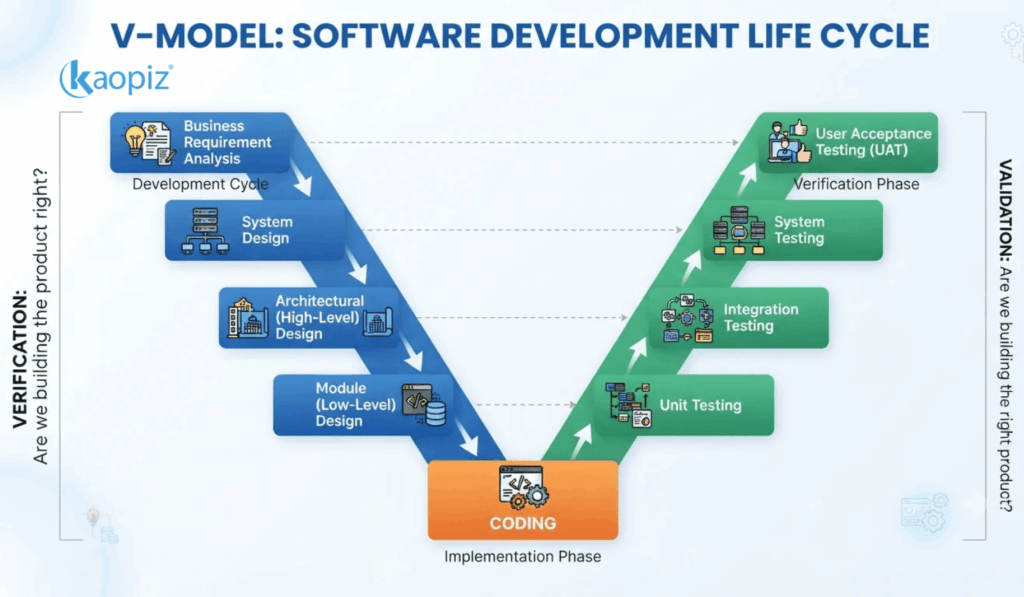
The V-model in software development is a sequential SDLC model that pairs every development phase with a matching testing phase. Requirements are paired with acceptance testing, system design with system testing, architecture with integration testing, and module design with unit testing. The test plan for each level is written during its design phase, before any code exists.
The V software development model gets its name from the shape of the diagram. The left side runs downward through verification, where broad business needs are broken into smaller, more detailed designs. Coding sits at the bottom of the V.
The right side climbs back up through validation, where each piece is tested and integrated until the whole system is checked against the original requirements. Verification asks whether the team is building the product right. Validation asks whether the team is building the right product.
In the SDLC life cycle, the V-model is often called an extension of Waterfall. On paper that’s true, but it misses why teams use it. In my experience, teams don’t choose the V-model for its sequence. They choose it because it forces one question at the start of every phase: “How will we prove this works?” If nobody can answer, the requirement isn’t ready.
How Does the V-Model Work? The Phases on Each Side
The V-model works in pairs: every phase on the left side produces a design and the test plan for its matching phase on the right side. The table below shows how each phase on the left connects to its test on the right.
| Development Phase | Key Output | Paired Test Level | Who Signs Off |
|---|---|---|---|
| Business Requirement Analysis | Requirements specification | User Acceptance Testing | Client business owner |
| System Design | System specification | System Testing | QA lead and client |
| Architectural Design | Architecture and interface specs | Integration Testing | Technical architect |
| Module Design | Module specifications | Unit Testing | Development lead |
Verification Phases (Left Side of the V)
The left side of the V moves from broad business goals to detailed technical designs. Each step adds detail and produces the test plan that will later check that level of the system.
Business Requirement Analysis
This phase defines what the software must do for the business and its users. Business analysts work with stakeholders to capture functional needs, performance expectations, security rules, and any compliance constraints.
The key outputs are a requirements specification and the Acceptance Test Plan. Writing acceptance criteria now exposes vague requirements early. If no one can describe how a requirement will be tested, it isn’t finished yet.
System Design
System design turns the requirements into a description of how the complete system will behave. The team defines user flows, hardware and software environments, data handling, and external dependencies, and checks that the requirements are technically feasible.
This phase produces the System Test Plan. Non-functional tests such as load, security, and recovery are planned here, so they are part of the design rather than added before launch.
Architectural (High-Level) Design
Architectural design splits the system into modules and defines how they connect. Architects choose the technology stack, design APIs and databases, and decide where third-party services and security controls fit.
The output is the Integration Test Plan. In my experience, most late-stage surprises happen at the boundaries between modules. Planning integration tests at this stage brings those risks into the open while the design can still change cheaply.
Module (Low-Level) Design
Module design describes each component in enough detail for a developer to build it. It specifies the internal logic, inputs and outputs, data structures, error handling, and dependencies.
This phase produces the Unit Test Plans. A loan-approval module, for example, would have separate unit test cases for the credit-score threshold, the debt-to-income check, and the rejection message, all written before any code.
Coding: The Base of the V
Coding sits at the bottom of the V, and in a well-run project it’s one of the shortest phases. By the time developers start, the module designs are approved and the unit test plans already exist. Their job is to write code that passes tests that have already been agreed, not to work out the design as they go.

When coding drags on, the cause is usually a gap in the left side of the V rather than a slow team. AI coding assistants have made this phase shorter still, which puts even more weight on getting the design right first.
Validation Phases (Right Side of the V)
The right side of the V runs the test plans written on the left, starting from the smallest level and working up. Each level checks one design phase, so when a test fails, the team knows exactly which document to look at.
Unit Testing
Developers test each module on its own, using the unit test plans from module design. A unit test confirms that a single piece of logic does what its specification says. In the loan-approval example, this means checking that an applicant just below the credit-score threshold is rejected and one just above it passes.
Integration Testing
Integration testing connects the modules and checks the contracts between them, as defined in the architectural design. QA engineers look for mismatched data formats, failed API calls, and timeouts with third-party services. Bugs found here usually come from two teams reading the same interface differently.
System Testing
System testing checks the complete application against the system design, including the non-functional targets set during that phase. An independent QA team runs end-to-end scenarios along with load, security, and recovery tests. This is the first point where the software is judged as a whole product rather than as a set of parts.
User Acceptance Testing (UAT)
In UAT, the client’s own users run the acceptance test plan written during requirement analysis. They work through real business scenarios, not technical test cases. Passing UAT means the business formally confirms the software does what it asked for. In regulated industries, the sign-off record also becomes audit evidence.
Key Principles of the V-Model
Four principles hold the V-model methodology together. Each one exists to stop a specific, expensive kind of mistake.
- Tests are defined before code is written. Every design phase ends with a test plan for its matching level, so vague requirements become measurable checks while fixing them still costs a meeting rather than a rework sprint.
- Every requirement is traceable. Each requirement links to a design element, a piece of code, and a test that proves it works, so the team can show where anything was tested in minutes.
- Each phase has a gate. A phase starts only after the previous one is reviewed and signed off, which slows the start but stops the team from building on a design no one has agreed to.
- Work moves from broad to detailed. The system is broken down one level at a time, from business goals to modules and logic, so problems are fixed at the level where they appear.
Example of the V-Model in Software Engineering
A traced example shows how the V-model works better than a phase list. Below, one typical real-world requirement is followed through all four test levels, and then we look at the industries where this level of discipline is standard.
One Requirement Traced Through the V
Take a common internet-banking requirement: “Lock a customer’s account after five failed OTP attempts within 15 minutes, and notify the customer by SMS.” Each design phase on the left side of the V turns this one sentence into its own test.
| Test Level | Planned During | Example Test Case | Run By |
|---|---|---|---|
| User Acceptance Testing | Business Requirement Analysis | A customer enters a wrong OTP five times. The account locks, an SMS arrives, and branch staff can unlock it. | Bank’s operations team |
| System Testing | System Design | The lockout works the same on web and mobile, and the counter resets after 15 minutes, even under peak login traffic. | Independent QA team |
| Integration Testing | Architectural Design | The authentication service sends a lock event, the notification service calls the SMS gateway, and if the gateway times out, the account still stays locked. | QA engineers |
| Unit Testing | Module Design | The counter increases on each failure, the fifth failure sets the status to “locked,” and four failures followed by 15 minutes of inactivity reset it. | Developers |
The value of this structure appears when something fails. Suppose UAT reveals that the bank expected one lockout across web and mobile, but the team built separate counters for each channel.
The table shows exactly where the gap began: the system design never stated that the counter was shared. In my experience, this is the V-model’s real benefit. It doesn’t prevent every mistake, but it shows which document caused one.
Where the V-Model Is Used Today
The V-model is most common in industries where a software defect can harm people or break the law, and where auditors expect proof of testing.
- Automotive: The ISO 26262 functional safety standard is structured around the V-model, so most vehicle software suppliers work this way.
- Medical devices: Manufacturers use it to meet IEC 62304, which requires testing at the unit, integration, and system levels for higher-risk software.
- Aviation: Software must show full traceability from requirements to tests under DO-178C, and the V-model provides that structure.
- Pharmaceuticals: Companies use it through GAMP 5 to validate the computer systems behind drug production.
- Banking and insurance: Teams use it for core systems where regulators review every change.
- Government: It’s common in public-sector projects with fixed-scope contracts.
What Are the Advantages and Disadvantages of the V-Model?
The V-model’s strengths and weaknesses come from the same trait: it makes teams decide early. That pays off when requirements are clear, but it becomes a cost when they keep changing.
Advantages of the V-Model
The V-model’s main advantage is control. Planning tests alongside design gives teams fewer surprises, clearer accountability, and records that hold up when someone asks for proof.

- Defects are found during design. Writing test plans during design forces teams to clarify vague requirements before coding starts, when a fix costs a document revision instead of a code rewrite.
- Scope and budget are easier to predict. Requirements are fixed and signed off early, so timelines and costs are more reliable, which matters for fixed-price contracts.
- Every test level has a clear owner. Developers own unit tests, QA owns system tests, and the client owns acceptance. When something fails, everyone knows who investigates it.
- Audits are faster. The traceability records the V-model produces are the evidence regulators and auditors ask for, so teams don’t have to rebuild them before a review.
- Handovers are smoother. Detailed documents at every level mean a new engineer or a new vendor can take over the system without depending on one person’s knowledge.
Disadvantages of the V-Model
The same structure that gives teams control also makes them slow to change direction. These drawbacks matter most when requirements are likely to shift during the project.
- Changes ripple through every level. A late change to a requirement means updating the matching design, test plans, and sometimes finished code, which makes changes slow and expensive.
- Users see working software late. Nothing runs until coding ends, so stakeholders often react to the real product only during UAT, when changes cost the most.
- The documentation is heavy for small projects. A short internal tool doesn’t need four levels of formal specifications, and forcing them adds cost without reducing much risk.
- Integration problems can still appear late. Integration tests are planned early but run only after coding, so issues with third-party systems may surface close to release.
When Should You Use the V-Model?
Use the V-model when your requirements are stable, a defect would be costly, and you need proof that every requirement was tested. The more of these apply to your project, the stronger the case for the V-model.

The most important of these is stability. The V-model struggles with uncertainty, not complexity. Aircraft flight software is extremely complex, but its requirements are known and stable, so the V-model works well. A startup’s first app is simple, but nobody knows yet what users want, so the V-model fails there. Before choosing the V-model, ask how likely your requirements are to change.
The V-model is a strong fit when your project has these signals:
- Requirements are signed off before design starts and are unlikely to change during the project.
- External audits or certification are required, so you need documented proof of testing at every level.
- The software controls physical hardware, such as vehicles, medical devices, or factory equipment.
- A defect would cause safety, legal, or major financial damage that a quick patch can’t undo.
- The contract has a fixed scope and price, so both sides need agreed acceptance criteria from the start.
Avoid the V-model for MVPs, consumer apps that depend on user testing, and products still looking for market fit. In those projects, the sign-off gates slow the team down at the point when speed matters most.
Most projects send mixed signals, though. A bank’s mobile app may need regulatory approval for its payment flow but frequent changes to its user interface. In cases like this, we usually apply the V-model to the regulated core and run the rest in sprints.
V-Model vs. Waterfall vs. Agile: What’s the Difference?
The main difference is when testing is planned. Waterfall plans tests after the software is built, the V-model plans them during design, and Agile plans and runs them in every sprint. Everything else about each system development model follows from that choice.
| Factor | V-Model | Waterfall | Agile |
|---|---|---|---|
| When tests are planned | During each design phase | After coding ends | At the start of each sprint |
| When tests run | After coding, level by level | In one testing phase at the end | Continuously, every sprint |
| Handling change | Costly, as every matching level must be updated | Costly, as earlier phases are often reopened | Expected, and handled in the next sprint |
| Documentation | Heavy, with full traceability | Heavy, organized by phase | Light, focused on working software |
| Client involvement | At sign-off gates and UAT | Mostly at the start and end | In every sprint review |
| First working software | Near the end | Near the end | Within the first few weeks |
| Best fit | Regulated, safety-critical systems | Small projects with fixed scope | Products with changing requirements |
The V-model and Waterfall look alike on a timeline, since both move in order. The difference is what each phase produces. In Waterfall, a design phase ends with a design. In the V-model, it ends with a design and a way to prove that design works, which is why defects are found earlier.
Agile takes a different approach altogether. It accepts that requirements will change and builds that change into the process.
Is the V-Model Still Relevant in 2027?
Yes, but many teams no longer use it as a fixed schedule. In regulated industries, the V-model development methodology now works as a structure for evidence. Teams build in short iterations, and the V-model defines the proof each iteration must produce: a test for every requirement at every level.
Running Mini-Vs Inside Agile Sprints
A common hybrid runs a small V for each increment. Every feature still moves from requirement to design to code, and then back up through unit, integration, system, and acceptance tests. The difference is scale: this happens within a single sprint or release.
The traceability matrix grows with each sprint, so the evidence is ready when an auditor asks for it. A related variation, the W-model, adds a testing track that runs alongside each development phase, so test design starts even earlier.
What AI-Assisted Coding Changes About the V
AI coding tools mainly speed up the bottom of the V. Code that once took days can now be drafted in hours, so coding takes an even smaller share of the project.
That moves the risk to both sides of the V. On our recent projects, I’ve seen coding time drop while requirement reviews and validation take a larger share of the schedule. When code is produced faster than people can fully review it, a precise requirement and a test written in advance are what keep quality under control.
We built this principle into Kaopiz AI-SDLC, our AI-driven development process, which we presented in Tokyo in November 2026. Five AI agents cover the lifecycle:
- KARI Writer drafts requirements and designs.
- KARI Engineer supports coding.
- KARI Inspector supports testing.
- KARI Manager handles project management and release.
- KARI Assistant answers project questions.
The structure follows the V-model’s logic. Every stage has a mandatory human review gate, nothing moves forward until an engineer approves it, and every action is logged for audit. AI drafts the documents, code, and test cases. Our engineers review them and make the final decisions.
AI makes the V-model’s discipline more important, not less.
How to Run a V-Model Project With an Outsourcing Partner Like Kaopiz
The key to outsourcing a V-model project is agreeing on who owns each test level before design starts. Most disputes between clients and vendors don’t come from bad code. They come from unclear sign-offs.

In our projects, we split ownership like this:
- Unit and integration testing: The vendor’s developers and QA engineers own these levels, and the results are shared with the client at each milestone.
- System testing: The vendor’s QA team runs it, and the client reviews the results and approves the system test plan in advance.
- User acceptance testing: The client’s business users run it against the acceptance test plan agreed during requirement analysis.
The acceptance test plan protects both sides. When it’s signed off at the start, the client knows exactly what will be delivered, and the vendor knows exactly what “done” means. For fixed-price projects, it’s the clearest way to stop disagreements about scope later.
Also ask your software development partner to deliver the traceability matrix with every release, not only at the end. It’s your proof that each requirement was tested, and it allows another team to take over the system in the future if needed.
Founded in 2014, Kaopiz has run V-model projects, including documentation-heavy work for enterprise clients. Our team of nearly 1,000 people works under ISO 9001 and ISO 27001 certified processes, so traceability and test evidence are part of how we deliver by default. On projects using Kaopiz AI-SDLC, this evidence is created automatically, because every AI-drafted artifact and every human approval is logged.
Conclusion
The V-model in software development comes down to one habit: plan the test when you write the requirement. That habit is why the model still works for banking, medical, and automotive systems in 2027, and why it fits well alongside Agile sprints and AI-assisted coding. Before you choose it, ask how stable your requirements are, not how complex your system is.
If you’re planning a project where quality and traceability can’t be compromised, talk to our team at Kaopiz. We’ll help you decide whether the V-model, Agile, or a hybrid fits your project best.
FAQs
- What Does the “V” in V-Model Stand For?
- The “V” describes the shape of the model’s diagram, not a word. It is often linked to verification and validation, the two halves of the model. Development phases run down the left side of the V and testing phases run up the right, with coding at the bottom where they meet. The model dates back to the late 1980s.
- Is the V-Model Agile or Waterfall?
- The V-model is a sequential model, so it is closer to Waterfall than to Agile. The main difference from Waterfall is that tests are planned during each design phase instead of after coding. Many teams now combine it with Agile by running a small V inside each sprint or release.
- What Is the Difference Between the V-Model and the W-Model?
- The W-model adds a full testing track alongside the development phases. In the V-model, each design phase produces a test plan. In the W-model, testers also review and test the design documents themselves while they are being written. This finds defects even earlier, but it requires a larger QA effort from the start.
- Which V-Model Testing Phase Does the Client Perform?
- The client performs UAT, the final phase at the top right of the V. The client’s business users run the acceptance test plan that was agreed during requirement analysis. Passing UAT means the client formally confirms the software meets its business needs.
- What Is a Traceability Matrix in the V-Model?
- A traceability matrix is a table that links each requirement to its design, code, and test cases at every level of the V. It shows that every requirement was built and tested, and it helps teams quickly find what a change will affect. In regulated projects, auditors often ask for it as proof of testing.
Author

Table of Contents
Don’t miss what’s next!
Thank you! Your form has been submitted successfully.