

Top 10 IT Outsourcing Companies in Vietnam (2026)
Every week, I talk to CTOs and engineering leads who are evaluating Vietnam as an outsourcing destination, and the same question comes up: “There are hundreds of vendors out there. How do I know which ones are actually worth talking to?”
It’s a fair concern. Vietnam now has over 4,000 registered IT companies, and the quality gap between the top 10% and the rest is significant. Choosing the wrong vendor doesn’t just cost money, it costs months of rework, misaligned expectations, and delayed roadmaps.
I’ve put together this guide based on what I see working for our clients and what the market data actually shows. Below, you find a breakdown of the top 10 IT outsourcing companies in Vietnam in 2026, including what each firm specializes in, who they’re best suited for, and what sets them apart beyond the usual marketing claims.
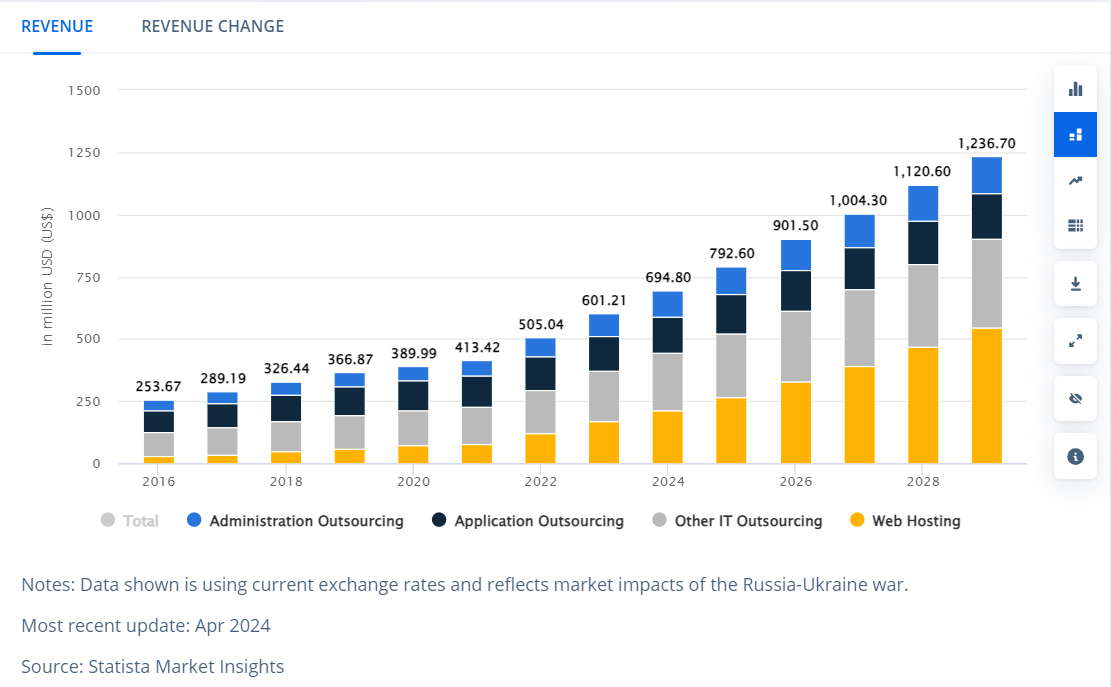
- Vietnam’s IT outsourcing market is projected to reach $1.28B by 2028 (17% CAGR), developer rates run $20–$40/hr, roughly 70% below US market rates, with senior dedicated engineers at $2,200–$5,000/month
- Top vendors range from enterprise giants (FPT Software: $1.22B revenue, 33,000+ engineers) to mid-market specialists (Kaopiz: AI & cloud, offices in Tokyo and Singapore) and domain-focused firms (Innotech, Sotatek, Rikkeisoft)
- Vendor selection matters more than country selection, evaluate ISO 27001 certification, English proficiency at team level, and case studies from similar projects before signing
Overview of IT Outsourcing Services: Why Choose Vietnam?
Vietnam’s IT outsourcing industry has witnessed remarkable growth over the past decade, firmly positioning the country as a key player in the global technology services market. More and more, businesses across the world are choosing Vietnam as a preferred destination for software development and offshore IT solutions.
Thanks to a unique combination of strengths, Vietnam offers substantial advantages for companies looking to outsource IT services. These include cost-effective development, a highly skilled tech workforce, and a rapidly expanding digital infrastructure.
In recent years, the country has gained strong momentum in areas such as software development, artificial intelligence, and cloud services, helping it stand out as one of Asia’s most promising outsourcing hubs. As global demand for IT outsourcing grows, Vietnam stands out as a rising star in Asia, thanks to:
1. Cost-Effectiveness
Hourly development rates in Vietnam range from $20 to $40, significantly lower than Singapore’s monthly developer salaries of $4,500 to $7,000, and 15–30% below comparable Indian rates. What’s less discussed is where those savings actually compound beyond the headline rate.
Vietnam’s cost of living index sits at 25.9 against New York’s baseline of 100 (Numbeo, 2025), which means lower office overhead, infrastructure costs, and operational expenses that flow directly through to vendor pricing.
A senior engineer in Vietnam costs roughly $3,500–$4,000 per month, the same budget that covers perhaps three weeks of equivalent San Francisco compensation. To put that in concrete terms:
- US: $12,000–$18,000/month for a senior full-stack developer
- Western Europe: $6,000–$10,000/month
- Vietnam: $2,200–$5,000/month, depending on seniority and stack
- Hourly outsourcing rate: $20–$40/hr for most engagement models
For teams scaling from 5 to 20 engineers over a 12-month roadmap, that delta is significant, and it’s a structural cost advantage that compounds across hiring, onboarding, and operational overhead simultaneously.
2. Skilled and Scalable Workforce
The talent picture is more nuanced than the numbers suggest. Vietnam has over 300 universities and educational centers dedicated to IT, producing approximately 57,000 graduates in IT-related fields annually. But supply still doesn’t meet demand, Vietnam faces an annual shortage of 150,000 to 200,000 programmers and engineers, which means the best vendors compete hard to attract and retain talent.
That competition tends to produce stronger engineering cultures and lower attrition than markets where talent is abundant and cheap.
Where that talent is concentrated matters for vendor selection:
- Ho Chi Minh City (~340,000 IT professionals): Best for scale, international-facing roles, and product-driven teams. Home to Quang Trung Software City and Saigon Hi-Tech Park, which together host global tenants including Intel, Samsung, and Nidec.
- Hanoi (~200,000 IT professionals): Stronger in IT services and R&D; technically disciplined engineers well-suited to enterprise systems and compliance-heavy projects.
- Da Nang (~35,000 IT professionals): Rising as a cost-effective destination for software development and outsourcing, better for stable mid-sized teams than high-volume scaling.
When I evaluate vendors for clients, city footprint matters: a firm headquartered in Hanoi delivery center gives you both talent density and engineering depth.
3. Strong Government Support
What’s changed significantly over the past few years isn’t just the volume of government rhetoric, it’s the specificity of the commitments. The National Digital Transformation Program targets a 20% GDP contribution from digital activities by 2025, backed by investments in STEM education, tech parks, and regulatory reform. Key developments that directly affect outsourcing buyers:
- Tax relief: In May 2025, the government introduced a new three-year Corporate Income Tax exemption for newly established SMEs including foreign-owned IT firms, reducing the cost barrier for international companies establishing a legal presence in-country.
- Data compliance: Decree 13, Vietnam’s new data protection law, is bringing the country’s governance framework closer in line with GDPR benchmarks, which matters for clients in Singapore, Australia, and the EU carrying data residency requirements.
- Digital acceleration: Vietnam launched a Country Digital Acceleration program in 2024 in alignment with the National Digital Transformation Program’s goals, backed by investment in tech parks and 5G rollout across major cities.
- AI investment: NVIDIA’s establishment of an AI research and development center in Hanoi signals that the country is actively building deep-tech capability, not just cost-competitive delivery.
4. Cultural Compatibility and Communication
Vietnam punches above its weight on project delivery culture. The alignment with Agile/Scrum practices is strong, and for Japan-facing work in particular, the attention to specification detail is notable — Vietnam is Japan’s second-largest software outsourcing partner, and the documentation discipline that Japanese clients require maps well to how stronger Vietnamese engineering teams already operate.
That said, English proficiency remains a real variable. Vietnam ranks 8th in Asia and 63rd globally on the 2024 Global English Proficiency Index, which translates to a meaningful spread between vendor tiers. What to screen for when evaluating a Vietnam-based vendor:
- English proficiency at the team level, not just the sales contact
- International client exposure, how many years has the team been working directly with US, Singapore, or European clients?
- Documentation discipline, especially critical for enterprise and Japan-facing projects
- Agile/Scrum maturity, look for certified Scrum Masters and a history of sprint-based delivery, not just vendors who list Agile in their service description
It’s one of the first things we screen for at Kaopiz, and it should be on your evaluation checklist, too.
5. A Thriving IT Ecosystem
Vietnam’s IT ecosystem has matured well beyond cost-competitive outsourcing into a serious destination for private capital and deep-tech investment. Vietnam’s digital economy reached $36 billion in 2024, representing 18.3% of GDP, and is on track to contribute 30–35% by 2030, positioning the country to become Southeast Asia’s second-largest digital economy, according to the Vietnam Innovation & Private Capital Report 2025.
The private capital signals are equally telling. Despite a 35% decline in global capital deployed, Vietnam recorded $2.3 billion across 141 deals in 2024, with PE buyouts alone accounting for $1.7 billion, reflecting sustained investor confidence in the country’s fundamentals. Within tech specifically:
- AI funding jumped from $10M to $80M in a single year, an 8x increase, as Vietnam emerged as a leading AI startup hub in ASEAN
- Business Automation investment surged 562% year-on-year
- Nearly 150 VC investors, the highest number since 2021, were active in Vietnam in 2024, led by players from Singapore, Japan, and Vietnam itself
For enterprise outsourcing buyers, this context matters beyond headline figures. A market attracting this level of private capital is one where your vendor has access to a competitive hiring environment, continuously upskilled talent, and an innovation culture that raises the baseline of what “standard delivery” looks like.
Top 10 IT Outsourcing Companies in Vietnam
Vietnam is home to a growing number of trusted IT outsourcing providers. These companies offer everything from full-cycle software development to cutting-edge technologies like AI and blockchain. Below are 10 of the most reputable IT outsourcing companies in Vietnam you should consider in 2026.
Notably, Kaopiz stands out as a rising star in the industry.
1. Kaopiz – Your Strategic Software Development Partner
Founded in 2014 in Hanoi, Kaopiz has grown from a software engineering firm into a multi-entity technology group with nearly 1,000 professionals across Vietnam, Japan, and Singapore. Over 12 years and 1,000+ projects, the company has built particular depth in AI development, cloud infrastructure (AWS Advanced Consulting Partner), and custom enterprise software for clients in Japan, Singapore, and broader APAC markets.
What sets Kaopiz apart at the mid-market level is the combination of delivery structure and proximity to client markets. The Japan office has been operational since 2016, and the Singapore office opened in late 2025, meaning account management and solution design happen in-region, not just delivery.
Kaopiz holds ISO 27001 and ISO 9001 certifications, an ISTQB Platinum Partnership, and has received the Sao Khue Award for seven consecutive years (2019–2025), alongside Vietnam Top 10 Digital Technology Company recognition in 2024 and 2025.
2. FPT Software
FPT Software is a subsidiary of FPT Corporation with $1.22 billion in revenue in 2024 and over 33,000 employees across 30 countries. Founded in 1998, it is Vietnam’s largest IT outsourcing firm by revenue and headcount, and the first Vietnamese tech company to surpass $1 billion in global IT services revenue.
FPT’s scale gives it capabilities that smaller vendors simply cannot match, the company has partnered with over 1,100 clients worldwide, more than 130 of which are Fortune Global 500 companies across aviation, automotive, banking, healthcare, and manufacturing.
3. TMA Solutions
Founded in 1997 in Ho Chi Minh City, TMA is one of the longest-standing IT outsourcing companies in Vietnam with a workforce of nearly 4,000 engineers serving clients across 30 countries.
TMA’s differentiation lies in its 10 specialized R&D centers covering AI, IoT, Fintech, 5G, and telecom, making it a strong choice for clients who need deep domain engineering rather than generalist development capacity. Its client base skews toward North America, Australia, and Europe, with particular strength in telecom and financial services.
4. Adamo Software
Adamo Software is a Vietnam-based IT outsourcing company that built its reputation around two industries rather than spreading thin across all of them: travel and hospitality, and healthcare. Instead of positioning as a general-purpose vendor, Adamo develops booking and reservation platforms, tour and experience products, telehealth and mHealth applications, and health data tools, which means its teams bring domain context to a project from day one rather than learning the industry on the client’s budget.
Its main model is the dedicated development team that works as a long-term extension of the client’s product team, and it applies AI inside these verticals rather than as a separate service. With clients across Australia, the UK, Europe, and Singapore, Adamo suits travel and healthcare companies that value domain expertise and delivery continuity over sheer headcount.
5. CMC Global
CMC Global is the international arm of CMC Corporation, one of Vietnam’s oldest technology conglomerates, founded in 1993. With 3,000+ employees and operations across 30+ countries, CMC Global provides full-cycle development capacity spanning cloud migration, system integration, cybersecurity, and AI-driven analytics.
CMC’s particular strength is in enterprise-grade project governance, its ISO certifications and structured delivery model make it well-suited for manufacturing, logistics, and government clients where auditability and compliance are as important as technical output. The company has been especially active in Japan and APAC enterprise markets.
6. Newwave Solutions
Newwave Solutions is one of the trusted software outsourcing companies in Vietnam with 300+ professionals, 800+ successful projects, and 200+ active clients. Over 14 years, the company has built a strong track record in delivering secure and scalable software solutions, reflected through ISO 27001 and ISO 9001 certifications, Top 10 ICT Companies in Vietnam 2022, and Sao Khue Award recognition.
Newwave Solutions provides end-to-end software development, leveraging AI and blockchain solutions to serve a wide range of industries, such as finance, healthcare and real estate. Serving clients across Japan, Europe, and Australia, the company is committed to delivering high-quality software solutions that support operational efficiency, digital transformation, and sustainable business growth.
7. Sotatek
Founded in 2015 in Hanoi, Sotatek is one of the top IT outsourcing companies in Vietnam. It has built a strong reputation in blockchain, Web3, and AI/ML, areas where many traditional outsourcing firms lack depth. Its 1,300+ talent team includes IT consultants and developers with deep expertise in banking and finance, insurance, automotive, media, healthcare, and education, with clients across Asia, Europe, and North America.
Sotatek’s positioning as a specialist in emerging technologies makes it a natural fit for startups and growth-stage companies undergoing digital transformation rather than large enterprises looking for stable, long-term managed services.
8. AMELA Technology
Founded in 2019, AMELA Technology has grown into a 200+ person software development company with strong roots in the Japanese market and experience across 200+ clients and 350+ projects. The company operates across software development, dedicated teams, IT outsourcing, and emerging technologies such as AI, with offices in Vietnam and Japan.
AMELA’s experience with Japanese clients, supported by its Japan-based operation, makes it a practical partner for companies looking to expand development capacity offshore. Its ISO-certified quality and information security systems, combined with flexible team scaling from individual specialists to larger development teams, position AMELA as a relatively agile alternative to larger outsourcing providers.
9. Innotech Vietnam
Founded in 2014, Innotech specializes almost exclusively in banking, financial services, and fintech, a deliberate vertical focus that gives it deeper domain knowledge than generalist outsourcing firms in this space. Innotech has built compliance-aware engineering teams experienced with the regulatory requirements that financial institutions in Singapore, Japan, and Southeast Asia operate under.
The company’s narrow focus is both its strength and its constraint: if your project sits squarely within fintech or core banking, Innotech is worth evaluating seriously. For anything outside financial services, a broader-capability vendor will serve you better.
10. VTI
Founded in 2007 and headquartered in Hanoi, VTI has built its practice across AI-powered solutions, custom software development, and IT consulting. The company serves mid-to-large clients in logistics, retail, and finance, with delivery capacity across Vietnam and a growing international client base in Japan and Southeast Asia.
VTI’s strength is in scalable delivery for complex, multi-year engagements. The company has expanded steadily with 1,800+ engineers and a track record in both product development and system integration work.
Conclusion: Vietnam – Smart IT Outsourcing Destination 2026
Vietnam is rapidly solidifying its position as a global IT outsourcing powerhouse, offering exceptional value for businesses aiming to innovate, scale, and stay competitive in the digital age. With a maturing tech ecosystem, cost-efficient development models, and a highly skilled workforce, the country has become a top choice for global enterprises and startups alike seeking reliable technology partners.
Among the many IT outsourcing companies in Vietnam driving this transformation, Kaopiz stands out as a rising leader. With a strong reputation for quality, transparency, and technological expertise, Kaopiz combines the advantages of Vietnam’s IT market with a personalized, client-first approach, delivering impactful solutions across industries and continents.
Whether you’re building a dedicated offshore development team, developing a complex software product, or integrating emerging technologies like AI and cloud, partnering with Kaopiz gives your business the flexibility, speed, and reliability needed to succeed in today’s fast-paced digital world.
In short, Vietnam offers the infrastructure — Kaopiz delivers the excellence.
FAQs
- How Much Does IT Outsourcing in Vietnam Cost?
- Hourly rates range from $20 to $40 depending on seniority and stack. For dedicated team models, a senior full-stack developer runs $2,200 to $5,000 per month, compared to $12,000 to $18,000 for an equivalent hire in San Francisco.
- Is Vietnam Good for IT Outsourcing?
- Yes, and increasingly so. Vietnam combines competitive rates, 560,000+ developers, and a government actively investing in digital infrastructure. Vietnam ranks #64 globally on the EF English Proficiency Index 2024, with IT professionals scoring at working-level proficiency. The primary variable is vendor selection: the quality gap between top-tier and mid-tier firms is significant, which is why evaluating delivery track record, certifications, and English proficiency at the team level matters more than country-level averages.
- How Do I Choose an IT Outsourcing Company in Vietnam?
- Five criteria separate strong vendors from average ones: domain expertise in your industry, certifications, English proficiency at the delivery team level — not just the sales contact — a track record of serving clients in your target market, and a delivery model that matches your engagement type. Ask for case studies from similar projects, not just a client logo list.
- What Are the Risks of IT Outsourcing to Vietnam?
- The main risks are vendor quality variance, talent attrition, and data security. Require ISO 27001 certification and a signed NDA before any code is written, and ask for references from projects of similar size — not just a client logo list.
- What Engagement Models Do Vietnam IT Outsourcing Companies Offer?
- Three models dominate: project-based (fixed scope, fixed price), dedicated team (extended team billed monthly), and time-and-materials (hourly, flexible scope). Most mid-to-large vendors offer all three. The dedicated team model typically yields the best cost efficiency for engagements longer than six months.
Author

Lucie Tran
Head of Growth of Kaopiz Global
Leave a Comment
Table of Contents
Don’t miss what’s next!
Thank you! Your form has been submitted successfully.



Pingback:What is OpenAI? Everything You Need to Know (2025 Guide)
Pingback:Top IT Outsourcing Trends 2025: What’s Shaping the Future
Pingback:10 IT Outsourcing Companies Singapore Business Should Know
Pingback:20 Cutting-Edge Technology Trends Shaping the World’s Future
Pingback:10 Best Countries for Software Development Outsourcing in 2025
Pingback:In-House vs Outsourcing: Which Is Right for Your Business?