

Top 25 Cutting-Edge Technology Trends Shaping the World’s Future
In 2026, the outlook for cutting-edge technology trends is poised to transform the entire industry, driving innovation, reshaping business models, and setting new standards for technology adoption across sectors.
As we look toward the future, understanding the top cutting-edge technology trends is essential for businesses aiming to maintain a competitive edge, improve operational efficiency, and deliver enhanced customer experiences. This comprehensive guide explores the cutting edge of technology meaning and the 25 most impactful trends shaping the world’s future, offering insights into their potential benefits.
Key Takeaways
- Artificial intelligence is becoming the driving force behind modern digital transformation, with trends such as Generative AI, Agentic AI, Multiagent Systems, and Hyperautomation reshaping enterprise operations in 2026.
- Businesses are increasingly prioritizing practical technology adoption focused on automation, scalability, cybersecurity, and operational efficiency rather than experimental innovation alone.
- Cloud infrastructure, AI supercomputing, edge computing, and confidential computing are evolving rapidly to support growing AI workloads and real-time enterprise applications.
- Emerging technologies such as Digital Twins, Spatial Computing, Robotics, and IoT are accelerating the convergence between digital and physical environments across industries.
- Responsible AI, cybersecurity, and data privacy are becoming essential priorities as organizations expand AI adoption and manage increasingly complex digital ecosystems.
- Healthcare and scientific innovation continue to advance through biotechnology, telemedicine, wearable technologies, and AI-powered diagnostics, enabling more personalized and connected healthcare experiences.
- Sustainable technologies, green cloud infrastructure, and energy-efficient systems are becoming critical components of long-term enterprise technology strategies.
What Is Cutting-Edge Technology?
Cutting-edge technology refers to the latest and most advanced innovations that push the boundaries of what is currently possible. It represents state-of-the-art tools, techniques, and systems that are at the forefront of development and application. These technologies often redefine industries, improve efficiencies, and open new avenues for growth and transformation.

The term “cutting-edge” implies being ahead of the curve, whether through pioneering research, breakthrough inventions, or early adoption of new solutions that have yet to become mainstream. Cutting-edge technology examples include artificial intelligence (AI), quantum computing, 5G networks, and blockchain.
In addition, cutting-edge technology in software development might mean leveraging the newest programming frameworks, integrating AI-powered automation, or adopting cloud-native architectures to build faster, more scalable, and secure applications.
Top 25 Cutting-Edge Technology Trends for 2026
As technology continues to evolve at an unprecedented pace, certain innovations are set to dominate and redefine industries in 2026. Here are the top 25 cutting-edge technology trends that businesses and individuals should watch closely to stay ahead in the digital age.
Generative AI
Generative AI (GenAI) is a cutting-edge branch of AI that creates new content, such as text, images, music, and code, by learning patterns from vast datasets. Leveraging advanced models like OpenAI’s GPT-5 and DALL·E, GenAI powers diverse applications ranging from creative writing and design automation to customer support and software development.
Today, it is no longer just experimental; it has become an essential tool in workplaces worldwide. In fact, 75% of generative AI users report using it to automate tasks and enhance work communications, underscoring its growing significance in enterprise environments.
According to McKinsey, organizations are increasingly shifting from experimental AI adoption toward enterprise-wide AI deployment focused on operational efficiency and business process automation.

Notable Examples:
In 2026, generative AI is evolving beyond content creation toward predictive reasoning, autonomous AI agents, and hyperautomation. Businesses are increasingly using AI not only to generate content, but also to automate decision-making, optimize workflows, and execute complex multi-step tasks with minimal human intervention.
Multiagent Systems
Multiagent systems are becoming a major AI trend in 2026 as businesses move beyond single AI assistants toward collaborative AI ecosystems. These systems allow multiple specialized AI agents to communicate, coordinate tasks, and automate complex workflows across areas such as software development, cybersecurity, and enterprise operations.
According to IBM Research, multiagent systems improve scalability, adaptability, and decision-making efficiency in distributed AI environments, making them increasingly important for enterprise AI adoption.
Notable Examples:
- Microsoft AutoGen: Framework that enables multiple AI agents to collaborate autonomously across enterprise workflows.
- CrewAI: Open-source multiagent platform designed for AI-powered business automation.
- LangGraph: Framework for orchestrating complex AI agent interactions and workflows.
- OpenAI Swarm: Experimental framework for coordinating specialized AI agents across tasks.
AI-Native Development Platforms
AI-native development platforms are transforming software engineering by embedding AI directly into the development lifecycle. These platforms help businesses accelerate coding, automate testing, optimize workflows, and improve software delivery through intelligent AI-powered assistance and automation.
According to IBM AI-Native Overview, AI-native systems are designed with AI embedded at their core, enabling organizations to build more adaptive, scalable, and intelligent digital products and services. As enterprise AI adoption continues to grow, AI-native development is becoming a key driver of modern software innovation.
Notable Examples:
- GitHub Copilot: AI-powered coding assistant that helps developers write and optimize code faster.
- Cursor: AI-native code editor designed for intelligent software development workflows.
- Replit Ghostwriter: AI-assisted development platform for rapid application building.
- Tabnine: AI code completion tool focused on improving developer productivity.
Hyperautomation
Hyperautomation is becoming a major enterprise technology trend in 2026 as organizations increasingly combine AI, machine learning, robotic process automation (RPA), and analytics to automate complex business operations. Unlike traditional automation, hyperautomation focuses on end-to-end workflow optimization across multiple departments and systems.

According to IBM, hyperautomation enables businesses to improve operational efficiency, reduce manual workloads, and accelerate digital transformation by integrating intelligent automation technologies at scale.
Notable Examples:
- UiPath: Enterprise automation platform combining RPA, AI, and workflow orchestration.
- Automation Anywhere: AI-powered automation platform for business process optimization.
- Microsoft Power Automate: Workflow automation platform integrated with Microsoft’s ecosystem.
- ServiceNow: Enterprise workflow automation platform for IT operations and business services.
Cybersecurity
Cybersecurity is a new cutting-edge technology for 2026 that protects digital systems, networks, and data from unauthorized access, attacks, and damage. As businesses increasingly rely on connected devices and cloud services, advanced cybersecurity solutions are essential to safeguard sensitive information and ensure operational continuity.
The global cybersecurity market is projected to reach $501.60 billion by 2030, growing at a CAGR of 11.6% from 2022 to 2030. As a result, this growth is fueled by the rise of smart devices, expanding e-commerce, and the increasing frequency and sophistication of cyberattacks. Organizations are investing heavily in technologies to detect, prevent, and respond to evolving threats.
Notable Examples:
- Zero Trust Security: Continuously verify users and devices for access.
- AI-Powered Threat Detection: Use machine learning to spot and stop threats instantly.
- Passwordless Authentication: Replace passwords with biometrics or tokens for safer access.
- SOAR (Security Orchestration, Automation, and Response): Automate security tasks and incident responses.
Cloud Computing
Cloud computing is one of the technology trends 2026 that delivers computing resources, like servers, storage, and applications, over the Internet. It provides businesses with scalable, flexible, and cost-effective infrastructure, fueling innovation and digital transformation.
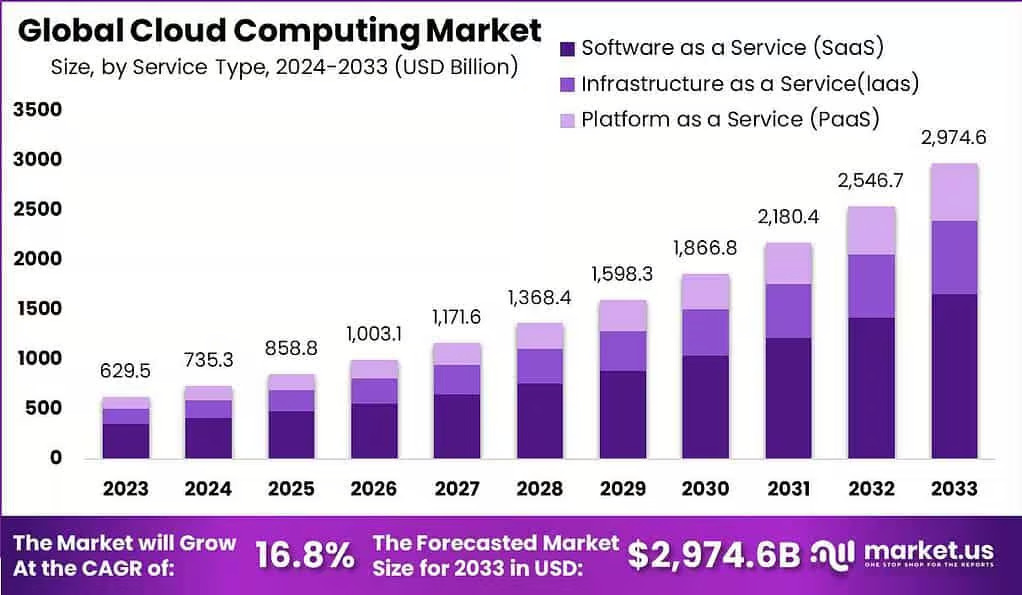
The global cloud computing market is projected to grow significantly, expected to reach approximately $2,974.6 billion by 2033, up from $629.5 billion in 2023, with a strong CAGR of 16.8% during the forecast period from 2024 to 2033. The increasing adoption of cloud services across industries, fueled by trends like remote work, big data analytics, and AI integration, drives this growth.
Notable Examples:
AI Supercomputing Platforms
AI supercomputing platforms are becoming essential for training and deploying advanced AI models that require massive computational power and high-speed data processing. These platforms combine high-performance computing (HPC), AI accelerators, and large-scale infrastructure to support complex AI workloads across industries such as healthcare, finance, cybersecurity, and scientific research.
According to IBM Supercomputing, modern supercomputing systems enable organizations to process enormous datasets, accelerate AI innovation, and solve computational problems far beyond the capabilities of traditional computing infrastructure.
Notable Examples:
- NVIDIA DGX SuperPOD: AI supercomputing infrastructure designed for large-scale AI training and inference.
- IBM Summit: High-performance supercomputer used for AI research and scientific simulations.
- Microsoft Azure AI Supercomputer: Cloud-based AI supercomputing platform powering advanced AI workloads.
- Google TPU Pods: AI-optimized infrastructure for large-scale machine learning and generative AI models.
5G & Edge Computing
The global 5G edge computing market is expected to reach $51,574.3 million by 2030, growing at a CAGR of 47.8% from 2025 to 2030. The rapid adoption of technologies like the Internet of Things (IoT), big data, and cloud computing across industries such as healthcare, education, manufacturing, and government fuels this explosive growth.
5G networks provide ultra-fast, low-latency wireless connectivity, while edge computing processes data closer to where it is generated, near the end users or devices. This combination reduces latency, lowers bandwidth use, and enhances overall system efficiency, making it ideal for applications requiring real-time processing and instant response.
Notable Examples:
Confidential Computing
Confidential computing is emerging as a critical cybersecurity trend in 2026 as organizations seek stronger protection for sensitive data during processing and storage. This technology uses hardware-based trusted execution environments (TEEs) to secure data while it is being processed, helping businesses reduce security risks in cloud and AI-driven environments.

According to Google Cloud Confidential Computing, confidential computing helps organizations protect data in use, supporting secure cloud adoption, regulatory compliance, and privacy-sensitive AI workloads across industries.
Notable Examples:
- Google Cloud Confidential Computing: Secure cloud infrastructure for protecting sensitive workloads and AI processing.
- Microsoft Azure Confidential Computing: Hardware-based security platform for confidential cloud applications.
- IBM Hyper Protect Services: Confidential computing solutions designed for enterprise-grade data security.
- Intel SGX: Trusted execution technology for securing sensitive data and applications at the hardware level.
Spatial Computing
Spatial computing is emerging as a major enterprise technology trend in 2026, enabling businesses to blend digital information with the physical world through augmented reality (AR), virtual reality (VR), mixed reality (MR), and real-time 3D environments. By moving beyond flat screens, spatial computing allows organizations to interact with data, systems, and workflows directly within physical spaces, transforming how teams collaborate, design, and operate.
According to IBM, spatial computing blends the physical and digital world using AR, VR, and real-time 3D technologies, offering organizations new ways to benefit from investments in devices and immersive enterprise applications across industries such as manufacturing, logistics, and healthcare.
Notable Examples:
- NVIDIA Omniverse: Real-time 3D simulation and spatial computing platform for industrial design, digital twins, and collaborative virtual environments.
- Apple Vision Pro: Spatial computing headset designed for immersive enterprise workflows, collaboration, and mixed reality applications.
- Microsoft HoloLens 2: Mixed reality device enabling hands-free AR experiences for industrial training, remote assistance, and field operations.
- Meta Quest for Business: Enterprise-focused VR/MR platform supporting virtual collaboration, training simulations, and productivity applications.
Quantum Computing
Quantum computing is one of the emerging cutting-edge computers that leverages the principles of quantum mechanics to perform complex computations far beyond the capabilities of classical computers. Therefore, by using quantum bits (qubits), quantum computers can solve certain problems exponentially faster, making them ideal for applications in cryptography, optimization, drug discovery, and complex simulations.
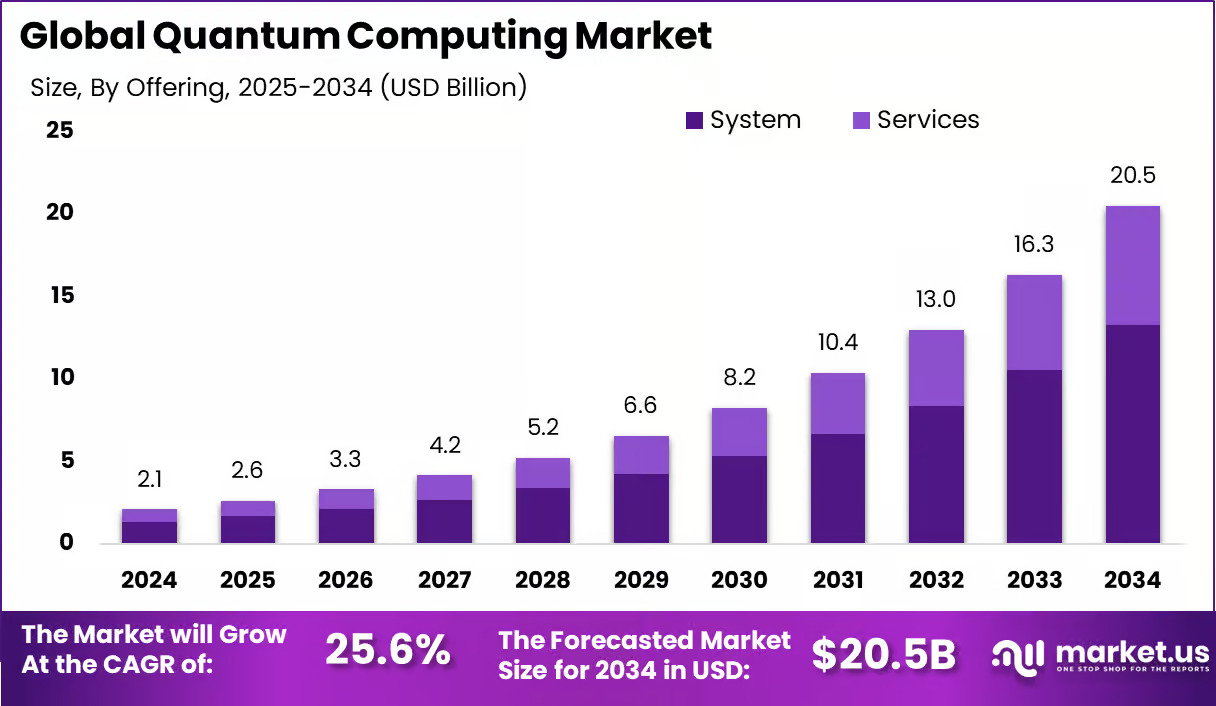
The global quantum computing market is projected to grow rapidly, expected to reach $20.5 billion by 2034, with a robust CAGR of 25.6% during the forecast period from 2024 to 2033. In 2024, North America dominated the market, accounting for over 37.6% of the revenue, driven by strong investments and technological advancements.
Notable Examples:
Internet of Things (IoT)
The IoT is a transformative technology that connects everyday devices and sensors to the internet, allowing them to collect, share, and analyze data to drive smarter decision-making and automation. IoT is revolutionizing industries by enabling real-time monitoring, predictive maintenance, and enhanced operational efficiency across sectors such as manufacturing, healthcare, agriculture, and smart cities.
The number of IoT devices worldwide is projected to more than double, rising from 19.8 billion in 2025 to over 40.6 billion by 2034. The consumer segment currently accounts for approximately 60% of all IoT devices in 2026, a proportion expected to remain steady over the next decade.
Notable Examples:
Robotics
Robotics is a cutting-edge technology that involves the design, construction, and use of robots to perform tasks traditionally done by humans, often with greater precision, efficiency, and safety. It is transforming multiple industries, including manufacturing, healthcare, logistics, and agriculture, by automating repetitive or hazardous tasks, enhancing productivity, and enabling new capabilities.
The global robotics industry is projected to reach $43.32 billion in revenue by 2027, driven by advancements in AI, machine learning, and sensor technologies that make robots smarter and more adaptable.
Notable Examples:
AI TRiSM
AI Trust, Risk, and Security Management (AI TRiSM) is the most modern technology focused on ensuring the responsible, secure, and ethical use of AI systems. The solutions help organizations manage AI-related risks, maintain transparency, and build trust by monitoring AI models for fairness, security vulnerabilities, and compliance.
According to Market.us, the global AI TRiSM market is projected to grow significantly, reaching $8.4 billion by 2033, up from $1.9 billion in 2023, with a CAGR of 16.0% from 2024 to 2033. This growth is driven by increasing regulatory scrutiny, the complexity of AI systems, and growing concerns around bias, privacy, and security.
Notable Examples:
Blockchain & DeFi
Blockchain technology underpins decentralized finance (DeFi), a cutting-edge innovation that enables financial transactions and services to operate without centralized intermediaries. By providing transparent, secure, and tamper-proof ledgers, blockchain fosters trust and efficiency across financial ecosystems.
The global decentralized finance market was valued at $26.9 billion in 2025 and is expected to grow $37.3 billion in 2026 to $1,417.7 billion by 2033, at a CAGR of 68.2% from 2026 to 2033. This explosive growth reflects increasing adoption of DeFi platforms that offer lending, borrowing, trading, and payment services in a decentralized manner.

Notable Examples:
Extended Reality (AR/VR/MR)
Extended Reality (XR), encompassing augmented reality (AR), virtual reality (VR), and mixed reality (MR), is revolutionizing how people interact with digital content by blending the physical and virtual worlds. In 2026, XR technologies enable immersive experiences across gaming, education, healthcare, training, and retail, enhancing engagement and transforming workflows.
The global XR market is projected to expand dramatically, growing from $117.7 billion in 2026 to approximately $519.5 billion by 2032, with an impressive CAGR of 30.8% during 2024 to 2033. This growth is fueled by advances in hardware, 5G connectivity, and software platforms that enable richer and more accessible XR experiences.
Notable Examples:
Nanotechnology
Nanotechnology involves manipulating matter at the atomic and molecular scale to create materials and devices with extraordinary properties. This cutting-edge technology in software development has applications across electronics, medicine, energy, and manufacturing, enabling breakthroughs like more powerful computing and targeted cancer treatments.
The global nanotechnology market was valued at $8.78 billion in 2025 and is expected to soar to approximately $139.37 billion by 2035, growing at an impressive CAGR of 31.85% between 2026 and 2035. Market leaders are actively pursuing mergers and acquisitions to accelerate innovation and capture market share.

Notable Examples:
3D Multi-Sensor Transmitters
Advanced devices, 3D Multi-Sensor Transmitters, integrate multiple sensors to capture spatial and environmental data in three dimensions. These cutting-edge technologies are essential for applications requiring precise measurement and real-time monitoring, such as autonomous vehicles, robotics, augmented reality, and industrial automation.
The global 3D sensor market is expected to grow to approximately $27.2 billion by 2033, with a CAGR of 16.7% during the forecast period from 2024 to 2033. This technology corner supports innovations in navigation, object detection, and environmental mapping across diverse sectors.
Notable Examples:
Conversational AI
Conversational AI refers to technologies that enable computers to understand, process, and respond to human language in a natural, conversational manner. This AI trend powers virtual assistants, chatbots, and voice-activated systems, transforming customer service, sales, and user engagement by providing personalized, efficient, and scalable interactions.
The global conversational AI market is projected to reach $41.39 billion by 2030, growing at a CAGR of 23.7% from 2025 to 2030. Businesses across industries are adopting conversational AI to automate customer support, improve user experiences, and gather valuable insights from interactions.
Notable Examples:
- Google Dialogflow: A popular platform for building conversational interfaces and chatbots.
- Amazon Lex: Powers Alexa and enables developers to create voice and text chatbots.
- Microsoft Azure Bot Service: Provide tools to build, connect, and manage intelligent bots.
- IBM Watson Assistant: AI-powered chatbot platform designed for enterprise use.
Low-Code/No-Code Platforms
Low-code and no-code platforms empower users to develop applications quickly with minimal or no coding experience. These cutting-edge technologies democratize software development by enabling businesses to build custom solutions, automate workflows, and accelerate digital transformation without relying solely on traditional developers.
According to Statista, the global low-code platform market is forecasted to reach approximately $65 billion by 2027, driven by the demand for faster app delivery and the need to address the IT skills shortage.
Notable Examples:
Digital Twins
Digital twins are virtual replicas of physical assets, systems, or processes that allow real-time monitoring, simulation, and analysis. They enable businesses to optimize performance, predict maintenance needs, and improve decision-making by creating a dynamic digital counterpart to real-world objects.
The global digital twin market is expected to surge from $24.48 billion in 2025 to $259.32 billion by 2032, growing at a remarkable CAGR of 40.1% during this period. This rapid expansion is driven by industries seeking to enhance efficiency and reduce operational risks through digital simulation.

Notable Examples:
- Siemens: Offer advanced industrial digital twin solutions for manufacturing and infrastructure.
- Microsoft Azure Digital Twins: Provide cloud-based systems for creating comprehensive digital simulations.
- Tesla: Use digital twins to optimize performance and safety in real time.
- GE Digital: Apply digital twins for predictive analytics and asset management in manufacturing.
Smart Transportation
Smart transportation leverages cutting-edge technologies like IoT, AI, and big data to create efficient, safe, and sustainable mobility systems. By integrating connected vehicles, traffic management solutions, and real-time data analytics, smart transportation enhances urban mobility, reduces congestion, and lowers environmental impact.
The global smart transportation market was valued at $124.6 billion in 2024 and is expected to grow at a CAGR of 12.8% from 2025 to 2034. This growth is driven by increasing investments in intelligent traffic systems, autonomous vehicles, and eco-friendly transport solutions worldwide.
Notable Examples:
Telemedicine
Telemedicine leverages digital technologies to provide remote healthcare services, enabling patients to consult with doctors and monitor health conditions without visiting medical facilities. This innovation has expanded healthcare access, improved patient convenience, and helped reduce costs.
In 2024, over 116 million people worldwide used online doctor consultations, nearly doubling from around 57 million in 2019. While growth is expected to continue, the pace will be steadier compared to the rapid increases seen during 2020 and 2021.

Notable Examples:
Sustainable Technology
Sustainable technology, also known as green technology, focuses on developing eco-friendly innovations that reduce environmental impact while promoting economic growth. These technologies support renewable energy, waste reduction, energy efficiency, and sustainable resource management, helping businesses meet Corporate Social Responsibility (CSR) goals and regulatory requirements.
The global green technology and sustainability market was valued at $25.44 billion in 2025 and is expected to reach $140.03 billion by 2034, growing at a CAGR of 20.70% over the forecast period.
Notable Examples:
Wearable Health Monitor
Wearable health monitors are top tech trends 2026 that track vital signs and health metrics in real-time, empowering users and healthcare providers to monitor conditions continuously and proactively. These devices include smartwatches, fitness trackers, and specialized medical wearables that measure heart rate, blood oxygen, glucose levels, and more.
The global wearable medical devices market is projected to grow to $543.9 billion by 2034. This rapid growth is driven by the increasing prevalence of chronic diseases and rising health awareness among consumers.

Notable Examples:
Why Businesses Should Embrace Cutting-Edge Technologies?
Cutting-edge technologies offer a multitude of benefits that can transform operations, customer experiences, and overall business performance.
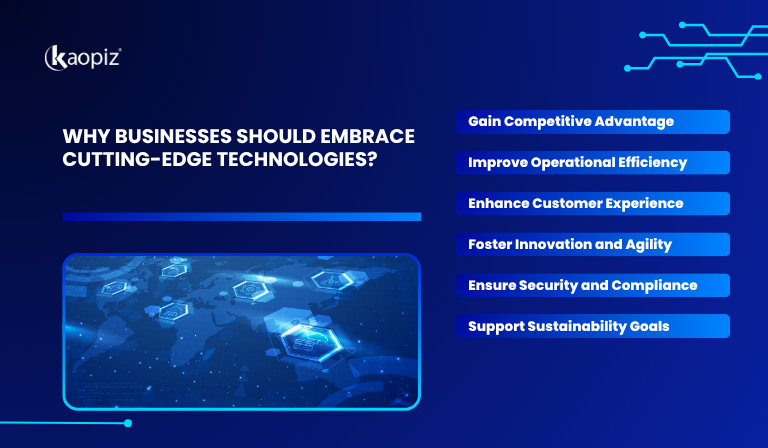
- Gain Competitive Advantage: Stand out by offering superior products, services, and efficiencies; capture new markets and innovate faster.
- Improve Operational Efficiency: Streamline workflows and reduce errors with AI, automation, and cloud computing, leading to cost savings and scalability.
- Enhance Customer Experience: Use conversational AI, IoT, and personalized analytics to deliver tailored solutions and real-time support.
- Foster Innovation and Agility: Build a culture of innovation to quickly adapt to market changes and seize new opportunities.
- Ensure Security and Compliance: Protect data and meet regulatory requirements with advanced cybersecurity technologies.
- Support Sustainability Goals: Reduce environmental impact and align with CSR initiatives through green technology adoption.
What Industries Benefit the Most from New Technology Services?
New technology services are driving profound transformation across numerous industries, enabling them to innovate, increase efficiency, and better serve their customers. Here are some of the key industries that benefit the most from adopting cutting-edge technologies:
Transforming Your Business with the Help of Kaopiz
Partnering with a trusted cutting-edge technology company is essential to successfully navigate innovation and transformation. Kaopiz is a proven IT outsourcing partner with a strong track record of delivering cutting-edge technology solutions tailored to meet your business goals.
With 1000+ successful projects completed for 500+ global clients across industries such as finance, healthcare, manufacturing, and retail, Kaopiz brings deep expertise and a client satisfaction rate of 98%. Our certified teams hold qualifications including ISTQB Platinum Partner status and AWS Advanced Tier Services Partner certification, underscoring our commitment to quality, security, and best practices.
Kaopiz offers comprehensive services spanning AI development, cloud migration, IoT integration, blockchain solutions, and custom software development. We work closely with your team to understand your unique challenges and provide scalable, secure, and efficient solutions that accelerate growth and improve operational efficiency.
By choosing Kaopiz, you gain a reliable partner dedicated to driving your digital transformation, enhancing customer experience, and helping you stay competitive in an ever-evolving technology landscape.
Conclusion
Cutting-edge technologies are reshaping the business landscape across every industry, offering unprecedented opportunities for innovation, efficiency, and growth. From generative AI and quantum computing to IoT and sustainable tech, these tech trends empower organizations to stay competitive, enhance customer experiences, and solve complex challenges in new ways.
As technology continues to evolve rapidly, companies that adapt and innovate will lead the way. Now is the time to explore, adopt, and invest in cutting-edge technology to unlock your business’s full potential and thrive in the digital era.
FAQs
- What Are the Challenges of Adopting Cutting-Edge Technology?
-
Businesses commonly face three key challenges when adopting new technology:
- Employee Resistance: Staff may push back due to fear of disruption or unfamiliarity. Training and clear communication help ease the transition.
- High Costs: Upfront investment in acquisition, integration, and maintenance can strain budgets.
- Knowledge Gaps: Specialized skills are often unavailable in-house, making implementation and ongoing management difficult.
- How Can Businesses Effectively Adopt Cutting-Edge Technology?
-
The most effective approach is to partner with or outsource to experienced technology providers. IT outsourcing gives businesses access to specialized expertise, reduces implementation risk, enables flexible scaling, and frees internal teams to focus on core operations.
- Can Small Businesses Adopt Cutting-Edge Tech?
-
Yes. Cloud services, low-code/no-code platforms, and affordable AI tools have made advanced technology accessible to businesses of all sizes. Through outsourcing and scalable solutions, small businesses can innovate competitively without heavy upfront investment.
- What Cutting-Edge Technologies Should Businesses Prioritize in 2026?
-
Focus on technologies with the clearest ROI: Generative AI, Agentic AI, Hyperautomation, cloud infrastructure, and cybersecurity. For industries bridging physical and digital operations, Digital Twins, Spatial Computing, and IoT are also high-priority investments.
- How Do Businesses Measure the ROI of Cutting-Edge Technology Investments?
-
Track metrics such as cost savings from automation, productivity gains, reduced downtime, and revenue from new digital capabilities. Set clear baselines and measurable KPIs before implementation to accurately evaluate outcomes over time.
Author

Lucie Tran
Head of Growth of Kaopiz Global
Leave a Comment
Table of Contents
Don’t miss what’s next!
Thank you! Your form has been submitted successfully.



Pingback:Healthcare App Development Cost in Singapore (2025 Guide)