
Perplexity vs ChatGPT – Which One Should You Use in 2026?
In 2026, the AI assistant landscape is more competitive than ever. Among the dozens of tools on the market, Perplexity AI vs ChatGPT stands out as two of the most popular choices for both individual users and businesses.
While both tools rely on advanced AI models, they serve different purposes and excel in different use cases. Perplexity positions itself as a real-time AI-powered search assistant, designed to deliver concise, source-backed answers. ChatGPT, on the other hand, is a conversational AI built to handle everything from creative writing and coding to brainstorming and customer support.
This blog breaks down the key differences between Perplexity vs ChatGPT, compares their features, pricing, performance, and ideal use cases, and answers the big question: Which one should you use in 2026? Let’s dive in.
Key Takeaways
- Perplexity AI is a real-time AI search assistant. It fetches live web data, cites sources, and gives concise factual answers, best for research, fact-checking, and staying current.
- ChatGPT is a conversational AI built for generation. It writes, codes, brainstorms, and reasons — best for creative work, automation, and multi-step problem-solving.
- Both cost ~$20/month for their Pro/Plus tiers.
- For most professionals, using both tools together delivers better results than choosing just one.
- If you can only pick one: choose Perplexity for accuracy-first workflows, ChatGPT for creativity-first workflows.
What Is Perplexity AI?
Perplexity AI is an AI-powered search assistant designed to deliver fast, concise, and accurate answers by combining large language models (LLMs) with real-time web search. Unlike traditional search engines, this AI tool summarizes information from multiple reliable sources and provides citation links directly in its responses, making it a go-to tool for fact-checking, research, and quick knowledge retrieval.
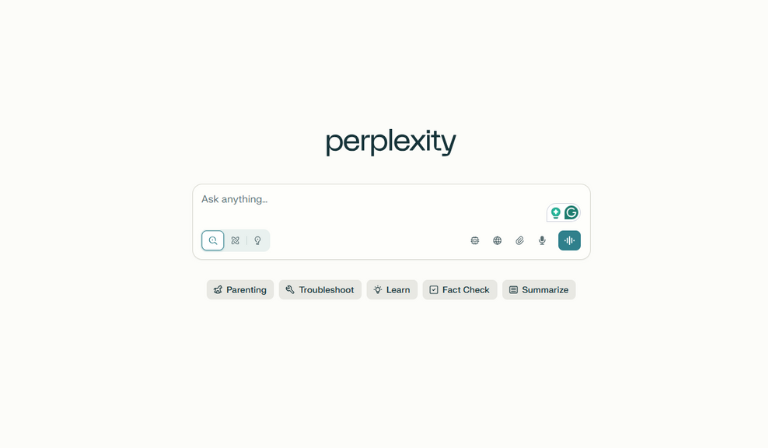
Launched in 2022, Perplexity has quickly gained popularity among professionals, researchers, and students because it offers:
- Real-time information retrieval (no outdated knowledge cutoff)
- Clear source citations for every answer
- Concise summaries instead of long lists of search results
- A chat-like interface for follow-up questions and deeper exploration
This tool bridges the gap between a search engine and a conversational assistant—ideal for those who value accuracy, transparency, and up-to-date information.
What is ChatGPT?
ChatGPT is a conversational AI assistant developed by OpenAI. It’s designed to generate human-like responses, engage in natural dialogue, and assist with a wide range of tasks—from content creation and coding to idea generation, customer support, and data analysis.
Unlike Perplexity AI, which focuses on search and factual retrieval, ChatGPT is built primarily for interactive, generative conversations. It can:
- Write and edit text (articles, emails, scripts, product descriptions)
- Generate and debug code in multiple programming languages
- Explain concepts clearly for education and training purposes
- Assist with brainstorming for creative and business ideas
- Simulate natural conversation for customer service or chatbot applications
ChatGPT is a versatile AI tool that excels in creativity, problem-solving, and conversation—making it ideal for individuals, teams, and businesses looking to automate tasks, generate ideas, or interact with customers more effectively.
Perplexity vs ChatGPT: Key Differences
While both Perplexity AI and ChatGPT are powerful AI tools, they are built for different purposes and excel in different areas. The simplest way to understand the difference: Perplexity reads the web so you do not have to. ChatGPT thinks so you do not have to.
| Factor | Perplexity AI | ChatGPT |
|---|---|---|
| Developer & Ownership | Developed by Perplexity AI Inc., an independent AI company focusing on AI search technology | Developed by OpenAI, a leading AI research lab focused on conversational AI and general-purpose LLMs |
| Technology & Data Sources | RAG + switchable LLMs; live web — always current | GPT-5.5 (training-based generation); training data + optional browsing |
| Purpose & Ideal Use Cases | Optimized for real-time search, fact-checking, quick knowledge retrieval | Optimized for creative writing, coding, brainstorming, customer support, and interactive tasks |
| Knowledge Freshness & Accuracy | Always up to date through live search; provides citations for sources | Relies on training data (knowledge cutoff) but can access web with browsing; fewer citations |
| Creativity & Output Style | Prioritizes conciseness and factual accuracy | Prioritizes creativity, detail, and conversational flow |
| Pricing & Subscription Models | Free plan; Perplexity Pro (~$20/month), faster responses, expanded limits | Free plan; ChatGPT Plus (~$20/month) unlocks GPT-5.5, faster responses, extra tools |
| Model Access | GPT-4 / Claude / Mistral (user-selectable); browsing is default; API not primary focus | GPT-5.5; Plus includes browsing, code interpreter, and file analysis; API available for developers |
| Performance & Response Quality | Extremely fast on factual queries; excels at concise, direct answers | Strong on reasoning and multi-step tasks; excels at structured, in-depth responses |
| Features & Integrations | Focused on search interface; mobile/web app; integrates citations and source previews | Wide range of tools; integrations via API for custom apps |
Developer & Ownership
Perplexity AI is developed by Perplexity AI Inc., a Silicon Valley startup founded in 2022. The company’s mission is to build an AI-powered search companion that delivers factual, concise, and transparent answers at speed. Its strategic focus is on competing with Google and traditional search, not on being a general-purpose AI assistant.
ChatGPT is developed by OpenAI, the AI research organization behind the GPT model family. OpenAI’s strategic scope is broader: it aims to build general-purpose AI that can reason, create, and interact across virtually any domain. ChatGPT is the consumer face of that ambition.
While both companies work with advanced AI technologies, their strategic goals differ:
- Perplexity focuses on becoming the go-to AI search companion, competing directly with Google and other search-integrated AI tools.
- In contrast, OpenAI positions ChatGPT as a versatile AI assistant, targeting a wide spectrum of use cases from coding and business support to content creation and research assistance.
Technology & Data Sources
Perplexity AI uses retrieval-augmented generation (RAG) — a technique that combines a live web search layer with an LLM. Every query triggers a real-time web fetch, which feeds current information into the model before it generates a response. The result: answers that reflect what is true now, not what was true when the model was trained, always cited with traceable sources.
Then, a common question is: “Does Perplexity use ChatGPT?”
- Yes, Perplexity relies on GPT models developed by OpenAI (and sometimes other LLMs) as part of its technology stack.
- However, Perplexity adds its own retrieval system and interface to create a different user experience from ChatGPT.
ChatGPT is built directly on OpenAI’s GPT models — GPT-5.5 on Plus, Pro, Business, and Enterprise as of 2026. Browsing is available in paid tiers but is not active by default on every query. Without browsing, ChatGPT draws answers from its training data, which carries a knowledge cutoff.
Key takeaway:
- Perplexity = RAG + switchable LLMs, optimized for real-time accuracy and citations
- ChatGPT = GPT-5.5, optimized for generation, reasoning, and creative output
Purpose & Ideal Use Cases
The Perplexity vs ChatGPT difference lies in the purposes. Although Perplexity AI and ChatGPT are both built on advanced AI models, their core purposes and best use cases are very different.
Perplexity AI is designed primarily as an AI-powered search companion. Its strength lies in:
- Research and fact-checking
- Academic work
- Market or compliance research
Because Perplexity emphasizes accuracy, concise summaries, and source citations, it works best when factual correctness is a priority.
In contrast, ChatGPT is built as a general-purpose conversational AI that excels in:
- Creative writing
- Coding and technical support
- Business automation
- Idea generation and brainstorming
It is ideal when creativity, reasoning, and structured conversation are key.
Key takeaway:
- Use Perplexity when you need accurate, up-to-date facts.
- Use ChatGPT when you need creative output, problem-solving, or detailed explanations.
Knowledge Freshness & Accuracy
One of the biggest distinctions in the Perplexity vs ChatGPT comparison is how each tool handles knowledge freshness and accuracy—a deciding factor for users who need up-to-date and reliable information.

Perplexity is built around real-time retrieval. Every query searches the live web. When our team asked both tools “What are the current EU AI Act obligations for general-purpose AI model providers as of 2026?”, Perplexity returned a structured answer in under 5 seconds, cited 6 sources including the official EUR-Lex portal and two enforcement-focused law firm publications, and correctly noted which obligations took effect in August 2025. There was no knowledge gap.
ChatGPT, with browsing disabled, produced a well-written answer, but it reflected the state of the Act from its training data, not the current enforcement status. With browsing enabled (ChatGPT Plus and above), the gap narrows significantly: ChatGPT can retrieve current information, but its citation structure is less systematic than Perplexity’s and requires the user to manually activate browsing for each session.
Key takeaway:
- Perplexity: Best for up-to-date, source-backed answers.
- ChatGPT: Best for reasoned explanations and creative outputs, but browsing is optional, and citation support is limited.
Creativity & Output Style
While both Perplexity AI and ChatGPT can answer questions effectively, their communication styles are fundamentally different—and this impacts how users experience their results.
Perplexity is minimalist by design. Answers are short, structured, and source-anchored. It does not adapt tone, write in different styles, or produce extended creative output — and it is not trying to. The interface is optimized for fast scanning, not reading.
ChatGPT is expressive and adaptive. It mirrors tone, adjusts complexity, structures arguments, and produces output across a wide range of formats. In a direct test generating a 1,000-word blog post on AI in healthcare, GPT-5.5 delivered a well-structured draft with a clear narrative arc, appropriate subheadings, and a consistent voice in a single pass. Perplexity produced an accurate, well-cited summary, genuinely useful as a research foundation, but not a publishable draft.
Key takeaway:
- Perplexity: Information delivery is precise and consistent.
- ChatGPT: Information delivery is flexible, creative, and audience-specific.
Pricing & Subscription Models
Both tools have expanded their pricing structures significantly in 2026. The simple “$20 for both” comparison no longer tells the full story.
Perplexity AI offers:
- Free: 5 Pro searches/day, standard model, citations included
- Pro ($20/month): Unlimited Pro Search, 20 Deep Research/day, model switching (GPT-4, Claude, Mistral), file uploads
- Max ($200/month): Unlimited Labs, Perplexity Computer (10,000 credits/month), full advanced model suite
- Education Pro ($10/month): Full Pro features for verified students and educators
- Enterprise Pro ($40/seat/month): Team collaboration, shared knowledge bases, security controls
- Enterprise Max ($325/seat/month): Unrestricted access to all features for research-intensive teams
ChatGPT offers:
- Free: Limited messages, GPT-4o mini, Codex Mobile included, ads shown (US)
- Go ($8/month): Light usage with ads; for price-sensitive users
- Plus ($20/month): GPT-5.5 default, 10 Deep Research/month, Codex, Agent Mode, Images 2.0, Sora (limited), Custom GPTs
- Pro $100/month: GPT-5.5 Pro model, 5x Plus limits, 50 Deep Research/month
- Pro $200/month: 20x Plus limits, 250 Deep Research/month, 1M-token context window, full Sora access
- Business ($20/seat/month): Team workspace, SSO, compliance controls, data not used for training
- Enterprise: Custom pricing, min. 150 users, data residency, 24/7 SLA
Key takeaway:
- Perplexity Pro focuses on improved search capabilities and live information retrieval.
- ChatGPT Plus focuses on enhanced creativity, reasoning, and tool integration.
Model Access (GPT Versions, API, Browsing)
Perplexity AI and ChatGPT both rely on OpenAI’s GPT models, but they provide access in different ways and pair the models with unique capabilities.
Perplexity AI:
- Free tier uses a standard search-optimized model
- Pro tier enables model switching: GPT-4 (OpenAI), Claude (Anthropic), Mistral, and others
- Perplexity does not offer access to GPT-5.5 — its stack prioritizes search accuracy over flagship generation capability
- Browsing is always active by default — every query fetches live web data
- API access: the Sonar API is available for developers building search-augmented applications, billed separately from subscriptions on a usage basis
ChatGPT:
- Free tier: GPT-4o mini with message limits; Codex Mobile now free on all plans
- Plus ($20): GPT-5.5 standard — the current default flagship model since April 23, 2026
- Pro $100 and Pro $200: GPT-5.5 Pro — a higher-capability variant exclusive to these tiers
- Browsing: available as an optional tool in Plus and above; not active on every query by default
- API: the full OpenAI API is available separately from subscriptions, billed per token, supporting GPT-5.5, GPT-5.4, and earlier models for custom development
Key takeaway:
- Perplexity: Always-on browsing, search-optimized LLM stack, limited developer API.
- ChatGPT: GPT-5.5 by default on paid tiers, optional browsing, robust developer API for enterprise integration.
Performance & Response Quality
When it comes to performance, both AI tools deliver smooth user experiences, but AI Perplexity vs ChatGPT’s strengths are optimized for different usage patterns.

Perplexity AI is built for speed and consistency:
- Low latency — most responses are generated almost instantly, even when pulling live search results
- Stable performance on both web and mobile apps, optimized for quick fact retrieval
- Designed to handle rapid-fire follow-up questions without noticeable slowdown
ChatGPT balances depth of processing with speed:
- Longer processing times for complex queries, especially in GPT‑4 mode, due to deeper reasoning
- Consistent accuracy in multi-turn conversations, with strong context retention over extended chats
- Optimized for long-form responses and multi-step tasks that require careful reasoning
Key takeaway:
- Perplexity → Optimized for fast, responsive queries in research-heavy workflows
- ChatGPT → Optimized for reliable, in-depth output where detail matters more than speed
Features & Integrations
The feature sets of Perplexity and ChatGPT difference—one optimized for search efficiency, the other for multi-purpose interaction.
Perplexity AI keeps its toolset streamlined:
- Citation-linked results for every answer, enabling instant source verification
- Follow-up thread navigation, ask deeper questions within the same research session
- File upload and document analysis (Pro and above)
- Perplexity Computer on the Max tier for autonomous multi-step task execution
- Clean, distraction-free mobile and web apps
- Sonar API for developers embedding live search into custom applications
ChatGPT offers a wider ecosystem of tools and integrations:
- ChatGPT Images 2.0 for AI image generation (Plus and above)
- Codex for code generation and execution, now available on all plans including Free (May 2026)
- Agent Mode for autonomous task completion within the ChatGPT interface
- Deep Research for multi-step, synthesized research reports (all paid tiers)
- Sora for AI video generation (Pro $200 only)
- Custom GPTs for building tailored AI assistants without code
- Memory features for persistent, personalized context across sessions
- Full OpenAI API for developers, supporting custom integrations, chatbots, and AI-powered applications
Key takeaway:
- Perplexity: Simple, research-focused feature set for fast information access
- ChatGPT: Rich, flexible ecosystem for creative, technical, and enterprise applications
Pros and Cons of Perplexity vs. ChatGPT
While both Perplexity AI and ChatGPT are powerful AI assistants, each comes with its own strengths and trade-offs. Understanding the pros and cons between Perplexity versus ChatGPT can help you decide which tool best fits your needs—whether for research, creativity, or business applications.
Perplexity
| Pros | Cons |
|---|---|
| Always current — no knowledge cutoff | Limited generative capability; not built for long-form writing |
| Every answer cites its sources | No image, video, or code execution tools |
| Fast, concise responses optimized for research | Sonar API is less mature than OpenAI’s API for developers |
| Model switching on Pro (GPT-4, Claude, Mistral) | Max tier ($200) is expensive for casual users |
| Clean, distraction-free interface | Less suited for creative or multi-step reasoning tasks |
ChatGPT
| Pros | Cons |
|---|---|
| GPT-5.5 now default on Plus — strongest generation quality in its history | Free and Go tiers show ads to US users (since February 2026) |
| Full tool ecosystem: Codex, Images 2.0, Deep Research, Agent Mode, Sora (Pro $200) | Browsing must be manually activated; not always-on by default |
| Robust OpenAI API for enterprise and developer use | Source citations inconsistent compared to Perplexity |
| Memory and Custom GPTs for personalized, workflow-specific assistants | Heavy users need $100–$200 Pro tier to avoid Plus usage caps |
| Business plan strong value at $20/seat after April 2026 price reduction | Can produce confident but incorrect answers without active source-checking |
When to Use Perplexity vs ChatGPT in Real Life?
Choosing between Perplexity AI and ChatGPT often comes down to your specific goals and workflows. Here’s when each tool works best in real-world scenarios.
When to Use Perplexity
This AI tool is the better choice when accuracy, speed, and up-to-date information are critical:
- Research and Fact-Checking – Quickly gather reliable information with source citations for verification.
- Academic Work – Summarize research papers, pull statistics, and compile reference lists.
- News and Market Analysis – Access the latest reports, financial trends, or industry updates.
- Compliance and Policy Research – Retrieve updated laws, regulations, or compliance guidelines.
Best for: Researchers, analysts, journalists, compliance officers, and anyone who needs fast, verified facts.
When to Use ChatGPT
ChatGPT is the better choice when creativity, reasoning, and adaptability are needed:
- Content Creation – Write blog posts, ad copy, product descriptions, or email campaigns.
- Technical Support and Coding – Generate, debug, or explain code in multiple programming languages.
- Strategy and Brainstorming – Explore product ideas, marketing campaigns, or creative solutions.
- Customer Support and Chatbots – Simulate natural conversations for support or sales automation.
Best for: Writers, marketers, developers, business strategists, and teams looking for a flexible AI collaborator.
Perplexity vs ChatGPT: Which Is Better in 2026?
Then, which is the better AI tool? There’s no single “winner” in the Perplexity vs ChatGPT debate—because the better choice depends entirely on your goals.
- Choose Perplexity AI if you need fast, accurate, and up-to-date information backed by citations. It’s the ideal choice for researchers, analysts, journalists, and professionals who prioritize reliability over creativity.
- Choose ChatGPT if you need a versatile AI assistant for creative work, coding, brainstorming, or customer interaction. It’s the better fit for writers, marketers, developers, and business teams who want rich, adaptable output.
In many cases, the most powerful approach is to use both together:
- Perplexity to gather fresh, verified information
- ChatGPT to expand, refine, and apply that information creatively
Bottom line for 2026:
- Perplexity = Your AI search engine for facts.
- ChatGPT = Your AI collaborator for ideas, content, and problem-solving.
Challenges to Consider When Using Perplexity and ChatGPT (+Singapore-Specific Tips)
While Perplexity AI and ChatGPT offer impressive capabilities, they also come with limitations, compliance concerns, and cost considerations. For businesses in Singapore, it’s essential to understand these challenges—especially in the context of PDPA regulations and industry-specific requirements—before integrating them into daily workflows.
Common Challenges with Perplexity and ChatGPT
While both tools are powerful, they come with certain limitations:
- Accuracy and Hallucinations – Perplexity cites sources, but web content can be biased or outdated. ChatGPT can produce confident but incorrect information, especially without browsing.
- Industry-Specific Limitations – Perplexity may lack depth in niche fields. ChatGPT may require custom prompts or fine-tuning to perform well in specialized industries.
- Cost and ROI Considerations – Subscriptions to Perplexity Pro and ChatGPT Plus cost around $20/month each. Using both can increase costs if the benefits aren’t clearly measured.
Singapore-Specific Tips for Businesses
Operating under Singapore’s PDPA means extra caution when using AI:
- Data Privacy & Compliance – Avoid inputting sensitive customer or business data into public AI tools.
- Regulatory Requirements – Ensure AI-generated insights comply with local regulations in finance, healthcare, and education.
- Best Practice – For enterprise use, consider private or on-premises AI deployments or API integrations with compliance controls.
In Singapore, the main risks are accuracy, compliance, and secure integration—but these can be mitigated with the right governance and implementation strategy.
How Kaopiz Helps Businesses Leverage AI Like ChatGPT & Perplexity
At Kaopiz, we help businesses unlock the full potential of AI tools like using ChatGPT for app development by integrating them into custom, secure, and industry-specific solutions. Our goal is to turn these AI assistants from standalone tools into business accelerators that align with your operations, compliance needs, and growth objectives.
How Kaopiz supports your AI development:

- Custom AI Integration: We connect AI models (including ChatGPT API and Perplexity-like search systems) into your internal platforms—CRM, ERP, e-commerce, or analytics dashboards—so your team can work with AI directly in existing workflows.
- AI-Powered Search & Knowledge Systems: We design enterprise-grade search assistants inspired by Perplexity, capable of retrieving real-time data, providing citations, and supporting decision-making in sectors such as finance, manufacturing, retail, and education.
- Chatbot & Virtual Assistant Development: We build ChatGPT-powered conversational interfaces for customer service, employee support, and sales enablement, customized for your industry and integrated with your data securely.
- Compliance-Ready AI Deployments: For Singapore-based businesses, we implement PDPA-compliant AI solutions—including private API access, on-premises options, and secure data handling protocols—so AI can be adopted safely and confidently.
Whether you want Perplexity-style fact retrieval or ChatGPT-level creativity, Kaopiz ensures these AI tools work as part of a scalable, compliant, and ROI-focused business solution.
Conclusion
In the Perplexity vs ChatGPT comparison, the right choice depends on your needs. Perplexity AI is ideal for those who prioritize speed, accuracy, and up-to-date information with citations—perfect for researchers, analysts, and compliance teams. On the other hand, ChatGPT excels in creativity, reasoning, and versatility, making it a great fit for marketers, developers, and business teams.
For many professionals, the most effective approach is to use both tools together—leveraging Perplexity for fact-finding and ChatGPT for creative application and problem-solving. In 2026, AI success is less about choosing one tool and more about integrating the right tools into your workflow—and Kaopiz can help make that integration seamless, secure, and scalable.
FAQs
- Are Perplexity and ChatGPT the Same?
- No. Perplexity AI is an AI-powered search assistant that retrieves real-time web results with citations, while ChatGPT is a conversational AI designed for creative writing, coding, problem-solving, and interactive tasks.
- Does Perplexity Use ChatGPT?
- Yes. Perplexity AI uses OpenAI’s GPT models (GPT‑3.5 and GPT‑4) along with its own retrieval-augmented search system to provide up-to-date, citation-backed answers.
- What’s the Difference Between Perplexity Pro vs ChatGPT Plus?
- Both cost $20/month but serve different needs. Perplexity Pro removes the daily search cap, unlocks 20 Deep Research runs/day, and adds model switching (GPT-4, Claude, Mistral) and file uploads. ChatGPT Plus gives you GPT-5.5, Images 2.0, Codex, Agent Mode, and 10 Deep Research runs/month. For heavier use, ChatGPT offers a Pro $100 tier (GPT-5.5 Pro, 5x limits) and Perplexity offers Max at $200/month (Labs + Computer workflows).
- Which Is Better for Search: Perplexity or ChatGPT?
- Perplexity AI is better for search because it always retrieves live information with citations. ChatGPT can perform searches with browsing enabled (Plus tier), but Perplexity is optimized for factual accuracy and source transparency.
- Which Is Better for Business Use in Singapore?
- It depends on your goals. Perplexity AI is better for research, compliance, and fact-checking, while ChatGPT is better for content creation, automation, and customer engagement. For PDPA compliance in Singapore, consider enterprise-grade AI integrations to ensure secure and compliant usage.
Author

Leo Nguyen
Chief Executive Officer of Kaopiz Global
Table of Contents
Don’t miss what’s next!
Thank you! Your form has been submitted successfully.