
Staff Augmentation vs Dedicated Team: Which Outsourcing Model Truly Fits Your 2026 Tech Strategy?
In my conversations with Singapore CTOs over the past year, the same question keeps coming up: “We need to scale our engineering team fast, should we augment or build a dedicated unit?” It sounds like a vendor question. It’s actually a strategic one.
Singapore’s IT services market is set to nearly triple from $29.80 billion to $65.80 billion by 2030, and 71% of employers here already report difficulty hiring AI talent. The pressure to move fast without making an expensive model mistake has never been higher.
Most articles comparing staff augmentation vs dedicated team stop at definitions. This guide gives you a structured decision framework based on real cost modelling, Singapore’s talent market, and the one risk almost no outsourcing guide talks about: the Ownership Cliff.
Key Takeaways
- Staff augmentation adds individual specialists to an existing in-house team for short-term, specialized needs under internal management.
- A dedicated team provides a fully autonomous unit of engineers, QA, and PM, managed end-to-end by the vendor.
- 74% of enterprises globally now use staff augmentation to overcome talent shortages.
- Singapore senior engineers with AI skills earn SGD 10,000/month vs SGD 8,500 without, an 18% premium that makes short-term AI augmentation cost-effective.
- The total-cost-of-ownership break-even between both models is 9 to 12 months. Beyond this point, dedicated teams consistently outperform on total spend.
- Singapore’s AI adoption reached 60.9% of the working-age population, ranking second globally, making outsourcing model decisions more strategically urgent than anywhere else in Asia-Pacific.
- The Ownership Cliff is the point at which knowledge fragmentation from rotating contractors costs more than a dedicated team’s monthly retainer. It is the most under-discussed risk in staff augmentation engagements.
What Is Staff Augmentation? Understanding the Flexible Talent Model
Staff augmentation is a workforce strategy in which a company contracts individual external engineers or specialists on a temporary basis and embeds them directly inside an existing internal team. The external professionals work under your organization’s management structure, use your project management tools, join your sprint ceremonies, and deliver work according to your technical standards.

According to the Global IT Staff Augmentation and Managed Services Market report (2026), approximately 74% of enterprises now use staff augmentation services to address talent shortages. The broader IT staff augmentation and managed services market was valued at USD 291.71 billion in 2025 and is projected to reach USD 317.96 billion in 2026, with a 9.0% CAGR through 2035.
Key Characteristics of Staff Augmentation
- Individual specialists integrate directly into your team’s workflow, sprints, and communication channels.
- Engineers report to your internal PM, tech lead, or scrum master, not to a vendor-side manager.
- Engagement is typically short to medium term, from 3 to 9 months, though some run longer.
- Billing is per engineer and variable by seniority and skill, with no fixed team overhead included.
- Onboarding time is typically 1 to 2 weeks per engineer, faster than a full recruitment cycle.
- You can scale up or down by individual engineer, giving fine-grained capacity control.
Staff Augmentation Model Benefits
The primary advantage is speed and precision. You access a specific technical capability, such as DevOps, cloud security, or AI/ML, within days rather than the 30 to 45-day average for traditional in-house hiring. A 2026 industry analysis found that companies using staff augmentation reduce their time-to-hire from an average of 45 days to just 7 to 10 days.
The model also provides financial flexibility during periods of uncertainty. Because costs are variable and tied to active engagement rather than permanent headcount, organizations can adjust their engineering investment in line with product priorities without the complexity of employment terminations or restructuring.
In my experience working with fintech clients in Singapore, staff augmentation works best as a precision tool, not a default strategy. The moment a team starts augmenting more than 3 engineers simultaneously, management overhead quietly becomes the hidden cost no one budgeted for.
What Is a Dedicated Development Team? The Autonomous Delivery Model
A dedicated development team is a complete, self-managing engineering unit assembled by an outsourcing vendor and deployed to work exclusively on your product over a long-term engagement. Unlike staff augmentation, where individual contractors join your existing structure, a dedicated team arrives as an integrated operational unit.

A typical dedicated team includes frontend and backend engineers, a QA specialist, a project manager, and optionally a UI/UX designer or DevOps engineer. Every role is assembled specifically around your product requirements.
The vendor’s project manager handles daily task coordination, sprint ceremonies, blocker resolution, and team performance. You define the product vision and set strategic priorities. You own the what; the vendor team owns the how.
Key Characteristics of a Dedicated Development Team
- A full operational unit of engineers, QA, PM, and optional designer or DevOps is assembled for your product.
- The vendor PM manages daily execution. The client directs strategic priorities and reviews deliverables.
- The team works exclusively on one product, building deep institutional knowledge over time.
- Engagement is typically 12 months or longer, with a predictable monthly retainer model.
- Knowledge is preserved within the team as a collective asset, not tied to individual contractors.
- This model is best suited to complex, long-term, or AI-driven products where context depth matters.
Dedicated Team vs Managed Services: An Important Distinction
A dedicated team is often confused with a fully managed service provider. In the dedicated team model, your organization retains full product ownership, including the roadmap, architecture, and business direction. The vendor manages execution, not strategy.
If you are evaluating contract structures alongside engagement models, our guide on ODC vs. Fixed-Price Contract explains how these two dimensions interact and which combination best fits different project types.
Staff Augmentation vs Dedicated Team: The Definitive Side-by-Side Comparison
The table below compares Staff Augmentation vs Dedicated Team across nine dimensions that most directly determine outsourcing success for Singapore tech organizations:
| Dimension | Staff Augmentation | Dedicated Development Team |
|---|---|---|
| Management Responsibility | High: your PM manages daily work | Low: vendor PM handles daily coordination |
| Engagement Duration | Short to medium: 3 to 9 months | Long-term: 12 months or more, often multi-year |
| Flexibility | High: scale per individual engineer | Stable: fixed team with defined composition |
| Cost Model | Variable hourly or monthly per engineer | Predictable all-inclusive monthly retainer |
| Deployment Speed | 1 to 2 weeks per engineer | 2 to 4 weeks for full team assembly |
| Your Oversight Required | 15 to 25% of a manager’s time per developer | 5 to 10% of your total time |
| Knowledge Retention | Low: exits with each contractor | High: compounds within the team over time |
| Best Fit | Specific skill gap, feature sprint, temporary scale-up | Long-term product build, full ownership, complex AI products |
| PDPA Compliance | Shared responsibility across your systems | Formalized under vendor Data Processing Agreement |
Management Responsibility: Who Directs the Work Every Day?
With staff augmentation, your organization owns 100% of the daily management layer. You assign tasks, run standups, review code, and make technical calls. This model works when your PM and tech lead have clear bandwidth, typically a team of 4 or fewer augmented engineers per manager.
With a dedicated team, the vendor’s project manager handles all of this. Your role shifts to reviewing sprint outcomes and setting strategic direction. You spend 5 to 10% of your time on oversight rather than 15 to 25% per contractor.
Engagement Duration: How Long Does the Project Actually Run?
Staff augmentation is financially optimized for engagements between 3 and 9 months. Below this threshold, the flexibility premium is worth it. Above 9 months, onboarding costs, knowledge transfer risk, and management overhead accumulate to the point where total cost converges with a dedicated team.
A dedicated team’s 12-month minimum commitment reflects the time needed for the team to genuinely learn your product. After that first cycle, every additional sprint delivers compounding institutional value that no rotating contractor arrangement can replicate.
Flexibility: When Does Per-Engineer Scalability Actually Matter?
Staff augmentation offers per-engineer flexibility. You can add or remove a single specialist on relatively short notice, which is valuable for projects with unpredictable or rapidly changing staffing needs.
A dedicated team offers stable capacity rather than variable capacity. You know exactly who is on your product, what they know, and what they can deliver. For most Singapore product teams building a defined roadmap, this stability is more valuable than the ability to swap individual engineers on short notice.
Cost Model: Variable Rates vs Predictable Monthly Retainers
Staff augmentation is billed per engineer at variable rates based on seniority and skill. This gives precise control over individual costs but makes overall budget forecasting less predictable, especially as team composition changes throughout the engagement.
A dedicated team is billed as a single all-inclusive monthly retainer covering engineering, QA, project management, and tooling. Finance teams consistently prefer this model because it enables accurate quarterly forecasting with no surprise line items.
Deployment Speed: How Quickly Can You Actually Get Started?
Staff augmentation is the faster model to launch. Individual engineers can typically be onboarded within 1 to 2 weeks of contract signing, making it the right choice when your project has a hard start date or an immediate capability gap to fill.
A dedicated team takes 2 to 4 weeks to assemble, as the vendor needs to staff multiple roles, align the team structure with your technical requirements, and ensure the full unit is operationally ready before engagement begins.
Your Oversight Required: What Is the True Management Cost?
This dimension is one of the most underestimated differences between the two models. With staff augmentation, each augmented developer requires 15 to 25% of a manager’s working time for daily direction, unblocking, code reviews, and sprint planning participation.
For a team of 4 augmented engineers, this adds up to 60 to 100% of a single manager’s capacity, effectively requiring a dedicated internal technical lead just to manage the contractor layer.
Knowledge Retention: Does the Product Knowledge Stay When People Leave?
Every time a contractor exits a staff augmentation engagement, a portion of your product’s undocumented context exits with them. For short, well-scoped projects, this risk is manageable. For complex, long-running products, it compounds into one of the most costly hidden risks in outsourcing.

A dedicated team mitigates this through structural continuity. The collective understanding of your codebase, architecture decisions, and business logic is held by the team as a whole rather than by any single individual. When a team member transitions, knowledge transfer happens internally within the team.
One healthtech client I worked with at Kaopiz switched from staff augmentation to a dedicated team at month 8. The trigger wasn’t cost, it was the third time a contractor exit caused a 2-week sprint delay. By that point, the cost of lost context had already exceeded six months of a dedicated team retainer.
Best Fit: Matching the Model to the Real Nature of Your Project
Staff augmentation is best matched to projects that are well-defined in scope, bounded in time, and additive to an existing internal capability. A strong fit is adding a DevOps engineer to accelerate a specific infrastructure upgrade, or bringing in a mobile QA specialist for a major app release cycle.
A dedicated team is best matched to projects where the scope will evolve, the timeline extends beyond a year, and the product will become a core business asset that requires continuous development and maintenance.
PDPA Compliance: Which Model Supports Cleaner Data Governance?
Under a staff augmentation arrangement, augmented engineers work within your organisation’s systems and infrastructure. Your organisation is the primary data controller, and contractors operate under your internal data governance policies. The compliance burden rests with you, and audit trail quality depends on how consistently your internal processes are enforced.
Under a dedicated team arrangement, the data processing relationship is formalised through a vendor-level Data Processing Agreement. The vendor assumes defined obligations as a data processor under PDPA, and the governance structure is contractually clear and auditable.
When Should Enterprises Choose Staff Augmentation?
The staff augmentation model delivers strong results in specific, well-defined scenarios. It performs best when an enterprise already has the management infrastructure to absorb additional engineers and when the skill gap is temporary, well-scoped, and bounded in duration.

- The business needs specialized skills temporarily: Staff augmentation is ideal when companies need niche expertise such as AI, DevOps, cloud security, or QA for a limited period. In Singapore’s high-cost talent market, short-term augmentation is often more cost-effective than permanent hiring.
- The organization already has strong internal management: This model works best when the company has experienced project managers, technical leads, and mature Agile processes. Without strong internal coordination, management overhead can quickly reduce cost efficiency.
- The project timeline is short and clearly defined: Staff augmentation delivers the most value for projects under 6 months, such as feature development, migrations, or release support. It provides flexibility without long-term staffing commitments.
- The goal is to extend existing capabilities: Staff augmentation is suitable when businesses already own the product roadmap and architecture but need extra execution capacity. For building entirely new products or capabilities, a dedicated team is often the stronger option.
If your business needs flexible access to specialized engineering talent without the long-term hiring burden, explore Kaopiz IT Staff Augmentation Services to quickly scale your development capacity.
When Should Enterprises Choose a Dedicated Team?
When considering Staff Augmentation vs Dedicated Team, the dedicated development team model is built for enterprises that need a complete, self-managing unit to own a product from end to end. It consistently outperforms staff augmentation when engagements extend beyond 12 months, when internal management bandwidth is limited, or when product complexity demands sustained institutional knowledge.

- The product is long-term and continuously evolving: Dedicated teams are ideal for projects with evolving roadmaps, integrations, and architecture changes. Continuous involvement helps preserve product knowledge and improve long-term delivery efficiency.
- The internal management team has limited bandwidth: A dedicated team reduces the need for daily oversight by transferring execution management to the vendor’s PM. This allows internal leaders to focus on strategy rather than operational coordination.
- The business needs product ownership, not just execution: Dedicated teams develop a deeper understanding of the product and proactively identify risks, technical debt, and improvement opportunities instead of only completing assigned tasks.
- Knowledge retention is critical for long-term success: Dedicated teams preserve technical and business context over time, reducing re-onboarding costs and minimizing the risk of knowledge loss in complex systems.
The Real Cost Breakdown: Total Cost of Ownership Over 12 Months
One of the most persistent misunderstandings is that staff augmentation is inherently cheaper. This is accurate for the first 3 to 6 months, but in my conversations with Singapore CTOs, the cost comparison rarely ends the debate. The real question is always: “Who owns the product when things go wrong?” Over a 12-month engagement, the picture changes significantly once all costs are properly accounted for.
Consider a representative Singapore scenario: an enterprise needs four mid-level engineers for twelve months to build a web application using a Vietnam-based offshore team. Beyond the obvious billing line items, there are several hidden costs in offshore software development that significantly affect total cost of ownership, including onboarding overhead, internal PM time, QA investment, and knowledge loss from contractor turnover.
| Cost Component | Staff Augmentation | Dedicated Team (incl. PM + QA) |
|---|---|---|
| Engineer Billing (12 months) | 4 x $3,500/mo x 12 = $168,000 | Included in monthly retainer |
| Project Manager + QA | $36,000 to $48,000 if hired separately | Included in retainer |
| Monthly Retainer (all-in) | N/A (pay per engineer) | ~$22,000/mo x 12 = $264,000 |
| Internal PM Overhead | ~$30,000 (25% of SGD 200k PM annual cost) | ~$12,000 (10% oversight only) |
| Per-Engineer Onboarding | 4 x ~$8,000 = $32,000 | ~$5,000 (team already integrated) |
| Knowledge Loss Risk | HIGH: each exit costs 6+ weeks of rework | LOW: collective knowledge preserved |
| Estimated 12-Month Total | $266,000 to $278,000 excl. knowledge loss costs |
$281,000 all-inclusive, predictable |
The table reveals a counter-intuitive truth. When PM, QA, onboarding, and internal overhead are fully accounted for in the staff augmentation model, the total cost converges with a dedicated team at the 9 to 12-month mark.
For any engagement planned to run beyond 12 months, the dedicated team almost always delivers a lower total cost, in addition to the compounding value of knowledge continuity.
The Decision Framework: A Practical Guide to the Final Choice
Based on the full analysis of Staff Augmentation vs Dedicated Team in this guide, the following decision framework provides Singapore technology leaders with a structured tool for choosing between staff augmentation vs dedicated team. Mapping the business situation against each factor will determine the right model for the current initiative.
| Decision Factor | Staff Augmentation | Dedicated Team |
|---|---|---|
| Planned Engagement Duration | Under 9 months | 12 months or more |
| Product Maturity Stage | Idea validation or bounded feature sprint | MVP greenfield build, growth phase, or scale |
| Internal Management Capacity | Strong internal PM and tech lead available | Management bandwidth stretched or limited |
| Requirements Definition | Well-scoped, stable, bounded scope | Evolving, complex, or long-horizon requirements |
| Team Size Needed | 1 to 3 individual specialists | 4 or more engineers with PM and QA included |
| AI Product Context | AI feature addition to an existing product | AI-first product build where AI is the core |
| Knowledge Continuity | Low priority: short project, context manageable | High priority: product knowledge is a long-term asset |
| Cost Structure Preference | Variable, pay-as-you-go per engineer | Predictable all-inclusive monthly retainer |
| PDPA Compliance Complexity | Standard: strong internal data governance exists | Complex: formalised DPA preferred for audit clarity |
| EIS / NAIIP Grant Alignment | Less likely to qualify for AI capability grants | Greater alignment with EIS and NAIIP eligibility |
The Hybrid Approach: When Both Models Work in Parallel
For Singapore organisations managing multiple concurrent product initiatives, the most effective strategy is often not a binary choice. A dedicated core product team provides stability and compounding knowledge for the flagship platform, while targeted staff augmentation fills specialist gaps for bounded workstreams such as a security audit, a platform migration, or a specific infrastructure upgrade.
The critical governance rule for hybrid engagements is boundary clarity. The enterprise must define precisely what augmented specialists deliver versus what the dedicated team owns architecturally.
Without this boundary, augmented contractors can create integration dependencies that undermine the dedicated team’s product ownership, generating exactly the knowledge fragmentation risk the hybrid structure was designed to prevent.
Why Singapore Businesses Choose Kaopiz for Dedicated Team Outsourcing
Most Singapore technology leaders I speak with aren’t just looking for a vendor, they’re looking for a team that thinks about their product the way an internal team would, without the overhead of building one from scratch.
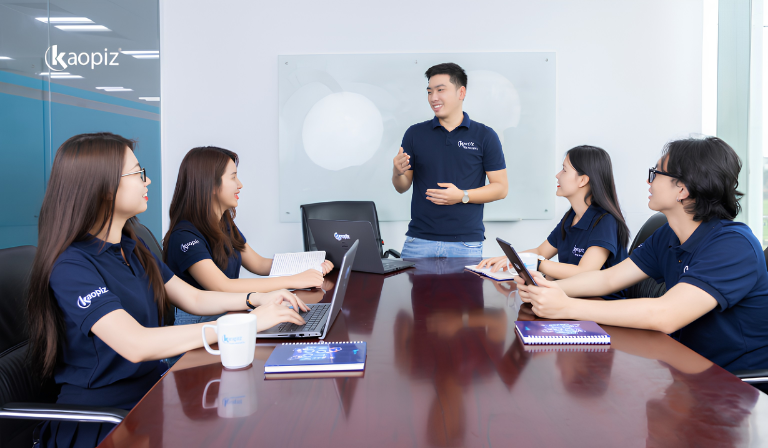
Kaopiz is a global software engineering company with a delivery hub in Vietnam. For over 12 years, we have delivered dedicated development teams to Singapore enterprises, fintech startups, healthtech companies, and retail technology organizations across Southeast Asia.
With 1,000+ professionals and 500+ clients globally, Kaopiz is a leading IT outsourcing company for Singapore businesses, combining deep technical expertise with a strong understanding of how Singapore product teams actually operate. We build dedicated teams that are engineered to your stack, aligned to your timezone, and accountable to your roadmap from day one.
What Sets Kaopiz Apart:
- Timezone alignment. Shared UTC+7 with Singapore means sprint reviews, standups, and blocker escalations happen in real time during your business hours, not asynchronously overnight.
- Full-stack team assembly. Every engagement is staffed to your exact technical requirements: frontend, backend, QA, PM, DevOps, and AI engineers where needed, no generalist filler.
- Grant-aligned engagements. Kaopiz has helped Singapore clients structure dedicated team engagements that align with EIS and NAIIP eligibility, reducing net investment cost from day one.
If you’re evaluating whether a dedicated team is the right fit for your next product build, I’m happy to walk through the numbers with you directly. Schedule a 30-minute call, no pitch, just a straightforward conversation about your specific situation.
Conclusion
The staff augmentation vs dedicated team decision is not about choosing the objectively better model. Both are powerful when matched to the right context.
Staff augmentation delivers speed and flexibility for short-term, well-scoped skill gaps where the organisation has the management capacity to absorb individual contractors. A dedicated team delivers institutional ownership, compounding knowledge, and lower total cost of ownership for long-term product builds — especially in an AI-driven context where team continuity is a competitive asset.
For Singapore technology leaders, the decision is further shaped by local dynamics: one of the world’s highest concentrations of AI talent demand, a regulatory environment that rewards structured data governance, government grant programmes that favour sustained capability-building, and the structural timezone advantage of Vietnam-based offshore teams.
FAQs
- What Is the Core Difference Between Staff Augmentation and a Dedicated Development Team?
- Staff augmentation embeds individual contractors into your team under your management. A dedicated team is a complete, vendor-managed unit. The core difference: who holds management responsibility.
- Is Staff Augmentation Always Cheaper Than a Dedicated Team?
- Only for the first 3 to 6 months. Once you factor in PM overhead, onboarding, QA, and turnover, both models reach cost parity at 9 to 12 months. Beyond that, dedicated teams typically offer better TCO.
- Can Staff Augmentation and Dedicated Teams Be Used Together?
- Yes. Use a dedicated team for your core platform and staff augmentation for specialist gaps on bounded workstreams. Define clear architectural boundaries to prevent augmented contributors from undermining the dedicated team’s product ownership.
- What Is the Ownership Cliff in Outsourcing?
- The point where accumulated knowledge fragmentation costs — rework, re-onboarding, undocumented decisions — exceed the monthly cost of a dedicated team. It typically hits at 9 to 18 months into a complex build and is a common trigger for switching engagement models.
- Can Singapore Companies Access Grants for Outsourcing Engagements?
- Singapore’s Enterprise Innovation Scheme (Budget 2026) and NAIIP programme offer tax deductions and grant support for AI capability building. Dedicated team engagements align more closely with these programmes than time-limited staff augmentation. Consult EnterpriseSG and your outsourcing partner to assess eligibility.
Author

Lucie Tran
Head of Growth of Kaopiz Global
Table of Contents
Don’t miss what’s next!
Thank you! Your form has been submitted successfully.