
IT Outsourcing for Australian SMEs: The Complete Guide to Scaling Technology in 2026
IT outsourcing for Australian SMEs has moved well beyond a simple cost-cutting tactic. Rising technology costs, persistent skill shortages, and rapid AI adoption are making it harder for smaller businesses to build and maintain full in-house IT teams, even as customers expect the same digital experience larger enterprises deliver.
Over the years, I have worked with businesses across Australia and Singapore evaluating outsourcing strategies, and the companies that succeed rarely chase the lowest hourly rate. They ask a better question: which capabilities should stay in-house, and which can be outsourced to improve speed, flexibility, and long-term competitiveness?
This guide breaks down what IT outsourcing means for Australian SMEs today, which services are best suited for outsourcing, how the main outsourcing models compare, and why so many businesses are now combining local leadership with offshore technology partners to scale more efficiently.
Key Takeaways
- IT outsourcing has evolved from a cost-cutting tactic into a strategic way for Australian SMEs to access enterprise-grade capabilities like AI, cloud, and cybersecurity.
- Managed IT Services maintain day-to-day operations, while IT outsourcing drives strategic growth through software development, cloud engineering, and AI initiatives.
- Rising local salaries and a persistent tech talent shortage are making permanent, in-house hiring increasingly unsustainable for smaller businesses.
- Outsourcing converts fixed overhead into flexible capacity, letting leadership teams scale resources up or down as priorities shift.
- High-performing SMEs outsource selectively, keeping strategic control in-house while delegating complex, specialized functions like cybersecurity and DevOps.
- Hybrid models are becoming the norm: production-critical systems stay local for compliance, while offshore teams scale engineering output.
- Vietnam has matured beyond a low-cost destination into a nearshore hub offering strong engineering quality and timezone alignment for real-time Agile collaboration.
- Choosing the right model requires a structured framework — workload classification, capability mapping, and risk review, rather than cost alone.
What Does IT Outsourcing for Australian SMEs Really Mean?
For many Australian SMEs, IT outsourcing still carries an outdated image: handing over technical support to a third party to reduce costs. In reality, the outsourcing landscape has evolved significantly. Today, businesses outsource not only IT operations but also software development, cloud infrastructure, AI initiatives, and cybersecurity to access capabilities that are difficult or expensive to build internally.
The shift is especially important for SMEs. Rather than investing heavily in permanent headcount, companies can access specialized talent and scale technical capabilities as business needs evolve. In this sense, IT outsourcing is less about replacing an internal team and more about extending it with the expertise, flexibility, and delivery capacity required to stay competitive.
IT Outsourcing vs Managed IT Services: What Is the Difference?
Although the terms are often used interchangeably, IT outsourcing and Managed IT Services are not the same. Managed IT Services focus primarily on maintaining and supporting existing technology environments, while IT outsourcing covers a broader range of capabilities, including product development, cloud engineering, cybersecurity, and strategic technology initiatives.
| Criteria | IT Outsourcing | Managed IT Services |
|---|---|---|
| Primary Goal | Extend business capabilities | Maintain IT operations |
| Typical Services | Software development, cloud, AI, cybersecurity | Helpdesk, infrastructure, monitoring |
| Engagement | Strategic and project-based | Ongoing operational support |
| Best For | Growth, innovation, digital transformation | Stability and daily IT management |
For many Australian SMEs, the choice is not either-or. Businesses often combine both models, using Managed Services to keep systems running smoothly while outsourcing software, cloud, or AI projects to specialized partners.
Why Are More Australian SMEs Choosing IT Outsourcing?
The growth of IT outsourcing for Australian SMEs is driven by more than cost pressure alone. Rising salaries, persistent talent shortages, and the increasing complexity of technologies such as AI, cloud, and cybersecurity are forcing smaller businesses to rethink traditional IT operating models. For many SMEs, outsourcing is becoming the fastest way to access capabilities that would otherwise take years to build internally.
Rising Talent Costs Are Changing the Economics
Hiring and retaining IT talent in Australia has become increasingly expensive. SMEs are no longer competing only with local businesses but also with large enterprises and global technology companies for the same pool of engineers, cloud architects, and cybersecurity specialists. The result is higher salaries, longer recruitment cycles, and greater pressure on operating budgets.
The Tech Council of Australia set a goal of 1.2 million tech workers by 2030, but the latest government workforce data shows the tech workforce shrank by roughly 31,000 jobs over the past year, putting that target at risk. For many organizations, this shortage is exactly why outsourcing offers a more sustainable alternative, providing access to specialized expertise without the cost and complexity of permanent hiring.
SMEs Need Enterprise Capabilities Without Enterprise Budgets
Modern businesses are expected to operate with enterprise-grade technology. Customers demand secure digital experiences, regulators require stronger data protection, and AI is rapidly becoming a competitive necessity. Yet most SMEs do not have the budget, or the need, to maintain a full team of specialists across every technical domain.

The stakes are becoming increasingly high. According to IBM’s Cost of a Data Breach Report 2025, the global average cost of a data breach reached USD 4.44 million, making cybersecurity and resilience priorities for organizations of every size. IT outsourcing enables Australian SMEs to access these capabilities without carrying the overhead of building them entirely in-house.
Outsourcing Turns Fixed Costs Into Flexible Capacity
Perhaps the most overlooked advantage of outsourcing is financial flexibility. Building an internal IT team requires long-term commitments: salaries, recruitment costs, training, infrastructure, and employee benefits all become fixed expenses regardless of business conditions.
Outsourcing changes this equation. Businesses can acquire the exact capabilities they need, for the exact duration required, and adjust investments as priorities evolve. This flexibility is becoming increasingly valuable as technology spending rises globally. Gartner’s latest forecast puts worldwide IT spending growth at 13.5% in 2026, reaching $6.31 trillion, driven largely by AI infrastructure investment. For SMEs, outsourcing provides a way to access these innovations without turning them into permanent fixed costs.
What Are the Benefits of IT Outsourcing for Australian SMEs?
The benefits of IT outsourcing for Australian SMEs extend far beyond reducing operational costs. As technology becomes a key driver of competitiveness, outsourcing allows smaller businesses to access capabilities, talent, and delivery speed that would be difficult to build internally. The most successful SMEs use outsourcing not as a substitute for their internal team, but as a strategic lever to accelerate growth and innovation.
Cost Efficiency Without Sacrificing Quality
The most obvious advantage of outsourcing is cost efficiency, but the real value lies in how costs are structured. Instead of committing to long-term salaries, recruitment expenses, and ongoing training, SMEs can access experienced professionals only when their expertise is required. This transforms technology spending from a fixed overhead into a flexible investment aligned with business priorities.
More importantly, lower costs do not necessarily mean lower quality. The rise of mature outsourcing destinations and specialized technology partners allows Australian SMEs to access high-quality engineering, cybersecurity, and cloud expertise at a fraction of the cost of building equivalent teams locally.
Faster Access to Specialized Skills
Finding experts in AI, cloud architecture, DevOps, or cybersecurity can take months in today’s talent market. Even when companies successfully recruit these specialists, retaining them remains an ongoing challenge, especially for smaller organizations competing with larger enterprises.
IT outsourcing provides immediate access to these capabilities. Businesses can bring in niche expertise for specific projects, scale teams quickly when new opportunities emerge, and stay current with rapidly evolving technologies without having to hire and train every skill internally.
Better Scalability and Agility
Business priorities rarely remain static. New products are launched, customer demands shift, and market conditions change unexpectedly. Building an internal team that can expand or contract at the same pace is both difficult and expensive.

Outsourcing gives SMEs the agility to respond faster. Teams can scale up during periods of rapid growth, add specialized expertise for strategic initiatives, or reduce capacity when priorities change. This flexibility allows businesses to experiment, innovate, and adapt without being constrained by fixed organizational structures.
More Time to Focus on Core Business
For many SMEs, technology is an enabler rather than the business itself. Yet internal teams often spend a disproportionate amount of time managing infrastructure, troubleshooting systems, or handling routine support requests instead of driving strategic initiatives.
By outsourcing operational complexity, businesses can redirect their attention toward what matters most: developing products, serving customers, entering new markets, and creating competitive advantages. The ultimate benefit of outsourcing is not simply doing IT more efficiently; it is enabling leadership teams to focus their energy on growing the business.
What IT Services Should Australian SMEs Outsource First?
Not every function should be outsourced at once. The most successful Australian SMEs typically start with areas that are expensive to build internally, require specialized expertise, or do not directly contribute to their core competitive advantage. By outsourcing these functions first, businesses can improve operational efficiency while keeping strategic control over their products and customer relationships.
Common services that Australian SMEs outsource include:
- Managed IT Support: Outsource helpdesk, infrastructure monitoring, and system maintenance to ensure stable day-to-day operations without maintaining a large internal support team.
- Cybersecurity Services: Access specialized expertise in threat monitoring, compliance, vulnerability assessments, and incident response that would be costly to build in-house.
- Cloud & DevOps Management: Delegate cloud migration, infrastructure optimization, CI/CD pipelines, and cloud operations to accelerate scalability and reduce operational complexity.
- Software Development: Extend internal capabilities with external teams for web applications, mobile apps, enterprise systems, or SaaS products while maintaining strategic oversight.
- AI & Data Engineering: Bring in experts for AI adoption, machine learning, data pipelines, and analytics projects without committing to permanent hires in a rapidly evolving field.
- QA & Testing: Improve software quality and release speed through dedicated testing teams specializing in automation, performance testing, and quality assurance.
The key is to outsource functions that create operational bottlenecks or require expertise that is difficult to hire locally. High-performing SMEs rarely outsource everything, they outsource selectively, focusing internal resources on what differentiates their business while relying on trusted partners to deliver specialized capabilities efficiently.
Types of IT Outsourcing Models: Which One Fits Your Business?
Choosing the right outsourcing model is often more important than choosing the vendor itself. Each model offers a different balance of cost, control, scalability, and expertise. The best choice depends on your business goals, internal capabilities, and the complexity of your technology initiatives.
| Outsourcing Model | Best For | Client Control | Scalability | Advantages | Limitations |
|---|---|---|---|---|---|
| Managed IT Services (MSP) | IT support, infrastructure, cybersecurity | Low | High | Predictable costs, 24/7 support, operational stability | Less suitable for product innovation or custom development |
| Staff Augmentation | Filling skill gaps in cloud, AI, DevOps, cybersecurity | High | High | Quick access to specialized talent, flexible team size | Requires strong internal management and technical leadership |
| Dedicated Development Team | Long-term software products, SaaS, mobile apps | Medium to High | High | Strong product ownership, knowledge retention, scalable delivery | Longer onboarding and higher commitment than augmentation |
| Project-Based Outsourcing | Cloud migration, legacy modernization, ERP implementation | Low | Medium | Clear scope, predictable timelines and budget | Less flexible when requirements evolve |
| Offshore Development Center (ODC) | SMEs with sustained development needs and multiple products | Medium | Very High | Dedicated offshore capability, cost efficiency at scale | Requires long-term planning and governance |
There is no universally “best” model for IT outsourcing for Australian SMEs. In practice, many growing businesses combine several models simultaneously. For example, using an MSP for daily operations, a dedicated team for product development, and staff augmentation to add AI or cloud expertise when needed. The goal is not to outsource more, but to outsource strategically.
Local MSP or Offshore Partner: Which Delivers Better Value for Australian SMEs?
For IT outsourcing for Australian SMEs, the decision between a local Managed Service Provider (MSP) and an offshore engineering partner is ultimately an operating model choice. It directly affects system reliability, delivery throughput, and the organization’s ability to scale engineering capacity without increasing governance or security risk.
Rather than a binary decision, most enterprises are optimizing a split model where local providers secure production stability while offshore teams extend delivery capacity. The real question is how each model contributes to cost structure, resilience, and engineering velocity across the stack.
Local Australian Providers
Local MSPs are primarily designed for operational assurance and compliance alignment. Their key advantage lies in faster incident coordination, reduced response latency, and stronger accountability in production environments where downtime has immediate business impact.
They also simplify regulatory and security requirements, particularly around data residency and audit readiness in the Australian market. However, this model typically comes with higher cost per resource and limited flexibility in scaling specialized engineering capabilities.
Offshore Providers
Offshore providers are most effective when the goal is to scale engineering output efficiently. They enable enterprises to expand development, QA, and infrastructure support capacity without being constrained by local hiring markets.
The trade-off is increased reliance on delivery maturity. Clear architecture, structured documentation, and strong governance are essential to avoid communication gaps and integration delays. Without these, operational friction can offset much of the cost advantage.
Why Australian SMEs Are Embracing Hybrid Models
In the context of IT outsourcing for Australian SMEs, hybrid models have become the dominant approach because they balance operational control with scalable delivery capacity. This typically involves keeping production-critical systems, security operations, and incident response local while leveraging offshore teams for build, testing, and iterative development.
When structured properly, this separation creates a more efficient operating model: local teams ensure stability and risk management, while offshore teams drive speed and cost efficiency. The result is a more elastic engineering organization capable of scaling without compromising governance or system reliability.
Why Vietnam Is Becoming Australia’s Preferred Nearshore IT Destination
For IT outsourcing for Australian SMEs, Vietnam has emerged as a strategic nearshore alternative that goes beyond traditional offshore cost advantages. The market is increasingly driven by delivery maturity, engineering talent depth, and improved operational compatibility with Australian business environments.
Rather than being positioned purely as a low-cost destination, Vietnam is now competing on predictable delivery quality, scalable engineering capacity, and improved collaboration models that align with modern distributed product teams.
- Timezone alignment enables real collaboration. Vietnam’s working hours overlap significantly with Australia, enabling real-time collaboration across product, engineering, and operations teams. This shortens the feedback loop between requirements and implementation and improves the responsiveness of agile ceremonies like sprint planning and stand-ups.
- Vietnam has moved beyond cost arbitrage. The Vietnamese tech ecosystem has matured into a capability-driven delivery hub, with strong expertise in full-stack engineering, cloud infrastructure, and DevOps. Engagement decisions are now based on engineering maturity and architectural alignment rather than labor cost alone.
- Cost efficiency without sacrificing delivery quality. Mature Vietnam-based teams support end-to-end software lifecycles, development, testing, and maintenance, letting organizations optimize engineering spend without degrading system reliability or code quality.
IT Outsourcing Framework: How Australian SMEs Should Make the Decision
For most enterprises, outsourcing decisions fail not because of vendor capability, but because of a missing evaluation framework. Without a structured approach, choices between local, offshore, or hybrid models tend to be driven by cost bias rather than operational fit. A more reliable method is to evaluate outsourcing through a clear decision sequence that maps business goals to delivery architecture.
The outsourcing framework below is designed to help standardize that evaluation process, ensuring alignment between engineering needs, risk tolerance, and long-term scalability.
| Step | Focus Area | Key Question | Output |
|---|---|---|---|
| 1 | Workload Classification | What should stay critical vs non-critical? | System & service segmentation |
| 2 | Capability Mapping | What skills are missing internally? | Skill gap analysis |
| 3 | Delivery Model Selection | Which model fits workload type? | Local / offshore / hybrid decision |
| 4 | Risk & Compliance Review | What are the regulatory constraints? | Risk control requirements |
| 5 | Cost-to-Value Evaluation | Where is value maximized per dollar spent? | Optimized sourcing strategy |
Each step requires its own breakdown. Workload classification defines which systems require high availability, strict compliance, or real-time support versus those suitable for distributed development. Capability mapping identifies gaps in cloud engineering, DevOps, QA automation, or product development capacity. Delivery model selection aligns workload types with the most efficient sourcing model — local stability, offshore scalability, or hybrid balance. Risk and compliance review ensures data governance, security controls, and audit requirements are properly addressed. And cost-to-value evaluation shifts focus from hourly cost to output efficiency, system reliability, and long-term scalability.
When applied correctly, this framework helps enterprises move from reactive vendor selection to structured sourcing strategy design. It also reduces the risk of fragmented delivery models that often lead to hidden operational overhead.
With a clear decision structure in place, the next step is evaluating delivery partners who can execute within this model effectively.
Why Australian SMEs Choose Kaopiz for IT Outsourcing
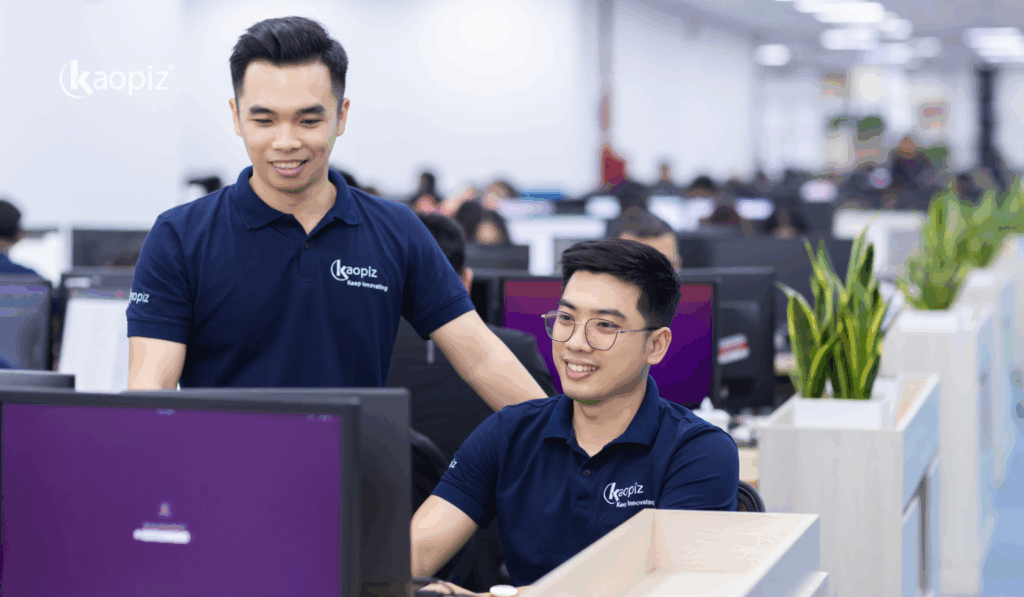
Kaopiz is a global technology company founded in 2014 with delivery hub in Vietnam and additional offices in Singapore and Japan. Over the past decade, our company has built a delivery model focused on nearshore collaboration, engineering accountability, and scalable software delivery for global clients, including a growing number of enterprises in Australia.
With more than 1,000 completed projects across fintech, healthtech, edtech, retail, and enterprise software, Kaopiz operates at the intersection of product engineering and managed delivery. Our engineering team of nearly 1,000 professionals supports end-to-end development across AI, cloud, and custom software solutions, structured for both speed and governance.
What makes Kaopiz a reliable IT outsourcing partner for Australian SMEs:
- Timezone overlap with Australia enables real-time collaboration, faster feedback cycles, and smoother Agile execution
- Direct communication with engineers reduces handoff layers and improves clarity in technical requirements and delivery
- Structured project governance ensures predictable milestones, transparent progress tracking, and consistent output quality
- Full IP ownership from day one guarantees complete control over codebase, documentation, and design assets
- Compliance-ready delivery practices support data protection and regulatory requirements in enterprise environments
- Flexible engagement options allow scaling through dedicated teams, staff augmentation, or project-based models
- Cross-industry delivery experience spans fintech, healthcare, education, retail, and enterprise platforms
- Proven global credibility reinforced by long-term client partnerships and international industry recognition
If your organization is currently evaluating outsourcing or nearshore engineering options, the most effective next step is to benchmark current delivery bottlenecks against a structured sourcing model and identify where external capacity can create immediate impact. Kaopiz can support this assessment with a tailored consultation and recommend the most suitable engagement structure based on technical and operational requirements.
Conclusion
Ultimately, IT outsourcing for Australian SMEs has evolved from a basic cost-saving tactic into a critical capability-driven strategy. Driven by rising local salaries and severe talent shortages, smaller businesses are leveraging external expertise to acquire enterprise-grade technologies like AI and cloud infrastructure. This shifts rigid overhead costs into flexible capacity, giving leadership teams the operational bandwidth needed to focus entirely on core business growth.
To achieve this scalability, businesses must choose a delivery model, whether managed services, staff augmentation, or dedicated teams, that aligns with their unique workload requirements.
In this landscape, Vietnam has emerged as a premier nearshore destination for Australian organizations, moving beyond mere cost arbitrage to compete on deep engineering maturity. Its significant timezone overlap enables seamless real-time Agile collaboration, making hybrid models highly effective for scalable product delivery.
In the end, a successful outsourcing transition relies not on reactive vendor selection, but on a structured evaluation framework. By systematically walking through workload classification, capability mapping, and risk compliance, enterprises can safeguard their data governance and optimize sourcing strategies.
FAQs
- What Is the Difference Between IT Outsourcing and Managed IT Services?
- Managed IT Services focus on maintaining and supporting your existing technology environment, like helpdesk and infrastructure. IT outsourcing covers a broader, strategic scope, including custom software development, cloud engineering, and AI initiatives.
- Why Are Australian SMEs Moving Away from Building Full In-House IT Teams?
- Rising local tech salaries and a persistent talent shortage make permanent hiring too expensive and slow. Outsourcing allows SMEs to turn rigid fixed overheads into flexible capacity and access specialized tech skills immediately.
- Which IT Services Should an Australian Small Business Outsource First?
- SMEs should start with operationally complex functions or niche areas that are hard to hire locally, such as Managed IT Support for daily stability, Cybersecurity for threat monitoring, and Cloud/DevOps Management.
- Why Is Vietnam Preferred Over Other Offshore Destinations by Australian Businesses?
- Vietnam offers a significant timezone overlap that allows real-time Agile collaboration and shorter feedback loops. Additionally, its tech ecosystem has matured beyond cheap labor into a high-quality engineering hub.
- How Can We Ensure We Choose the Right IT Outsourcing Model?
- Do not choose based on cost alone. Use a structured framework: first classify which workloads are critical, map your internal skill gaps, and then select the model — local, offshore, or hybrid — that fits your risk tolerance and scalability goals.
Author

Lucie Tran
Head of Growth of Kaopiz Global
Table of Contents
Don’t miss what’s next!
Thank you! Your form has been submitted successfully.