
The Complete IT Outsourcing Guide for Australian Businesses in 2026
Hiring a senior software developer in Australia right now costs upward of AUD 145,000 a year, before superannuation, recruitment fees, or the six-month wait to fill the role. Meanwhile, the country faces a shortfall of approximately 312,000 technology workers by 2030, with universities producing only around 7,000 IT graduates annually to meet that demand. The gap between what Australian businesses need from technology and what the local market can realistically supply has never been wider, and this IT outsourcing guide is designed to help you close it.
I’ve spent the past several years at Kaopiz helping businesses across Singapore and Australia navigate this exact problem. The companies that get IT outsourcing right aren’t the ones with the biggest budgets; they’re the ones with a clear framework.
This IT outsourcing guide covers everything an Australian business needs to make a confident outsourcing decision in 2026: the models, the trade-offs, an eight-step vendor selection process, and the Australia-specific compliance checkpoints most generic guides skip entirely.
Key Takeaways
- IT outsourcing converts unpredictable fixed hiring costs into manageable operational expenses, with savings of 40–60% vs. local Australian equivalents.
- The 4 main engagement models, project-based, dedicated team, managed services, and staff augmentation, serve different business needs and stages.
- For Australian businesses, nearshore Vietnam offers the best balance of cost, timezone overlap (~3 hours), and delivery quality.
- Australian Privacy Act 2024 (APP 8) makes the client legally responsible for how personal data is handled by overseas partners, compliance must be contractual, not assumed.
- A 4–6 week scoped trial before any long-term commitment is the most reliable way to validate an outsourcing partner.
- Governance, sprint reviews, escalation paths, quarterly business reviews, and a documented exit plan, is what separates a high-performing engagement from one that drifts.
What Does It Mean to Outsource IT?
IT outsourcing means contracting an external provider to handle technology functions that would otherwise be performed by an in-house team. Those functions can range from building and maintaining software applications to managing cloud infrastructure, cybersecurity, data engineering, or end-user technical support. The provider takes on delivery responsibility, and in most well-structured engagements, accountability for outcomes as well.
What Services Can Be Outsourced?
Almost any technology function that doesn’t require direct access to proprietary internal systems or sensitive institutional knowledge can be outsourced.

In practice, Australian businesses most commonly outsource the following:
Software and application development:
- Custom web and mobile application development
- API development and third-party integrations
- Legacy system modernization and re-platforming
- Quality assurance and automated testing
Infrastructure and cloud:
- Cloud migration and architecture design (AWS, Azure, GCP)
- DevOps, CI/CD pipeline setup and maintenance
- Infrastructure monitoring and management
Data and AI:
- Data engineering and pipeline development
- Business intelligence and analytics platforms
- AI and machine learning model development
Cybersecurity:
- Security assessments and penetration testing
- Compliance implementation (Essential 8, ISO 27001)
- Security monitoring and incident response
IT support and operations:
- Helpdesk and end-user support
- Network administration and monitoring
- Device and endpoint management
The decision of what to outsource should always start with one question: Does this function require deep institutional knowledge that only exists inside the business, or is it a specialized execution capability that an external team can deliver more efficiently? If the answer is the latter, it’s a candidate for outsourcing.
IT Outsourcing vs. Outsourced IT Support: What’s the Difference?
These are often treated as interchangeable, but they describe fundamentally different scopes of work.
IT outsourcing, in the strategic sense, refers to partnering with an external team to build, develop, or engineer technology products. Custom software development, cloud architecture design, AI and data platform engineering, cybersecurity implementation, and application modernization all fall into this category. The engagement is typically ongoing or project-bound, and the output is something that advances the business’s capabilities.
Outsourced IT support, by contrast, is operational. It covers the day-to-day work of keeping existing systems running: helpdesk services, device and endpoint management, network monitoring, remote troubleshooting, and routine patching. Where strategic IT outsourcing builds what comes next, support outsourcing maintains what already exists.
The table below shows the differences between IT outsourcing vs. IT outsourced support:
| IT Outsourcing | Outsourced IT Support | |
|---|---|---|
| Purpose | Build and advance technology capabilities | Maintain and stabilize existing systems |
| Typical services | Software development, cloud architecture, AI/data engineering, cybersecurity implementation | Helpdesk, device management, network monitoring, remote troubleshooting, patching |
| Engagement type | Project-based or ongoing development partnership | Ongoing managed service contract |
| Primary output | New or improved software, systems, infrastructure | System uptime, issue resolution, user productivity |
| Team profile | Developers, architects, engineers, QA specialists | Support technicians, system administrators, network engineers |
| Success metric | Delivery velocity, product quality, business outcomes | Ticket resolution time, uptime %, user satisfaction |
The most effective Australian businesses I’ve worked with don’t treat these as competing budget lines. They run both in parallel, a dedicated development team advancing the product roadmap while a managed support layer keeps the environment stable underneath it.
The State of IT Outsourcing in Australia (2026)
Australia’s technology sector is growing at a pace that its domestic talent pipeline cannot match. IT spending in Australia is forecast to reach AUD 172.3 billion in 2026, an increase of 8.9% from 2025, driven primarily by investment in AI, cybersecurity, and cloud infrastructure, according to Gartner.
The managed services and outsourcing segment sits at the center of this expansion; the broader IT services market is projected to grow from $32.26 billion in 2025 to $38.34 billion in 2026 and is forecast to reach $90.96 billion by 2031, at an 18.86% CAGR, according to Mordor Intelligence.
The demand side of this equation is being shaped by a structural talent problem that shows no sign of resolving quickly. Key figures from the ACS Digital Pulse 2025 and Konnect’s 2025 Market Scan paint a clear picture:
- Digital technology contributes AUD 134 billion to the Australian economy and employs over one million people, yet skills shortages persist, particularly in AI, cybersecurity, and data analytics.
- 312,000 additional tech workers are needed by 2030, with only 7,000 IT graduates produced annually.
- Big businesses alone are losing AUD 3.1 billion per year due to digital skills gaps, projected to reach AUD 16 billion by 2030.
- Cybersecurity, AI engineering, and cloud architecture face the sharpest scarcity, with senior salary premiums exceeding 20% year-on-year.
- 72% of Australian employers have resorted to sourcing IT talent internationally as a result.
This is not a temporary adjustment. It reflects a fundamental mismatch between what Australian businesses need to compete digitally and what the local labor market can supply. IT outsourcing guide, particularly to nearshore partners in Southeast Asia, has moved from an optional cost-saving measure to a core part of how Australian companies maintain their technology delivery capacity.
Advantages of IT Outsourcing for Australian Businesses
For most Australian businesses, the decision to outsource IT starts with cost, but the ones that stick with it long-term do so because of everything else.

Based on my experience working with clients across fintech, healthtech, and enterprise software, the advantages of outsourcing IT development compound over time in ways that are difficult to replicate through internal hiring alone.
- Significant cost savings: Outsourcing converts salaries, superannuation, and recruitment overhead into predictable operational expenses, with savings of 40–60% compared to equivalent local hiring commonly reported.
- Access to specialized talent on demand: Outsourcing partners in Australia can deploy pre-screened cloud, AI, and QA specialists within two to three weeks, versus six months or longer domestically.
- Faster time-to-market: External teams arrive with established workflows and engineering standards, eliminating internal ramp-up time and compressing delivery timelines significantly.
- Flexibility to scale without hiring risk: Engineering capacity can expand or contract in direct response to project demand, no lengthy recruitment cycles, no redundancy costs.
- Sharper internal focus: When execution is handled externally, leadership redirects from technical firefighting to strategy, customer experience, and growth.
- Access to emerging technologies: Outsourcing partners invest continuously in AI, cloud-native, and cybersecurity capabilities, giving businesses immediate access without carrying the training overhead in-house.
Disadvantages of IT Outsourcing And How to Mitigate Them
Outsourcing works well when it is set up well. The IT outsourcing risks below are real, but every one of them is manageable with the right governance in place from the start. I’ve seen each of these play out with clients, and in most cases, the problem wasn’t outsourcing itself; it was the absence of a clear framework before the engagement began.
- Loss of direct control over delivery: When an external team owns execution, visibility into day-to-day progress can diminish without the right structure. Mitigation: establish weekly sprint reviews, shared project management tooling (Jira, Linear, or Notion), and a defined escalation path, not just a Slack channel.
- Communication and timezone challenges: For true offshore partners (India: 3.5–5.5 hour gap; Eastern Europe: 6–9 hours), async bottlenecks add a full day to every feedback cycle. Nearshore Vietnam–Australia East Coast narrows this to ~3 hours, making daily standups viable within normal business hours for both sides.
- Data security and IP protection risks: This is the risk most Australian businesses underestimate until something goes wrong. Mitigation: require IP assignment clauses (not just licenses), project-level NDAs, and verify your partner’s data handling practices against Australian Privacy Principles before signing anything.
- Hidden costs from poorly defined scope: Change requests, scope creep, and knowledge transfer overhead can erode cost savings quickly. Mitigation: invest time in a detailed Statement of Work upfront and consider a T&M-with-cap or fixed-scope sprint model rather than open-ended engagements.
- Vendor dependency over time: Long-term reliance on a single provider without documented processes creates lock-in risk. Mitigation: require thorough documentation throughout the engagement and establish a knowledge transfer protocol as part of the contract from day one, not as an afterthought at offboarding.
Types of IT Outsourcing Models: Which One Fits Your Business?
Choosing the wrong engagement model is one of the most common reasons outsourcing relationships underdeliver. In this IT outsourcing guide, I show how the four main IT outsourcing models differ, and when each one makes sense.
- Project-Based Outsourcing: A defined scope, app build, platform migration, API integration, delivered within an agreed timeline and budget. Best for one-time deliverables with clear acceptance criteria.
- Dedicated Development Team: A team of engineers and a PM embedded in the client’s workflows on a monthly retainer. Best for ongoing product development. In my experience, this model delivers the most consistent results for Australian growth-stage businesses.
- Managed IT Services: Ongoing responsibility for defined IT operations, infrastructure, cloud, helpdesk, and cybersecurity under an SLA. Best for businesses with compliance obligations such as Essential 8 or ISO 27001.
- IT Staff Augmentation: Individual specialists embedded within an existing team to fill specific skill gaps. Best for short-term capacity needs where the client has strong internal engineering leadership.
| Project-Based | Dedicated Team | Managed Services | Staff Augmentation | |
|---|---|---|---|---|
| Best for | One-time deliverables | Ongoing product work | IT operations | Filling skill gaps |
| Engagement length | Fixed term | Long-term | Ongoing | Short to medium term |
| Client manages? | Low | Collaborative | Low | High |
| Cost structure | Fixed or T&M | Monthly retainer | Monthly SLA | Daily/monthly rate |
| Scales easily? | No | Yes | Yes | Limited |
IT Outsourcing Examples: What Australian Companies Actually Outsource
IT outsourcing guide in Australia spans far beyond generic software development. The use cases vary significantly by industry, but the underlying driver is consistent: a capability the business needs but cannot build or maintain internally at the required speed or cost. Across the projects Kaopiz has delivered for Australian and Singapore-based clients, these are the most common examples:
- Fintech: Core banking platform development, payments API integration, real-time transaction monitoring systems, and regulatory compliance tooling (CDR, open banking)
- Healthcare and healthtech: Patient management systems, health platforms, clinical data pipelines built to Australian Privacy Act compliance standards
- Mining and resources: IoT data platforms, predictive maintenance software, and remote asset monitoring systems, particularly relevant to WA-based operations
- Retail and e-commerce: Headless commerce migrations, mobile app development, loyalty platform builds, and warehouse management integrations
- Government and govtech: Legacy system modernization, citizen-facing digital services, and Essential 8-compliant application development
- Professional services: Custom CRM development, workflow automation, document management systems, and client portal builds
- Education and edtech: Learning management systems, student engagement platforms, and institutional data analytics tools
The most common entry point, regardless of vertical, is a web or mobile application that the internal team lacks either the bandwidth or the specific stack knowledge to build. From there, many Australian businesses expand the engagement to cover ongoing maintenance, feature development, and eventually broader platform ownership.
IT Outsourcing Guidelines: A Step-by-Step Process for Australian Businesses
A strategy doesn’t start with vendor selection; it starts with internal clarity. The businesses that get the most out of outsourcing are the ones that define what they need before they talk to anyone. In this IT outsourcing guide, let’s explore the 8 steps of a successful IT outsourcing strategy.
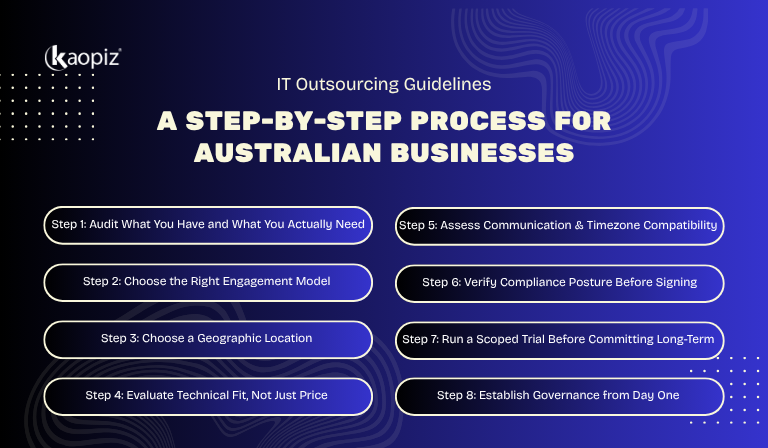
Step 1: Audit What You Have and What You Actually Need
Before approaching any vendor, answer three questions internally:
- Which functions require institutional knowledge that only exists inside the business?
- Which require specialized execution skills you don’t currently have?
- Which are ongoing versus project-bound?
The output of this step is a simple scope document, not an RFP, just internal clarity on what you’re outsourcing and why.
Step 2: Choose the Right Engagement Model
Match the model to the need.
- Project-based for defined deliverables
- Dedicated team for ongoing product work
- Managed services for operational stability
- Staff augmentation for filling a specific stack gap
Getting this wrong early creates friction that compounds throughout the engagement.
Step 3: Choose a Geographic Location
Location affects timezone overlap, compliance exposure, and day-to-day communication quality, not just cost. Three models apply to Australian businesses:
- Onshore (within Australia): highest cost, zero timezone friction, full regulatory alignment. Suitable for highly sensitive functions but not scalable for most SMEs.
- Offshore (India, Eastern Europe, Philippines): lowest cost, but timezone gaps of 5–9 hours create async bottlenecks that add a full day to every feedback cycle.
- Nearshore (Vietnam, Indonesia, Malaysia): the sweet spot for most Australian businesses, 40–60% cost savings versus local hiring, with a ~3-hour timezone gap that keeps daily collaboration viable.
For most Australian businesses, balancing cost, quality, and collaboration, a nearshore partner in Southeast Asia hits the criteria that matter most.
Step 4: Evaluate Technical Fit, Not Just Price
Assess tech stack alignment, seniority mix, and the vendor’s vetting process for their own engineers. Request code samples from previous projects, ask specifically about QA processes and documentation standards, and seek references from clients in similar verticals. A vendor who agrees to everything in the first call is a red flag, not a green one.
Step 5: Assess Communication and Timezone Compatibility
Test communication before committing. Is there a dedicated PM, or do engineers communicate directly with the client? How are blockers escalated? What project management tools does the team use? For Australian businesses, prioritize partners with a daily overlap window of at least two hours, enough for a standup and real-time problem-solving without waiting until the next business day.
Step 6: Verify Compliance Posture Before Signing Anything
This is the step most generic IT outsourcing guides skip, and the one Australian businesses most commonly regret skipping. Key checkpoints:
- Australian Privacy Act (amended 2024): Under APP 8, Australian organizations remain legally responsible for how personal data is handled overseas, even when processed by a third-party outsourcing partner; liability follows the data, not the contract. Your vendor agreement must reflect this.
- Essential 8: If delivering software for government or regulated sectors, cybersecurity baseline requirements apply to the supply chain.
- IP ownership: All code, design assets, and documentation must be contractually assigned to the client, not licensed. These are not the same thing.
- NDA structure: Project-level, not just company-level.
I’ve had Australian clients come to us after a failed engagement where they couldn’t get their own code back. The contract had no IP assignment clause, just a license. It’s the kind of detail that seems minor until it isn’t.
Step 7: Run a Scoped Trial Before Committing Long-Term
A 4–6 week discovery sprint or POC tells you more than any proposal deck. Evaluate delivery quality, communication rhythm, code standards, and how the team handles ambiguity and changing requirements. Expand the engagement only after trust is established through actual work, not promises.
Step 8: Establish Governance from Day One
Governance is what keeps an outsourcing relationship from drifting into a vendor relationship. Establish from the start:
- Weekly sprint reviews and async status updates
- Defined escalation path beyond a shared Slack channel
- Quarterly business reviews to reassess scope, velocity, and strategic alignment
- A documented exit plan: knowledge transfer protocol and handover timeline
The exit plan, in particular, is something vendors rarely volunteer. Ask for it upfront, a partner confident in their work won’t hesitate to agree to it.
Biggest IT Outsourcing Companies in Australia
The global IT outsourcing market is projected to reach $120 billion in 2026, growing at 6.7% CAGR, according to Research and Markets. The largest share is held by a small number of enterprise-scale providers built to serve Fortune 500 clients, with minimum engagement sizes, procurement complexity, and contract cycles that make them a poor fit for most Australian SMEs.
Understanding where these providers sit, and where specialists like Kaopiz fit in, helps businesses choose an IT outsourcing partner in Australia at the right scale.
| Company | HQ | Expertise | Why Fit for AU? |
|---|---|---|---|
| Accenture | Ireland | Strategy, consulting, managed services, AI transformation | Enterprise only, minimum engagement size and procurement complexity make it unsuitable for most AU SMEs |
| Kaopiz | Vietnam | Custom software development, AI, cloud, staff augmentation, dedicated teams | Built for AU mid-sized and enterprise businesses, nearshore timezone (~3h gap), APAC delivery track record, 1,000+ projects, flexible engagement models |
| TCS | India | Enterprise IT, cloud, ERP, application management | Enterprise only, structured for Fortune 500 engagements across 55 countries |
| Infosys | India | Digital transformation, cloud, AI, engineering services | Enterprise only, strong APAC presence but targets large-scale, multi-year contracts |
| Wipro | India | Cloud, cybersecurity, IT operations, data analytics | Enterprise only, AU clients typically large financial or government organizations |
Enterprise providers serve a purpose, but that purpose is large-scale, multi-year transformation programmes for organizations with dedicated procurement teams. For the majority of Australian businesses, the right partner is one that operates at their scale, communicates directly, and can move at product speed. That is where the regional specialist tier, and Kaopiz specifically, fits.
Why Vietnam Is Australia’s Natural Nearshore IT Partner
When Australian businesses evaluate outsourcing destinations, the conversation often defaults to India or the Philippines. Vietnam deserves a closer look, particularly for teams where daily collaboration quality is non-negotiable.
- Timezone advantage: At UTC+7, Vietnam sits just 3 hours behind Australia’s East Coast, close enough for daily standups, real-time code reviews, and same-day issue resolution within normal business hours for both sides.
- Strong technical talent pool: Vietnam graduates approximately 57,000 IT students annually, with growing specialization in software engineering, AI, and data science.
- Competitive cost structure: Engineering talent costs 40–60% less than Australian equivalents. For a dedicated team of five engineers, the annual cost difference versus local hiring typically exceeds AUD 500,000.
- Maturing delivery standards: Vietnam’s outsourcing industry now operates with ISO-certified processes, agile delivery frameworks, and engineering standards comparable to established markets. Kaopiz, for example, operates through structured project governance and transparent reporting, with extensive experience working with clients across Singapore, Japan, Australia, and North America.
- Cultural alignment: Vietnamese engineering teams rank consistently high for communication responsiveness and long-term partnership orientation, qualities that matter in sustained engagements where trust compounds over time.
For Australian businesses weighing cost, collaboration quality, and delivery confidence, Vietnam is not a compromise, it is the structurally correct choice for nearshore IT outsourcing.
Kaopiz: Your Trusted IT Outsourcing Partner for Australian Businesses in 2026
Founded in 2014 and headquartered in Hanoi, Vietnam, with offices in Singapore and Japan, Kaopiz has spent over a decade building the delivery model that Australian businesses need right now: engineering teams that operate at nearshore timezone, communicate directly, and take full accountability for outcomes.
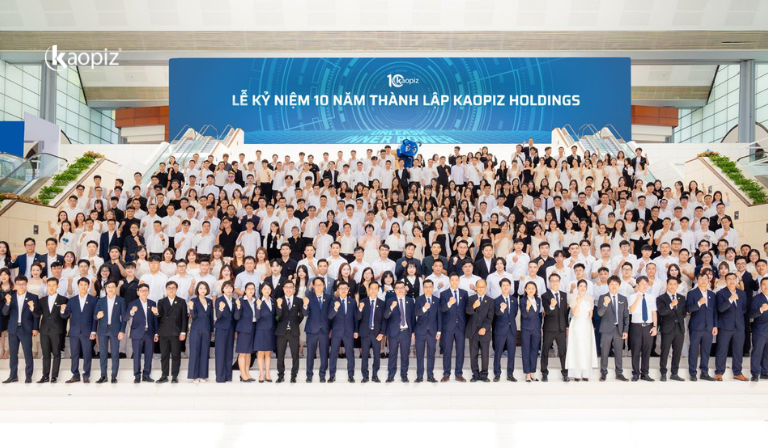
Across more than 1,000 projects delivered to clients in Australia, Singapore, Japan, and North America, the industries we work with most closely mirror the verticals where Australian outsourcing demand is highest, fintech, healthtech, edtech, retail, and enterprise software.
Our team of 1,000+ engineers, consultants, and technology specialists combines deep technical expertise across AI, cloud, custom software development, and staff augmentation with the structured governance that regulated-market clients require.
What sets Kaopiz apart for Australian businesses specifically:
- Nearshore timezone: Our teams overlap with Australian East Coast business hours every morning, daily standups, real-time reviews, and same-day turnaround are standard, not exceptions.
- Direct communication: Clients work directly with engineers and a dedicated PM, no account management layers, no offshore relay chains.
- IP ownership as standard: All code, documentation, and design assets are contractually assigned to the client from day one.
- Australian Privacy Act compliance: Our data handling practices are structured around AU regulatory requirements, including APP 8 cross-border obligations.
- Flexible engagement models: Project-based, dedicated team, staff augmentation, or managed services, matched to where the business actually is, not a preferred contract template.
- Recognized delivery quality: Clutch Top Software Developer 2026, Global Award Fall 2024, Vietnam Top 10 Digital Technology Company 2024.
If you are evaluating IT outsourcing partners for a 2026 engagement, I am happy to review your requirements and recommend the right model, no commitment required.
Conclusion
IT outsourcing is no longer a cost-cutting tactic for Australian businesses; it is a structural response to a talent market that cannot keep pace with technology demand. The businesses that get it right are the ones that approach it with a clear framework: the right model, the right location, the right compliance posture, and the right governance in place before the first sprint begins.
The eight-step process in this IT outsourcing guide is designed to give Australian businesses exactly that framework, from internal scoping through vendor selection, trial engagement, and long-term governance. Applied consistently, it significantly reduces the risk of failed engagements that give outsourcing an undeserved reputation.
FAQs
- What Is the Difference Between IT Outsourcing and IT Staff Augmentation?
- IT outsourcing typically involves delegating an entire function or project to an external provider, the vendor takes responsibility for delivery, team composition, and outcomes. IT staff augmentation, by contrast, embeds individual specialists within the client’s existing team to fill specific skill gaps, with the client retaining full project management responsibility. Outsourcing transfers ownership; augmentation adds capacity.
- What Are the Biggest Risks of IT Outsourcing?
- Loss of delivery visibility, timezone delays, data security exposure under the Australian Privacy Act, hidden costs from poorly scoped contracts, and vendor dependency. All are manageable with the right governance structure, compliance clauses, and a scoped trial before committing long-term.
- How Much Does IT Outsourcing Cost in Australia?
- Costs vary by engagement model, location, and team size. A dedicated team of five engineers with a nearshore Vietnam-based partner typically costs 40–60% less than equivalent local hires, translating to annual savings of AUD 500,000 or more. Staff augmentation is priced at a daily or monthly rate per specialist; project-based engagements are scoped individually.
- Is Vietnam a Good IT Outsourcing Destination for Australian Companies?
- Yes, the ~3-hour timezone gap enables daily collaboration within normal business hours, engineering talent costs 40–60% less than Australian equivalents, and Vietnam’s outsourcing industry has matured significantly in delivery standards and English proficiency.
- How Do I Ensure Data Privacy Compliance When Outsourcing IT in Australia?
- Under APP 8 of the Australian Privacy Act, your organization remains legally responsible for how personal data is handled by an overseas partner. Require explicit IP assignment clauses, project-level NDAs, and contractual data handling obligations aligned to the Australian Privacy Principles. For regulated sectors, address Essential 8 (government) or CDR (fintech) obligations in the vendor contract specifically.
Author

Lucie Tran
Head of Growth of Kaopiz Global
Table of Contents
Don’t miss what’s next!
Thank you! Your form has been submitted successfully.