
Online Examination System Case Study: How Kaopiz Built a Platform for 30,000 Simultaneous Test Takers
When a client tells me their exam system needs to handle tens of thousands of students at the exact same moment, my first question is never about the technology. It’s about what happens if it fails during a live exam window. There is no retry button when a student’s test freezes mid-answer.
This online examination system case study covers a real platform we built for a Japan-based education company, from the scalability challenge that started the project to the results we measured after launch. We’re keeping the client’s name confidential at their request; the project details below are accurate.
Key Takeaways
- Client: Japan-based education company running offline tutoring schools plus AI-driven digital learning products, expanding internationally.
- Scope: Global online examination system for elementary and junior high school students, covering math, English, and Japanese across multiple exam formats.
- Tech stack: AWS, PHP Laravel, VueJS, Node.js, deployed on PC, iPad, and Android tablet.
- Scale: Built to reliably support 10,000 to 30,000 simultaneous test takers.
- Results: ~40% less administration workload, grading cut from 3–5 days to under 24 hours, ~30% fewer payment inquiries, ~25% higher registration completion.
Client Introduction
Our client is a large, established education company headquartered in Japan, operating both offline tutoring schools and a growing portfolio of digital learning products, including AI-driven independent study tools and online private tutoring.
Beyond its domestic business, the company has been expanding internationally, running academic support programs in Southeast Asia and investing in research to improve basic academic outcomes for students. Education technology outsourcing was a natural next step as their ambitions outgrew what an internal team alone could support.
Project Overview
The company needed a global examination system for elementary and junior high school students, covering mathematics, English, and Japanese, across multiple formats: multiple choice, essay, and writing. The core requirement was scale. The platform had to support 10,000 to 30,000 students taking exams simultaneously, while also handling registration, fee payment, automated grading, result analysis, and certificate issuance in one connected system.
Main Features We Built
To meet that scale requirement without compromising the exam-day experience, we built the platform around five connected modules rather than a single monolithic system. Here’s what each one does.
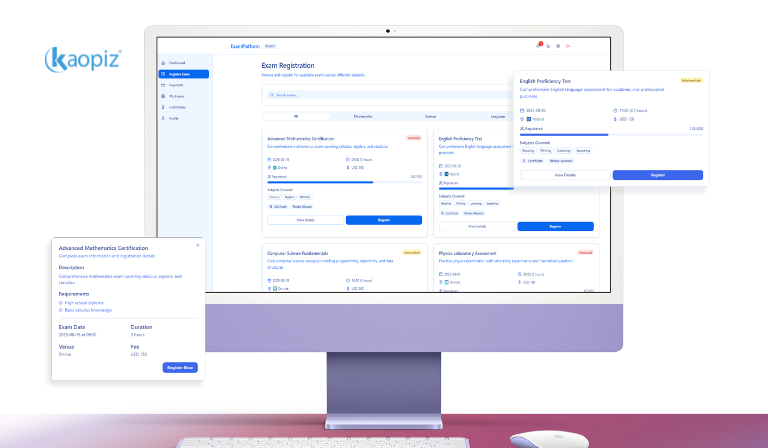
- Exam Delivery Engine: Multi-subject, multi-format testing (multiple choice, essay, writing) with automatic marking for objective question types.
- Parent and Test-Taker Registration: A simplified flow for registering students, confirming exam schedules, and managing examinee information.
- System Administration Console: Centralized management of exam questions, schedules, exam locations, and supervisors, replacing what had been a manually coordinated process.
- Multi-Currency Payment System: Online exam fee payment with support for multiple currencies, plus payment history tracking and automated reminders.
- Scoring and Ranking Engine: Automated marking combined with result analysis by category and region, including a ranking function designed to keep test-takers motivated.
The Problems: Why Large-Scale Exam Administration Was Breaking Down
In my conversations with education companies scaling internationally, the same pattern shows up: the exam gets bigger before the system does.
Complexity of Large-Scale Test Administration
The client needed a system that could reliably handle 10,000 to 30,000 simultaneous test takers, but their existing setup lacked the scalability and stability for that load. Coordinating test schedules and locations was a heavily manual process, which meant the operation depended on people rather than infrastructure.
Inefficiency in the Grading and Evaluation Process
Marking exams and analyzing results took time the client didn’t have. Test-takers waited days for feedback, and there was no way to compare results by region or category, which limited how the client could use its own data.
Our Solutions
We designed and built a cloud-based examination platform on AWS, using PHP Laravel for the core system and VueJS with Node.js for the front-end and real-time components, deployed across PC, iPad, and Android tablet.
- Scalable Infrastructure: We architected the platform to reliably support 10,000 to 30,000 concurrent test takers, moving the client off a system that couldn’t guarantee stability at that scale.
- Streamlined Test Administration: We built management tools that centralized scheduling, location coordination, and supervisor assignment, reducing how much of the operation depended on manual coordination.
- A Simpler Experience for Parents and Students: We designed an intuitive registration flow so parents could register, confirm schedules, and manage exam details without friction.
- Deeper Data Utilization: Automatic marking, paired with detailed result analysis by category and region, gave the client a feedback loop that hadn’t existed before.
The engagement ran across our standard phased delivery model, basic design, coding, integration testing, release, and ongoing maintenance, with a cross-functional Kaopiz team embedded throughout: PM, Team Lead, Bridge SE, developers, QA testers, and a Comtor supporting communication.
Results
| Metric | Outcome |
|---|---|
| Concurrent test-taker capacity | Scaled to support up to 30,000 simultaneous test takers |
| Test administration workload | Reduced by approximately 40% through centralized schedule, location, and supervisor management |
| Grading turnaround time | Cut from 3–5 days (manual) to under 24 hours via automatic marking |
| Payment support | Enabled exam fee payments across 3–5 currencies, reducing payment-related support inquiries by approximately 30% |
| Registration completion rate | Improved by approximately 25% with the simplified parent and test-taker interface |
| Cross-region analysis | Enabled result comparison and ranking across multiple regions and categories, a capability that didn’t exist before |
| Manual staffing dependency | Reduced by approximately 35–50% during exam sessions |
The number I’d point to first is the grading turnaround. Going from a 3-5 day wait to under 24 hours doesn’t just look good on a slide, it changes how a student experiences the exam itself. Feedback that arrives while the material is still fresh is feedback a student can actually act on.
Conclusion
Building an examination system that can hold up under real exam-day pressure isn’t just a scalability problem, it’s a trust problem. Students and parents need to know the system will work exactly when it matters most. If you’re evaluating what it takes to build or modernize a large-scale online examination platform, we’re happy to walk through what that would look like for your project.
FAQs
- How Do You Build an Exam System that Supports 30,000 Simultaneous Test Takers?
- It starts with cloud infrastructure designed for peak concurrency, not average load, paired with a database architecture that can handle simultaneous writes without bottlenecking. We stress-test against the client’s actual peak scenario before launch, not a theoretical estimate.
- Can an Online Examination System Support Multiple Currencies for Fee Payment?
- Yes. We integrated a payment layer that supports multiple currencies alongside payment history tracking and automated reminders, which also reduces support inquiries tied to failed or unclear payments.
- How Much Faster Is Automated Grading Compared to Manual Marking?
- In this engagement, grading turnaround dropped from 3-5 days to under 24 hours. The exact improvement depends on question format, objective formats like multiple choice see the biggest gains from automation.
- Is This Type of System Only Useful for Large Education Companies?
- No. The architecture scales down as well as up. The core value, centralized administration, automated marking, and data-driven result analysis, applies to any organization running exams at volume, even if that volume is in the hundreds rather than tens of thousands.
- What Happens If the Exam Platform Experiences Downtime During a Live Test?
- The infrastructure is architected for high availability, with redundancy built in specifically for exam-day scenarios where downtime isn’t an option. We also run supervised load testing beforehand to catch failure points before they can affect real test-takers.
Author

Lucie Tran
Head of Growth of Kaopiz Global
Table of Contents
Don’t miss what’s next!
Thank you! Your form has been submitted successfully.